
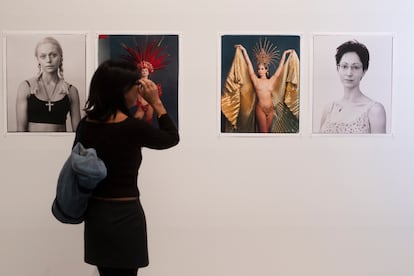
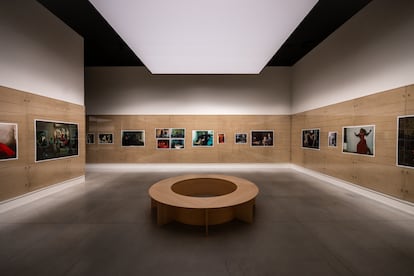
Annie Leibovitz (Waterbury, Connecticut, 76 years old), perhaps the most influential portrait painter of our time, stops in Spain. The photographer reviews Wonderland its long relationship with fashion from the MOP Foundation of A Coruña, promoted by the president of Inditex, Marta Ortega Pérez. The exhibition covers five decades of work, from its beginnings in a Rolling Stone still countercultural until his blockbusters for Voguepassing through his black and white work, road scenes and fantasies inspired by fairy tales.
Intertwined in the tour are his alliance with Anna Wintour, the intellectual mark left by Susan Sontag, his partner for 15 years, and his recent portrait of King Felipe and Queen Letizia, conceived “as if it were an oil painting.” More than a career review, Wonderland It works like the closing of a cycle: a reckoning with fashion just at the moment when Leibovitz announces that he wants to leave it behind. Tall, imposing and wearing hiking boots, the photographer answered our questions this Friday in A Coruña.
Ask. Do you close your stage in fashion photography? Should we read this exhibition as a requiem?
Answer. Yes, I’m done. When Anna Wintour asked me, many years ago, to work for VogueI said yes because I had always admired fashion photographers. I remember when I was young, browsing European magazines at the newsstand that I couldn’t afford, with photos of Helmut Newton, Richard Avedon or Irving Penn. But it’s a job that has its own rules: you can take the photo however you want, as long as the clothes are visible. I’m not saying that I won’t do it again one day, but in the years that I have left I want to return to portraiture, to tell stories again. There are a lot of things happening, the world is in a very interesting time.
P. He says his mission has been to photograph his time. When you look at all your work put together, what do you see?
R. It’s a good question. I have always refused to do this exercise because it would mean that I am reaching the end, but the truth is that I am getting older. I’m working on my first retrospective: I want to be the one to decide what’s important in my work, I don’t want someone to do it after I die. I tell you that there will be four volumes. Right now I’m overwhelmed by the amount of material out there, so I don’t know how to answer your question. My opinion changes all the time, depending on the angle I look from.
P. Don’t you think there have been two halves, its documentary photos and its majestic staging? He once said that, after returning from Sarajevo, it was difficult for him to remember what the good profile of Barbra Streisand was.
R. I didn’t remember that quote, but it’s true. When someone tells you that about the profile it’s always a little irritating, although I have to say that Barbra was a little right. Yes, there have been two halves. Returning to certain photos, like those from my youth or those from Sarajevo, forces me to be more honest, to justify each image I take.
P. To what extent did Susan Sontag influence your way of looking? You said that she understood things that you didn’t understand.
R. I wish I had her by my side. It made me more serious, she had a very solid value system. In reality, we talked little about photography, even though it was one of his specialties. Sometimes he told me: “Please stop taking pictures of people in bed.” And he was right: in my work there have been too many beds. At the end of her life, already ill, I photographed her a lot. That material is in A Photographer’s Lifewhich is my favorite book, my photographic version of The year of magical thinkingby Joan Didion. My way of living grief.
P. It was a controversial book. They accused her of publishing photos that Sontag would not have approved.
R. I didn’t care. I didn’t think about others, I did it for myself. My children had just been born and my father had died. It was a time of loss and rebirth. It was a personal need.
P. Sontag said that the photographer can be a vampire, that there can be manipulation in his work. Was he right?
R. I understand what he meant. Talking about manipulation is a bit strong, although you have to be aware of the power that the image has.
P. More than manipulation, would you call it seduction? Do you have to know how to seduce each model?
R. Have you seen me? Do I look like someone capable of that to you? (laughs). But yes, someone like Rihanna, for example, is not trying to do anything in particular, but her mere presence drags you into her world. It could be a form of seduction, of course.
“At first, the drug seemed like an experiment to me, but it ended up taking over me. When I realized it, I sought help by all means”
P. He went to Bosnia in the nineties, which was a turning point in his career. Would you return to the war front today, to Ukraine or Palestine?
R. We cannot compare that war with those of today, although they are all equally atrocious. I really follow current photojournalists like Lynsey Addario, who do extraordinary work. But I am going to continue on my ground: I feel lucky to have my own space and I plan to take advantage of it until the end.
P. Aren’t you interested in your work having a more political aspect again?
R. Yes, I have a project in mind when I return to New York, but I can’t tell you about it. We just had elections and five women have assumed important positions: governors, lieutenant governors… There is a new generation arriving, and that excites me.
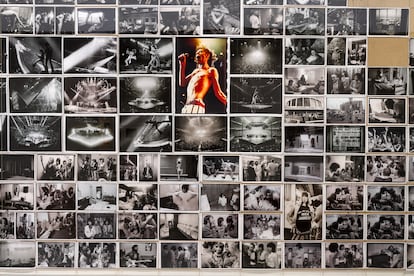
P. One of his first big assignments was to cover a long tour by The Rolling Stones in the seventies. It took him eight years to get out of it and he has said that it almost cost him his life. In the exhibition he has included a photo of his camel…
R. I never considered myself a person prone to addiction, but in the seventies and early eighties drug use was everywhere. At first it seemed like an experiment, but it ended up taking hold of me. When I realized it, I sought help by all means until I entered a center. I was there for a month, they gave me the tools I needed and I left determined not to touch that stupid thing that is drugs again. And so it has been. I never looked back.
P. Her collaborators describe her as an extreme perfectionist. Do you recognize yourself in that description?
R. Yes, it’s a curse. Over the years it becomes exhausting to want to do everything so well. I wish I knew how to do it differently, but I don’t know how to do things by halves. It’s a flaw, but also the only way I know how to work. And I know it drives those who work with me crazy, which makes me feel bad. My brothers and sisters are the same. We are all workaholics. I don’t know where it comes from exactly, maybe from some fear of stopping…
P. Can you imagine leaving it one day?
R. At times, yes. The pandemic helped me slow down. Have children too. Getting older is another great help, although little is said. During the pandemic we confined ourselves to upstate New York and it was the longest period I spent in our country house. I watched the sky, the weather, how the seasons changed. I was fascinated by being still. It didn’t come naturally to me: as a child my family moved every few years. But I had a wonderful childhood, always on the go.
P. He says there are many beds at his work. There are also many cars.
R. Yes. In my youth I lived in California, where people live more in their cars than in their houses. It was all about moving, driving, being on the road. Today it is no longer the same: there is too much traffic, that feeling of freedom has been lost. But if you manage to get out on the road, it’s still a fantastic feeling. And it also has to do with my childhood: when I was little we moved all the time. Going from one person to another when taking portraits is like traveling from one city to another: I’m good at it for 15 minutes, but then the moment comes when I think, “What am I doing here? Where can I go?”
P. Can your work be read as a portrait of your country, its beauty and also its tragedy?
R. Yes, I think so. My work has been very focused on the US. When we made the book Women with Susan (Sontag) in 1999, I wanted to include women from all over the world, but she said, “Let’s stay home.” He was right. What you see in my work is, above all, an American portrait. I hope other things are detected in the whole, but I know that in it the privilege of being from there is perceived. Even with setbacks like abortion, women in the United States are still luckier than many others in the rest of the world.
P. In the exhibition there is a sensational portrait of Donald and Melania Trump from 2008: she steps down, triumphant and very pregnant, from a plane, while he waits for her in the shadows, inside a car.
R. I finally found the right place for that image: among the fashion photos. Melania loves that photo. It’s one of my favorite walls in the exhibition: I use fashion to make a social comment.
P. Would you photograph them again today or would the political implication be different?
R. Yes, I would like to do it. I’m very interested in Melania and I’ve been thinking about doing something with her for a while. So yes, I would…
P. He also portrayed King Felipe and Queen Letizia in 2024.
R. They gave me complete freedom. I looked at the historical portraits of the Spanish monarchy, studied the Palace and thought about doing something classic and formal. I wasn’t worried that it seemed that way, I was attracted to that solemnity. I wanted it to be like a painting done in the dark. The King was charming, he was very relaxed. For the Queen it was a little more complicated. And I get it: no woman finds it pleasant to be in front of a camera. She had to think about many more things than him: hairstyle, clothes, her image…
P. Do you notice that anxiety in all the women you portray? Are they increasingly worried about their image, about social pressure?
R. They always have been. That apprehension has always existed. I don’t know if things get better over the years. But many of the women who appear in the final part of the exhibition appear very self-confident, with great poise. I was impressed, for example, by Penélope Cruz’s comfort in front of the camera.
“For the Queen it was more complicated than for the King. It is not pleasant for any woman to be in front of a camera,” she says about her portraits of Felipe and Letizia in 2024.
P. What changes when you photograph an anonymous person, without power or public exposure?
R. Basically it is the same job, except that the strangers are less conditioned by the idea of what the result should be and they relax more. Sometimes, with famous people, you have to deal with their own self-image. I have recently started taking private portraits again, of unknown people, and I really enjoy them: it’s about getting to the essence of someone. Today even children know how to pose and what their best angles are, but that has always been the same to me. I’m more interested in finding out who a person really is than what they look like. My job is to decipher that mystery, whether they are famous or not. Right now I look at you and I’m thinking about how I would portray you, how I would pose you, to reflect who you are.
P. What photo would you take of me?
R. I think the result would be nice, because he seems like a nice, very natural person to me. But let me tell you, I wouldn’t portray him in this ugly light… (laughs).
P. After 50 years of career, what still interests you about looking through the viewfinder?
R. That every time is like starting from scratch. Each portrait is a small psychological puzzle that must be solved. It is always different and that is the magic of this job.
P. What is left for you to do?
R. I’ll answer you honestly: stay relevant until you drop dead.