
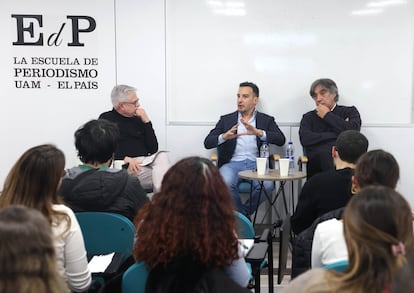
Agustín Díaz Yanes and Alejandro Amenábar were born more than 20 years apart, but they began directing films at the same time. The first with No one will talk about us when we are deadin 1995, and the other with Thesisjust a year later. Two of the most outstanding debut films in recent Spanish cinematography, recognized with eight and seven Goya awards respectively. Then the cinema was bustling and you could only see it in the theaters. Three decades after that, with the two established as big names in our cinema and with an industry completely different from the one where they were born, both return to the screens after more than five years of absence. This Tuesday they met with the students of the 40th class of the Master of Journalism at the UAM-EL PAÍS School to talk about those production models transformed by digital platforms and their new jobs: A ghost in battle y The captive.
There are few similarities, a priori, between the artistic vision of both directors, but they share a long career and validity that allows us to better understand the new functioning of cinema in the 21st century, increasingly swallowed up by digital platforms. Today their feature films are opening up to new formats and come under the umbrella of Netflix, which finances part of The captive in exchange for its exclusivity on the platform and produces completely A ghost in battlewhat they call Netflix original—. Models that have ceased to be simple alternatives and have become regular features in large productions. “Today movies are consumed on the screen a lot. I have never seen some of my favorite movies in a cinema. I like to make movies with whatever budget is needed and that’s it. I don’t care if it goes directly to the platform without going to the cinemas. I want freedom and budget,” Amenábar said as soon as he began.
The experience is particularly novel for Díaz Yanes —Amenábar had already debuted While the war lasts y Fortunea miniseries produced by and for Movistar Plus+—, who returns to directing after Oro, released in 2017. The first project of a 75-year-old veteran filmmaker, who opens himself to a model like this, distanced him from the traditional and forced his film to be shown in theaters for only three weeks. “At first I went in with some hesitation, thinking that Netflix might torture me, but they were the only ones interested in the film and I hadn’t directed for many years and I couldn’t say no. Then I had complete creative freedom and, for the first time, I don’t know if it’s good or not, no problem with the budget,” he said.
The result was a film with “much more money than expected” and the views of many millions of people, surely more, the filmmaker has said, than any of his other films. “It is very difficult to make films today that reach a budget of 10 million euros. The one we had planned, for example, was much smaller. I would have lost locations, the Italian songs, which are very expensive, and my salary,” he continued.
The same has attracted Amenábar to the multinational platform. The captive, what receives Netflix with a different financing model—only a portion of the budget in exchange for exclusivity in the streaming— had, unlike A ghost in battle, a longer presence in theaters, although, the director explained, without the financing of the platform, it would have remained stagnant: “Mine is a film designed to be exploited in the cinema, but Netflix has allowed us to build the house of cards and probably with the reality of current cinema we would not have been able to make it.”
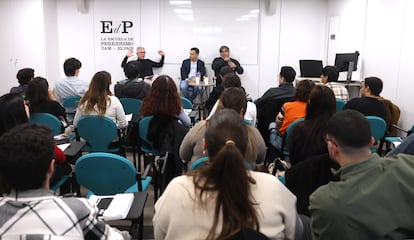
It is true that both continue to feel an attraction for the rooms and, beyond puritanism, they find palpable benefits in them. “The rooms at least allow what you have dedicated two or three years of your life to to have much more weight,” said Amenábar. And reaching platforms that host hundreds of thousands of audiovisual products carries the enormous risk of getting lost in an immense catalog. “It may be that you go to a platform, they give you the money, and no one sees the film,” Díaz Yanes stated. And Amenábar has complemented: “It can happen to you that you are successful or that your film goes unnoticed.”
Nor has one of the controversies that drags the issue most in the industry: the relationship of film academies with these models. A relationship that for Díaz Yanes “is going badly.” “I have already said that making a film on Netflix has many benefits, but this weighs,” said the director. His colleague differs: “I think that the debate is rather about what we consider a film suitable for the Goya. And it is a debate that the Oscars or the Golden Globes are having right now. It is a debate in which our films do not enter because they have been in movie theaters, but the Academy protects, like the Academy of Language, the essences.”
Theirs, although nominated for the Spanish film awards that will be presented next month, do not appear in the most important categories of a night in which they promise to star. Sirâtby Oliver Laxe and Sundaysby Alauda Ruiz de Azúa. “For me, the interesting thing this year is to see how the Academy is going to choose the winning film. I think it will have a divided heart. I won’t say more,” said Amenábar. A debate that Díaz Yanes did not want to enter because he had not seen Laxe’s film: “I never see movies in which a child dies.” Whichever the winner is, Netflix will have to wait at least another year to be the protagonist on the top of the awards.