
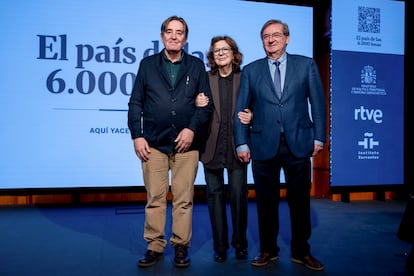
The Secretary of State for Democratic Memory and RTVE presented this Wednesday an interactive map with data on the nearly 6,000 Civil War graves located throughout the national territory. Cristina Bravo, director of RNE News, has explained that no Spaniard lives more than 50 kilometers from any of these clandestine burials, some individual, and others with the remains of more than 3,000 victims, such as that of the San Rafael cemetery (Málaga). The presentation of the map took place at the headquarters of the Cervantes Institute, whose director, Luis García Montero, served as host and congratulated himself for hosting “an act of memory and against misinformation.”
Fernando Martínez, Secretary of State for Democratic Memory, recalled that 20 years ago he was commissioned to coordinate the preparation of the first map of graves in Andalusia. “Since then,” he said, “a lot of progress has been made. During the time of the Government of José Luis Rodríguez Zapatero, the state map of graves had 2,000 marked. Today there are more than 5,000 registered.” The map shows the clandestine burials of victims murdered by the two sides that faced each other in the Civil War, but Martínez stressed that while “the graves of the victors were exhumed in the postwar period, those of the losers, the Republicans, did not begin until the arrival of democracy and with many difficulties.”
The first exhumations of those shot during the Civil War took place after Franco’s death. “I opened my father’s grave with my hands,” Esperanza Pérez Zamora told this newspaper in 2012. In the years of the democratic transition, he investigated, town by town, the whereabouts of eight shot relatives. He ended up exhuming, with other families, 150 victims of Franco’s regime. In those first years after the death of the dictator, a group of widows and children of those who were shot set out to search and open the graves where the murderers dumped their loved ones. In Navarra and La Rioja, kneeling in the ground, with no tools other than a shovel and their own hands, they were accompanied by some priests who were ashamed of the role of the Church during the Civil War, when their ecclesiastical superiors supported the military coup as a “crusade.” The attempted coup d’état on February 23, 1981 stopped that process, which was restarted in 2000 thanks to the push of civil society.
The Secretary of State explained that nearly 18,000 victims have already been exhumed. The coroner Francisco Etxeberria estimates that there are about 11,000 skeletons left to recover from the Francoist graves. Martínez insisted that opening them “does not open wounds, they close them,” and recalled a recent confrontation with “a prominent PP leader” who asked him: “Why don’t you leave the dead alone?” “I asked him, in turn, what he would do if he knew that his mother was lying like a dog in the mountains. And he remained silent.”
Rosa León, who during the Transition popularized the poem as an anthem against the death penalty At dawn, by Luis Eduardo Aute, and current advisor of RTVE, presented the interactive map as “a tool for the memory of today and tomorrow to know the reality of the past.” “We all lose when the truth loses; we all fail when we are complicit in concealment,” he added. In that sense, Martínez considered it a success that, thanks to the agreement with RTVE, the map of graves will appear on the website of the Secretary of State for Memory to increase its dissemination and thus “combat the reactionary wave on a global scale.” Pilar Bernal, director of digital content at RTVE, highlighted that the interactive map has a great contribution from the public entity’s historical archive, “a legacy of all Spaniards.”
The interactive tool has information on some 67,000 victims, such as María Domínguez, the first democratic mayor of Spain, who was assassinated in 1936 and whose remains were exhumed and identified in 2021. Or those of José Sosa, a tinker shot in 1937. The family was told that he had eloped with another woman. His daughter, Pino, was able to recover the remains in 2017. José Sosa had not escaped; He lay with 13 other murdered people in the Tenoya well, in Arucas (Gran Canaria), covered in garbage and quicklime. They had even thrown the chassis of a truck inside.