
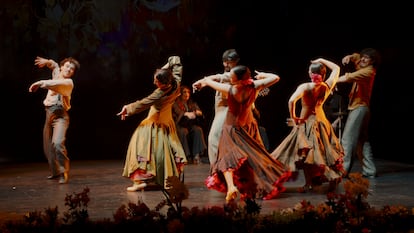
Hullabaloo It premiered last night with the expectation that great productions or unusual collaborations generate. This show fulfilled both and the stage space of the Museum University of Navarra (MUN), which co-produces the show together with the Khawla Arts & Culture and ADMAF foundations (Abu Dhabi Foundation for Music and the Arts), was full and, for tonight’s performance, there are no tickets either.
According to the words of its creators and architects, it is a show of music, dance and poetry that generates the encounter between the Arab and Spanish cultures. The first idea is fulfilled: the 80-minute montage summons text, projections, live musical compositions and movement on stage. Flamenco, one would have to say. Above all, flamenco, both choreographically and musically.
So that other idea that runs through the promotion and conception of this show, which defines it as a place for the coexistence of two cultures, is not so fulfilled. The flamenco dance and music of Manuel de Falla, whose 150th anniversary of his birth is being celebrated in 2026, sweep the stage presence in an obvious way. Also uncomfortable and delicate, if the show is put in context with the current political situation, in which a large part of the Arab world suffers from the privileged West with wars and genocide. So what wanted to be a dialogue ends up as a monologue, with some Western Asian asides. Of course, completely insufficient and unbalanced, also taking into account the Andalusian heritage that they left in the origins of flamenco, although there are also those who defend that there is no such relationship as if flamenco had been born by spontaneous combustion.
Just as the direction and dramaturgy of the work is signed by Ignacio García and Jihad Mikhael, and the musical has advice from Aya El Dika Mawla, also present in a few moments on stage with the performance of the lute, the truth is that in the dance, both in choreography and advice, only Jesús Carmona appears. Given the result, the Arab namesake of the prestigious dancer would have been needed, to ensure the richness of the numerous dances of Arab origin that exist, such as the dabke, belonging to the folklore of Palestine and Lebanon, which has become a dance of resistance.
Ignoring the latter in a show with dance as the protagonist, where the coexistence of east and west is appealed, at a time like the current one, creates a deep scenic decay. And although on some occasions the similarities are pointed out physically, especially in the arms, between the body movement of flamenco and some Arab dances, it is so anecdotal that it almost goes unnoticed. As do the four very young dancers from Egypt, Syria and Morocco, who are not professionals but students from the Sharjah Performing Arts Academy, but they sustain their interventions. Although overwhelmed by the level of the professionals on the flamenco side (Carmona, Lucía Campillo and Pablo Egea, above all). Only at the end, the four guest dancers perform a small choreography closer to contemporary dance than to specific or general Arab folklore.
The Lebanese actors Rafic Ali Ahmad and Cynthya Karam are really wonderful and overflow emotions with just the right restraint when they are on stage: he from strength; her, from the poetic. Karam also sings a couple of songs that taste very little, as they are intervened by flamenco (musically or in person) before they finish. The shawl number, in which the dancer seems to want to cover the singer, in an attempt to merge or meet cultures, does not work and comes as if the outfit was trying to imprison her.
It is difficult to understand how the character of Cynthya Karam, who plays Farah, an Arab botanist who comes to the Alhambra to investigate the Andalusian heritage, and who appears as the protagonist of the story, ends up relegated to a secondary role too many times, while Carmona’s character, a young florist who meets her, ends up being the center of attention. Although at the beginning some supertitles on projections (wonderful ones with Arabic calligraphy) locate the action, this does not happen again and the story is not understood by itself in some scenes such as the one of the lovers’ anger.
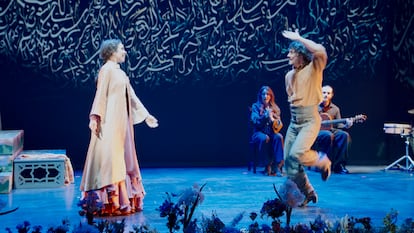
The young Navarra Symphony Orchestra, formed for the occasion by 80 university students, and the costumes by Yaiza Pinillos, which she made taking into account the designs also devised by young students from Pamplona, exceed what was expected and add, in many ways, to the evening.
The term “algarabía”, the title of the show, comes from the Arabic arabiyaah, which was initially translated as “typical of Arabic, of the Arabic language” and ended up meaning (in Spanish) something like a tangle or confusing noise of several people speaking at the same time. And it testifies quite well to the fragilities that run through the work. Algarabía traveled to Abu Dhabi in April, but as we are informed from the MUN, the performance in the capital of the Arab Emirates is delayed until November due to the international situation. There is time if we want to review the scenic imbalance and alleviate the debt with Arab culture that ends up passing through it.