
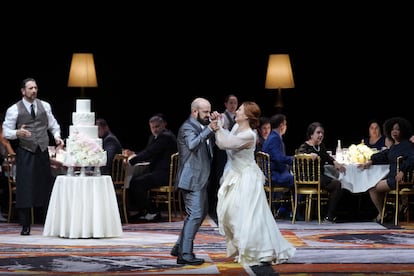
The first Bluebeard in history did not have a blue beard, but blood. Marshal Gilles de Rais fought alongside Joan of Arc in the liberation of Orleans, but died dishonorably by hanging accused of raping, torturing and murdering dozens of children in his castle of Champtocé. Two and a half centuries later, Charles Perrault adapted the atrocities of the French aristocrat in his Tales of yesteryearwhich Maurice Maeterlinck later used to write the drama that would give rise to the opera Ariadne and Bluebeard, de Paul Dukas.
“When I started researching the origins of the monster, the first thing that caught my attention was that Maeterlinck’s symbolist nightmare was published in 1899, at the same time as The interpretation of dreams of Freud,” says stage director Àlex Ollé (Barcelona, 65 years old) during the break from one of the rehearsals of the production that premieres this afternoon at the Teatro Real in Madrid. “This coincidence encouraged me to turn the castle into a mental space that functioned like Ariadne’s subconscious.”
In its adaptation, the doors of the fortress do not hide mysteries, but rather reveal us to deeper abysses. “Ariadna marries Bluebeard without knowing his dark past or the sad fate of his other five women,” explains Ollé. “From there, the entire drama is divided into two planes: the real world that happens during the wedding banquet with the guests and the interior visions that the protagonist experiences until she reaches the last room, where, as happens in the myth of the Minotaur, she finds the exit from the labyrinth.”
Unlike Perrault’s story, and Béla Bartók’s operatic version that was seen on this same stage in November, Bluebeard’s previous wives do not appear dead after turning the last key. “Here they remain locked up and subjected to the cruelty of their captor: exhausted, in pain, mute and paralyzed by an atrocious fear, a kind of Stockholm syndrome,” she says. “Ariadne heals their wounds and tries to convince them to escape with her, but they all refuse to leave the dungeon and, in the end, she leaves alone.”
For Ollé, this ethical dilemma, apparently contradictory in its message, only reinforces the validity of the script. “There is a clear feminist component in Ariadna’s disobedience and bravery,” she reflects. “The problem is not with her, but with the social conventions that lead the other five women to give up their freedom.” A question of gender, he says, but also of number. “There are many Bluebeards. Hence, for me they represent more the symptom than the disease of a system that tolerates, normalizes and silences violence.”
A chorus of women led by Ariadna ends up rebelling against this tyranny and erects a barricade of tables and chairs on stage. “This pyramid of resistance against the castle’s gears of power transforms individual conflict into a collective struggle,” continues Ollé in one of the theater’s rooms. “That is why I have not wanted to explicitly reproduce the abuse suffered by these women,” she clarifies. “Blood does not contribute much to certain types of stories. On the other hand, the violence that we do not see can disturb us.”
It was Joan Matabosch, artistic director of the Teatro Real, who suggested he work on an updated version of Ariadne and Bluebeard which took shape in a co-production with the Lyon Opera. There it premiered behind closed doors during the pandemic restrictions. “In an empty room it doesn’t look the same, because there is a very powerful scene in which Bluebeard is tied up and exposed frontally to the audience,” he reveals by way of spoiler. “So it will be the viewers of Madrid who decide what to do with him five years later.”
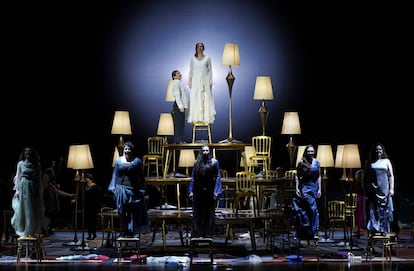
Ollé left Fura dels Baus three years ago, but his style remains faithful to the company’s ideology, which in his book Opera: instruction manualrecently published by La Cama Sol, describes it as a combination of impact theater, total spectacle and dramaturgy of emotions. “My Barbazul drink from all those sources,” he confirms. “The key is in what I call friction flowerand which consists of raising, defending and confronting your ideas with those of many other people. And for that you need to surround yourself with the best.”
His regular collaborators include Alfons Flores (responsible for set design), Josep Abril (costumes) and Urs Schönebaum (lighting). “Without them, nothing I do would make sense,” he admits. “A good concept is of little use if you are not able to put it into practice, which requires a team of professionals who speak your same language.” That and many hours of rehearsal. “Whether it’s a premiere or a revival, we work from scratch with each cast. Arriving at the theaters with ten days to spare seems reckless to me.”
In the pit will be the Israeli maestro Pinchas Steinberg, a great connoisseur of Dukas’ opera, which had not been heard at the Royal Theater since 1913, six years after its premiere in Paris. “An almost Wagnerian orchestration coexists in the score with a more declaimed vocal line, in the style of Debussy, so only the best singers can afford the main roles.” It refers to the Irish mezzo-soprano Paula Murrihy and the Italian bass Gianluca Buratto, who will play the lead couple until February 20.
In Ollé they are waiting for it later in Barcelona (Manon Lescaut), Valencia (Turandot), Syracuse (The Persians), Frankfurt (blood wedding) and Florence (Simon Boccanegra). “I can’t complain, I’m always busy: whether with Puccini, which for me is like the Beatles, or with the Liceu micro-operas that I commission from young creators.” Now the body asks for a shock similar to the one he applied to another monster during the world premiere of Frankenstein in Brussels. “I wish they would offer me to adapt The vegetarian from Han Kang… It would be a dream.”