
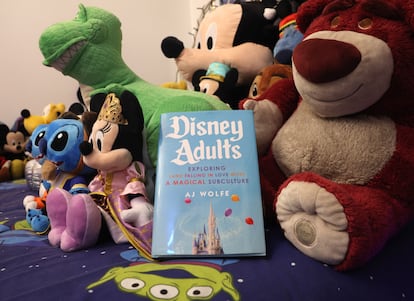
Daniel Pontón is 35 years old and has a great passion: he is what is known as a Disney adult. Her hobby appears in every corner of the house in Parla (Madrid) where she lives with her fiancé. So much so that they are considering removing the bed from the guest room/museum to make room for the invasion of stuffed animals. On the soft pillows there are Mickey, Stitch, Jack Skellington, Olaf, Chip and Chop… and other unknown ones. The shelves and walls are also covered. All this memorabilia, and other hard-to-find collector’s jewelry, like park keys, are souvenirs from your time at Disney stores and theme parks. Because Pontón, who tries to go to the one in Paris at least every two months, has just become, thanks to his TikTok channel with more than 110,000 followers, a influencer official of European Disneyland. With his social name, iDanny, he is part of a subculture that is often viewed with contempt, but that has been carving out a social and economic niche for years in one of the world’s great cultural companies, which in 2025 will once again be the leader of the global box office.
The psychology and sociology of this niche audience, the rejection they arouse, their economic relevance and their obsession is what the book studies from various perspectives. Disney Adults (for now, only in English) by AJ Wolfe. The 48-year-old author explores this social tribe from within after building her own company thanks to being a Disney fan herself. On the web The Disney Food Blog It began by rating the food in the parks and is now one of the reference sites for visitors. “I sought to explain that our subculture does not denote immaturity or escapism, but rather community, creativity and nostalgia. Stereotypes are built in the extremes, in the exaggeration of networks, when reality is much more routine. This is our way of building identity by sharing hobbies”, Wolfe explains to EL PAÍS by email. She writes it from knowledge and in the first person, but also questioning what is happening around her: “We feel close to what makes us safe, protected and happy,” she points out.
Pontón, for example, plays music from the park to relax, escape from his professional and personal routine, and return to his safe place, something many Disney fans do. He listens to the birds and nature of the Secuoya hotel and the loop of the parking lot. “When you visit the parks, everything outside ceases to exist. It creates a feeling of relaxation where you only have to worry about which character to hug, where to eat or which attraction to ride. I compare it to people for whom the only thing that relaxes them is the beach. It’s a safe place where you control everything,” says iDanny. Wolfe points out in the book that it is “the best escape from reality, because everyone is happy there, (…) and an effortless existence is embraced for a few days (…). In addition, it helps us face reality better when we return,” he says. Everything that surrounds Disney, from musicals to merchandisingit is a world without “surprises” and where “everything works”. She highlights another sensory experience that brings back the best memories: the smell of the water in the attraction of Pirates of the Caribbean.
But, if there is this halo of happiness and optimism around it, why is this movement so reviled and parodied? Wolfe says in the book that actually the neural patterns among sports fans, Star Wars, Star Trek or Disney are not so different, and that these followers are not more obsessive or consumerist, but he maintains that “since this fandom It has such a feminine and diverse presence, culturally it is perceived as different, more childish or embarrassing. Traditionally, femininity has been rejected as less serious, while passion in masculine fields is celebrated”: “We have had to fight to be considered adults.” On their website, 80% are readers, and they are also the ones who usually plan vacations.
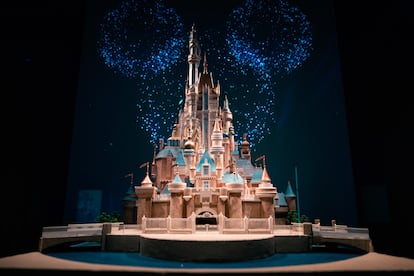
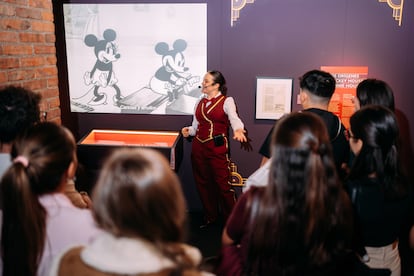
In Disney: the exhibition. 100 years of magicin Madrid until January, the audience is diverse: parents with T-shirts Star Warspeople without children, couples or retired friends whom Disney has accompanied throughout their lives in an exhibition that reviews the history of the company. Among these intergenerational visitors, a mother and daughter, ages 30 and 50 and both named Yolanda, dance to Disney hits with their helmets on. As for Pontón, its founding moment was the resurgence of animation in the nineties with The lion king o Aladdinalthough they have not been able to afford to go to the park and feel that “magic that makes you be a girl again” that they talk about.
Because being a Disney fan is an expensive passion. Wolfe says in her book that when she became a fan, the souvenirs They became “collectibles” and that created a “completeness” that had to be stopped as it became an obsession, immersed in fervent competition with the rest of the followers. There came a time when he felt that some objects did not even interest him, it was simply FOMO (fear of missing out), exploited by a Disney capitalism that sells exclusive buckets of popcorn for $30. She has paid 1,000 dollars for nights in a hotel, and the man from Madrid has queued at dawn to get mickeys exclusive. Today she wears an expensive and gigantic Pandora bracelet made of Disney figures: “I don’t have children, nor do I go out to party, so the money I have is spent on my hobby, but there are times when you have to say: it will be again.”
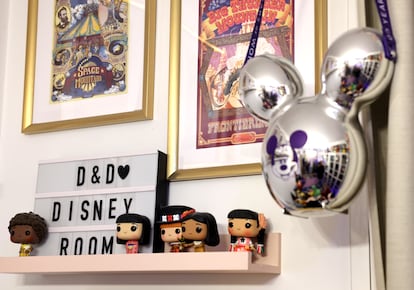
Although both defend that there are many degrees, also for those who cannot spend as much: “Football or Taylor Swift fans continue to be fans even if they don’t go to events. You can be part of a community online or share it with your friends. But it is true that parks are becoming more expensive. We will have to see how much the public is willing to pay, because the food rivals the prices of big cities,” explains Wolfe. IDanny, in fact, recommends in his account strategies to save in the parks, and not fall into the debt that many sink into: “The ‘I don’t want to deal with the world, so I run away’ part can be good, but you have to ask, how are your finances going? And at work? How do your friends feel about you? Have you called your mother? There is a line where you begin to turn your back on your life,” says a psychologist in the essay.
Due to its ability to spend, Disney knows that it has one of its greatest financial assets in this audience, not only for new parks like Dubai, but also for its chain production. The recent nostalgic hits of The lion king o Lilo y Stitchfor example, not only appeal to children, but to adults looking to relive their childhood. Fans of yesteryear now have enough money to travel back in time, and this is one of the few companies that can push “emotional” spending, the book notes. There are very expensive experiences for those who want to get married in the park, and specialized cruises are booming: until 2024 there were only five, but before 2031 they plan to add 13 ships that sail the waters around the world. One of them has its own island. This market niche is expected to exceed 2 billion in revenue in Disney accounts by 2029.
Perhaps the challenge now, in fact, is to attract generation Z and alpha to the brand, which has expanded its audience in recent years thanks to Star Wars, The Simpsons, Avatar (one of the house’s biggest billion-dollar hits this year, along with Zootropolis 2 o Lilo y Stitch) or Marvel. That’s why Disney has just signed agreements with video games Fortnite or Sora’s artificial intelligence technology to raise future Disney adults.
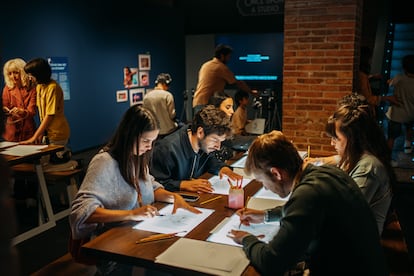
Rocío and Alejandro are another 26-year-old couple who have traveled from Malaga to Madrid to see the exhibition. They are drawing characters on one of the tables in this interactive exhibition. In their house they have united several Disney worlds, the most traditional of hers and that of Marvel and Star Wars his. After passing through the park this year, his goal is to return annually. For this there are also specialized agents, such as Ariel Ferrero, an Argentine living in Madrid, passionate about Disney and specialized in its parks and cruises globally: “From Disney, they even give us courses so that we are updated and know the details. And there are more and more adult packages, although in reality there we all become children.”
Eight of the 10 most visited parks in the world are Disney. In 2023, those from Florida and California exceeded 17 million visitors; Tokyo, 15, and Shanghai, 14. Especially after the pandemic, and with a society where there are fewer children, visitors millennials and generation X have grown up. Which also means that these dream places now serve beers or cocktails.
Disney and Pride
They have also included parties such as Pride, knowing that the LGTBI public is an important portion of Disney adults. Pontón acknowledges that there is still a lot of work to be done on this aspect of diversity, especially after the company’s latest setbacks against the Trump Government: “When Disney approaches the LGTBI, there is a lot of criticism that stops them. But it is true that six years ago there were no Pride collections, nor content like that on platforms and parks. Now we have the Disneyland París Magical Prideand that gives visibility,” he explains. “It is important to have a love story between two princes. I would like there to be more steps, but if before there were possibilities, now there are fewer.” Wolfe recognizes that this “frustration” exists: “It is difficult to see that decisions, values and politics do not align with yours, and it is a tension that exists in the majority: managing our passion with the awareness that it is a business machine.” A Disney adult economy that is not so new either, because already in 1935, Disney collected 30 million in licenses, in particular for the first Mickey watch.
Both are fully aware of the good and bad of this framework. “The positive side is that you express yourself freely, it can encourage joy, creativity, a sense of identity and community. And it is also a good place to deal with stress and find happiness in routine. But it can be problematic if you turn it into escapism to escape from responsibilities and emotions. And there is a social and judgmental stigma that makes you not be understood,” Wolfe details.
IDanny says that, although he doesn’t like football, he shares the “passion of what they feel.” And he explains that his hobby is similar: “What happens is not normative, it is not socially accepted, but it is a consensus that I don’t know who has created. Anything that goes beyond that is attacked. It’s an easy joke, but I don’t hurt anyone. The videos are always positive, I show what you do in the park, the reaction of the characters, it’s nice… I already know that there is a person inside the suit, but in that moment you live the fantasy and the magic.”
What do you respond to all those who reject this underworld because it “infantilizes”? “To be understood by others is to be loved. Those who hate it will never understand us,” responds a superfan in the book, who also points out that there are very valid criticisms, and that they make themselves: the competition, the exaggeration of some influencers that make them look bad, excessive nostalgia, addictions that lead to million-dollar debts (many fans cut for a while to detoxify). Pontón, who collects more than 100 different Mickey ears and got engaged in the Paris park, says that “Disney adults are happier”: “So we live longer, thanks to having found our community and a safe place to meet like-minded people.”