

The actress and animal rights activist Brigitte Bardot (Paris, 91 years old), one of the greatest symbols of French cinema—and of France itself—died this Sunday. For weeks he had been recovering from an operation, the second time in a few months. On that occasion, after 11 years of media silence, he had the courtesy to come out to deny his own death when the rumors grew. In his own way, without hiding anything. Neither the wrinkles with surgery or makeup, nor his character or ideological inclinations, increasingly radical, with crude euphemisms. “I don’t know who the idiot is who spread that hoax,” he concluded. This time, perhaps the same God who had created the woman in the legendary Roger Vadim film that launched his career in 1956 has taken her again.
The figure of Bardot, known as BB, colossally transcended the perimeter of cinema and anticipated some of the great revolutions that the second half of the 20th century set in motion. Long before becoming a muse of the extreme right and a fierce activist for the defense of animals, she was also the enigmatic symptom of a France in profound transformation after the traumas of the Second World War. Their style, immortalized with headscarves, a black elastic band placed at the hairline, or checked pants vichywas the transfiguration of a desire contained for decades, the temporary hinge between two worlds. A France that had not yet died and another that had not yet been born. A country where women became sexually emancipated and abruptly abandoned the social and cultural background, although they did so by becoming the main object of consumption of the new time.
Bardot was on the cover of gossip magazines. Aspirational gossip, for different reasons, of men and women who inaugurated the modern history of Europe. The imaginary illustration that accompanied the work of intellectuals and artists such as Roland Barthes or Jean-Luc Godard, dazzled by its beauty. Even the pages of authors like Simone de Beauvoir. BB embodied an enigmatic nature, a wild and innocent creature that man had to tame through his irrepressible virility. But also, as the author of The second sex (1949), was “the locomotive of women’s history,” who spoke to her gender with her permanent and spontaneous “wordless affirmation of sexual equality.” Feminist despite herself.
BB was born on September 28, 1934 in the boring 15th district of Paris, in a wealthy family. Daughter of Louis Bardot, engineer, and Anne-Marie Parrot Mucel, a housewife and passionate about the arts, grew up in a bourgeois environment where she received a strict education, but also permanent artistic stimulation. From a young age she showed talent for classical dance and, at just 7 years old, she entered the Paris Conservatory, where she began her training as a dancer.
Fashion and cinema were two hemispheres with no continuity for a young and beautiful woman – although the adjective was too poor in her case – with artistic ambition. At the age of 15 he appeared on the cover of Ellean unbeatable business card that caught the attention of filmmaker Roger Vadim, who would catapult it into the cinema with And God created woman (1956). His family was opposed at first. It was her grandfather who helped her: “If that little girl must one day be a whore, she will be with or without the cinema. If she must never be a whore, it will not be the cinema that can change her. Let’s give her a chance, we have no right to dispose of her future.”
The director, devoted to a 16-year-old girl, turned into her Pygmalion, He waited until she turned 18 to tie her up in an early marriage. The girl mutated into a woman, and the woman became one of the greatest icons of the French New Wave, which pulverized the narrative canons of cinema. An aesthetic and social symbol of the 20th century, capable of putting the Cannes festival into orbit while democratizing the bikini on its beaches from an innocent sexuality.
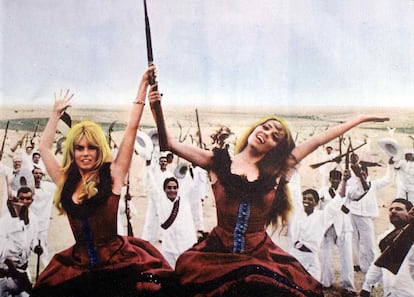
Bardot made 45 films. Most of them, without great interest or artistic depth. But also some memorable films: In case of misfortune (1958), by Claude Autant-Lara; ¿Do you want to dance with me? (1959), by Michel Boisrond; or Long live Maria! (1965), by Louis Malle, where his figure faced for the first (and last time) Jeanne Moreau, the other great myth of French cinema.
BB, he loved champagne, General De Gaulle and animals, as an editorial in Le Figaro this Sunday. And he almost always did what he wanted. Also in music, where he recorded 60 songs and inspired legendary songs such as I love you neither sharing with its author, Serge Gainsbourg, a recording studio and bedroom. And perhaps it was BB who best deciphered the enigma of the Jewish singer-songwriter. “He, who was probably the little Jewish and Russian prince who dreamed of reading Andersen, Perrault and Grimm, became, faced with the tragic reality of life, a touching or repugnant Quasimodo depending on our moods. Deep down in that fragile, timid and aggressive being hides the soul of a frustrated poet of tenderness, truth and integrity.” Bardot later did not want the recording to see the light of day and Gainsbourg had to settle, in the same way as Gainsbourg, with recording it again with Jane Birkin.
The Bardot enigma, a mystery turned into zeitgeistwas presented as an antidote to the usual stereotype of women, to the only roles that that world had assigned to them until then: mother, wife or whore, as the artist’s own grandfather would say. She changed her partner, she didn’t want to have children (she had one years later). He did not depend on anyone, or anything, and provocatively exhibited a freedom that ran through every inch of his body. But he never wanted to turn it into an ideology. “Feminism is not my thing. I like guys,” she said in an interview a year ago, denying that the two things were compatible.
Vadim was replaced by his co-star, actor Jean-Louis Trintignant. If a man got tired of admiring her, she replaced him, said her biographer Marie-Dominique Lelièvre. Boredom, indifference, deep and silent contempt that could seem fake, but that over the years became real. The same one that gave the title to the film by Jean-Luc Godard, which established her as a cult actress. In Contempt (1963) He outlined a silent portrait of the feminine mystery like the one that enveloped his own figure. And all this without a trace of guilt. That was what the censors (and the moralists of the time) could not stand: a woman who behaved as if her body and its pleasure did not cause her the slightest remorse. Until 1973 he got tired, in part, of all that. Also from all those people who overinterpreted their lives. Bardot retired prematurely and permanently from the screen, to settle in La Madrague, her mythical mansion in Saint-Tropez.
Bardot cut her career short when she was 39 years old. The actress was exhausted by the media pressure, the harassment of the press and the constant exposure. She felt “prisoner” of her image and the myth that the industry had created around her. Bardot was a symbol, also for a consumer society that had shaped her and then devoured everything that radiated from her figure. He had filmed enough movies and no longer found happiness or motivation in acting. His interest in men, in the human race in general, in short, was displaced by his passion for animals. After leaving cinema, he dedicated his life completely to activism. In 1986 she created the Brigitte Bardot Foundation for the protection of animals, which is still active today.
Ideological evolution
If Bardot is a beautiful and passionate portrait of French society, however, her ideological evolution was also a mirror in which to find answers to political transformations. To the almost hegemonic advent today of the extreme right. Since he left the cinema almost five decades ago, he became increasingly inclined towards positions of intransigence with immigration and close to the then National Front of Jean-Marie Le Pen. in his book A cry in the silence (A scream in the silence), Bardot affirms that there is an “Islamization of France” and warns of a “dangerous infiltration” of Muslims who, according to her, do not adapt to French laws and customs but want to impose their own. In an open letter to then-president Nicolas Sarkozy, she wrote: “I am tired of being under the yoke of this population that is destroying us… imposing its actions.” These statements have earned him multiple convictions for inciting racial hatred. But in recent times he has also attacked some movements such as MeToo that he never understood and observed “talented” friends like Gérard Depardieu as a witch hunt.
Bardot always dreamed of living “with her feet in the water”, on the shores of the Mediterranean. As soon as he could afford it, he bought the house of his dreams, La Madrague, for 24 million francs at the time (about 500,000 euros today), which has been the scene of the most massive parties and also a refuge for the animals to which he decided to dedicate his life through a foundation that bears his name. Last May, Bardot revealed that she no longer lived in La Madrague and preferred the tranquility of La Garrigue, the house she owns in the hills above Saint-Tropez, on the French Riviera. His death extinguishes any controversy, and definitively illuminates the myth.