
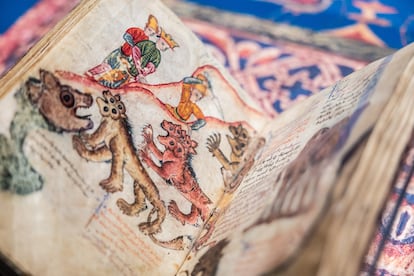
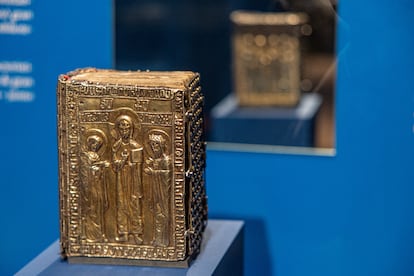
And Gospel from 1249 lined with carved gold that possesses—they say—powers of intermediation with the Divinity, a History of Alexander the Great in which fine drawings of lions with several heads appear or a Bible from 1654 ornamented not only with engravings, but with tiny porcelain plates on which there are painted stages of the life of Christ. In Armenian culture, the manuscript has not only been a vehicle of knowledge, but also a repository of the country’s identity and even a sacred object, even capable of working miracles according to popular tradition. Today the National Library of Spain opens an unusual window to this cultural heritage of the Caucasus, with the exhibition Along the paths of the map of spirituality: Armenian manuscript art. An exhibition that brings together in Madrid some of the most valuable pieces of the written tradition of Armenia. The exhibition, which can be visited until June 21, proposes a journey through more than a thousand years of history through codices, miniatures and objects with a profound symbolic meaning.
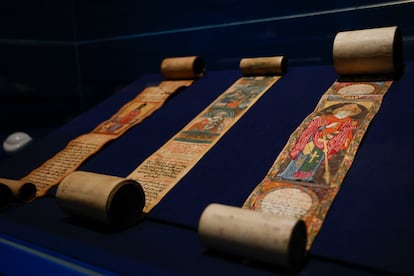
“It has been many months of work, but it has been worth it,” says Yvette Tajarian, the curator of the exhibition, referring to the exceptional nature of the exhibition. The exhibition has been organized by the National Library together with the Ministry of Education of Armenia, with the collaboration of the Matenadaran Institute of Manuscripts (where the works come from) and the Armenian embassy in Spain. The central axis are 11 codices dated between the 8th-9th and 18th centuries, selected for their artistic, historical and spiritual value. Added to them are three phylacteries—written amulets, known as hmayil—that reflect a lesser-known dimension of this tradition: the belief in the protective power of the written word.
“One of the most valuable and curious objects in the exhibition is the miraculous intercessor manuscript, the Khndrakatár“, explains Tajarian. “It represents the Armenian culture of prayer and tradition attributes to it powers of divine intercession.” In fact, the book is exhibited once a month in the Matenadaran Armenian museum so that people come to recite their prayers and wishes. The mystical connection of the manuscript is not an isolated case: the tour allows the visitor to understand how these manuscripts articulated the intellectual, religious and daily life of the Armenian communities, both in their historical territory and in the diaspora. And, of course, also admire its beauty: one of the most striking elements of the exhibition is the visual richness of the manuscripts, internationally recognized, constitute one of the hallmarks of this tradition.
“Each miniaturist had his own technique, and the evolution can be seen over the centuries,” says the curator, who points to the different use of colors and proportions. Developed in different regional schools – such as Cilicia, Vaspurakan or Crimea – these illustrations combine an intense color palette and narrative expressiveness; works like Gospels medieval or History of Alexander the Great They allow us to appreciate this stylistic diversity. “We Armenians are in diaspora today,” Tajarian notes, “but we have always been dispersed around the world.” Armenia, in fact, has a population of about three million people, while the diaspora (increased especially after the genocide perpetrated by the Turks in 1915) is spread throughout the world and exceeds 10 million.
More than artistic value
In addition to the curator, the inauguration was attended by Óscar Arroyo Ortega, general director of the Library, who pointed out the exhibition as an “example of alliance of civilizations, and a sample of that enlightenment that was the creation of the manuscripts”; the president of the Royal Board of Trustees of the institution, Daniel Fernández, who was the one who proposed this initiative two years ago; the ambassador of Armenia in Spain, Sos Avetisyan, who stressed that “the exhibition is a bridge of friendship between Armenia and Spain” and that “it seeks to bring one of the most valuable treasures of our culture to the Spanish people”; the director of the Matenadaran, Ara Khzmalyan, and the Secretary of State for Culture, Jordi Martí, who said that “the corridor that now opens between the Matenadaran and the Library is an enriching exercise of cultural responsibility that surely does not end here.”
They all stressed that the importance of the exhibition lies not only in its artistic value, but also that it is an opportunity to understand the history of Armenia as a crossroads between East and West: many of the manuscripts on display were produced in contexts of mobility, trade or exile, which explains the presence of diverse influences and the breadth of the topics of their contents: theology, philosophy, medicine, astronomy or law. “They are, in miniature, a compendium of our entire culture,” says Tajarian, underlining the role of these documents as a testimony of a people who have known how to preserve their identity throughout the centuries.
Located in Yerevan, the Armenian capital, the Matenadaran Institute is considered one of the most important in its field in the world and houses the largest existing collection of Armenian manuscripts. With nearly 23,000 copies in Armenian and other languages, the Matenadaran is an archive, museum, library, research institute and restoration center. “We can say that it has functioned as a repository of world culture,” says Tajarian about the importance of this archive as a repository of a memory that goes beyond the borders of Armenia.
The Madrid exhibition also offers the possibility of viewing pieces that rarely leave their place of origin, since most of the manuscripts on display leave Armenia for the first time. For example, a palimpsest from the 8th-9th centuries (testimony of the reuse of parchment in times of scarcity) and an 18th century manuscript translated from Spanish into Armenian, a symbol of cultural contacts between both worlds. Another of the greatest gems is a codex from 1306 recently restored by specialists from Matenadaran itself, whose miniatures have been recovered and presented as independent pages. “When it was found it looked like a stone; it was practically fossilized,” highlights the commissioner. “But it could be rebuilt thanks to the most advanced restoration techniques.” Behind her, a video shows the Matenadaran facilities, and shows the meticulous process of reopening the pages and reconstructing the volume.
At a time when cultural institutions are committed to internationalization and dialogue between traditions, On the roads… underlines the role of manuscripts “as vehicles of connection between eras, territories and ways of understanding the world,” insists Tajarian. As a bridge between Spain and Armenia, many of those present at the event today remembered the figure of Leo V of Armenia, the last Armenian king of Cilicia, who lost his kingdom in 1375, went into exile throughout Europe and in 1383 arrived in Castile, where he received the lordship of Madrid, Andújar and Villarreal, which he administered until his death. That is, Madrid was the “capital” of Armenia before it was even the capital of Spain. Exhibitions like the one inaugurated today not only remember those historical ties, but also demonstrate that both countries continue, through culture, history and art, more connected than we sometimes imagine.