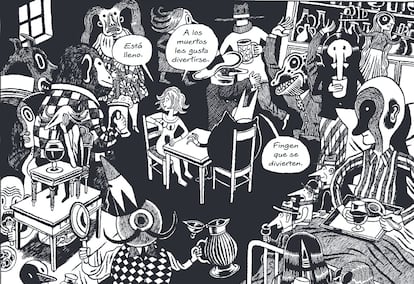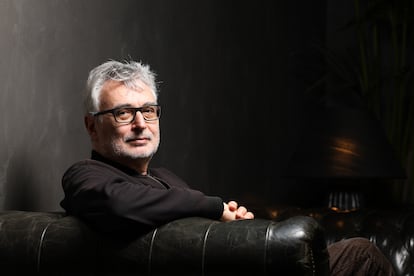
There are mysteries that human beings have always investigated. Some enigmas, by dint of searching, end in an answer. Others, however, remain in the unresolved drawer. It is difficult to ever discover what the world of the dead looks like, if it exists. Although, after visit it In a vision, Saint Teresa of Ávila said that he was stinking and lacking in love. Comic artist David B. cannot confirm it firsthand, but he read the story of the Spanish mystic and drew his own Beyond. “I imagined it similar to reality, like a caricature, with people trying to continue as if they were alive,” he says. A place with houses, restaurants, jobs, cars or animals. But without cold or heat, nor smells or climate. Where buildings multiply and pile up, food is made of shadows and creatures parade like a forgotten god, yesterday’s newspaper or a skeleton outside its closet. Or the suited host who gives the title to Mr. Owl and the Land of the Dead, recently published in Spanish by Salamandra Graphic.
Another phrase helped guide the comic: “Tiger forever.” It comes from a story by Horacio Quiroga, where a feline tries unsuccessfully to undertake other lives, until proudly embracing what it already is. David B. and Marine, his ex-partner of 10 years, made it “the catchphrase” of their relationship. And even when they had already separated, she encouraged the author to extend those 12 pages about a Mr. Owl and a young woman in the Afterlife that he had drawn in the nineties. At that reunion, Marine told him that she was suffering from cancer. And that she felt identified with that girl who is afraid of her shadow, but dares to step into the other world. “I did it thinking about her,” says the artist. His ex-partner, however, was never able to read it. Although his memory shines in Marie, a scared, brave, energetic and passionate protagonist about life. And in the dedication, on the very first page.
“Sometimes we are all afraid of our shadow,” says David B. Marie’s, in particular, has the silhouette of an indomitable tiger. Hence Mr. Owl convinces him to enter the world of the dead and try to tame her. Thus a dreamlike adventure is unleashed, with touches of humor, tears and noir. And the artist himself seems to be unchained: at 67 years old, the author of the famous graphic novel Epilepticabout his brother’s illness, here he gives free rein to the ideas, drawings, strangenesses and narrative twists that populated his head. “Now I make the books that I want, that I like to draw. I usually start with a feeling, something that I feel like designing,” he says.
The artist always carries a small notebook with him, so that inspiration never catches him off guard. As he shows the pages, full of texts and doodles, he says that he hasn’t drawn much these days: he had enough with presentations and trips across half of Spain. However, his passion for comics has accompanied him everywhere, for decades. She says that she was already hiding behind the decision to study advertising, just to please her parents. Not even in the home of two art teachers, apparently, comics were considered a good career choice. “Then it wasn’t seen as a profession. They told me that I could do it just for fun, if I had time. But I chose that school because there was Georges Pichard, who taught both advertising and comics. And I joined his classes even if they didn’t touch me, secretly…”, shares the artist. He got his diploma, but never worked. And when, in 1990, he founded the independent publishing house L’Association with other cartoonists, His commitment to cartoons was doomed.
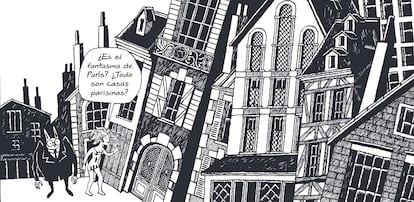
The passage of time has validated it. Over the years, David B. has published a surreal tribute to Nick Carter and André Bretonan esoteric walk through Paris in The events of the night o a mixture of war and dreams in Reading the ruins. Not even when he addresses realism, as in his Newspapers in Italy or in Epileptic, give up magic. His best-known work told of the pain of a child and an entire family. And he faced the paradox that launched the author’s career: the suffering so close to him also made his art emerge. “How can we assume that the misfortune that destroyed his brother is what gave rise to his life?” summed up the synopsis of Epilepticoften considered one of the best of the 21st century.
“It is the book that made me the author I am, with which I learned to draw, my style. My birth work,” says David B. Before publishing it, the artist made an agreement with his family which parts of his privacy should not be made public. “I didn’t want to make a book against him,” he recalls. But the recent deaths of his brother and mother have pushed him to return to his masterpiece. The sequel, which he is preparing, aims to recover material that he did not share then, as well as narrate what has happened in recent years. And the author is not very fond of looking back: he does not usually read it again, he explains that he often does not even remember his old works. “When I have to do it, for an exhibition, I actually like it, because I have forgotten everything. And my journey makes me quite happy, I realize that I have done many things and I still want to draw and tell stories,” he adds.
Almost 70 years old, just like 30. Although his status has changed. And with it, perhaps, his freedom: “I have always been able to do what I wanted, never books I didn’t want. But I have found myself confronting some big editors over choices I didn’t share. I used to work on works with them to finance those I wanted to launch through L’Association. Now that I’m older I’ve chosen to dedicate myself to what I like.” The little notebook in his pocket can’t wait: it has many pages still blank.