
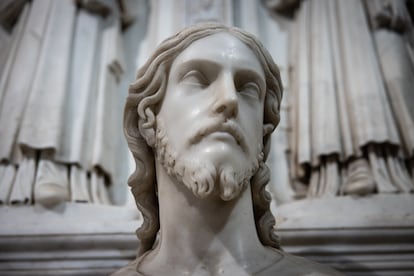
Cameras, journalists, friars, carabinieri and a lot of expectation. The Basilica of Saint Agnes Outside the Walls, in Rome, became the setting this Wednesday for a long-awaited presentation that had been talked about for days: a marble bust of the Christ the Saviorwhose attribution was lost over the centuries and which rested peacefully in this church since the 17th century, would actually be a work by Michelangelo Buonarroti. This is stated by a self-proclaimed “independent researcher”, Valentina Salerno, who has published a 25-page essay to prove it (with barely twenty bibliographical citations) and who, after nine years of self-financed research, also claims to have found at least twenty other works that could be by the Renaissance genius. Without a doubt a great event, if it were not for the fact that, at the moment, no expert on Michelangelo has corroborated his hypotheses. “Well, I have presented all the documentary evidence, I have searched for nine years in archives and museums around the world and I think I can affirm that the bust is by Michelangelo. It was attributed to him in many documents that I have found, although that trace was later lost. Now it will be up to the experts to express their opinion,” he declared during the press conference.
No one would mind adding a Michelangelo to their collection and, in fact, the abbot of the Basilica of Saint Agnes was there to support Salerno’s research, accompanied by Michele Rak, a university professor specialized in literature and language, a friend of Salerno (but lacking knowledge about Michelangelo, as he himself confirmed to this newspaper) and by a carabinieri colonel, “because when a new work is discovered, security becomes an essential issue,” as he expressed during the presentation. It is shocking that there was a carabiniere but no expert on the Renaissance genius given the solemnity of the organized event, but that, it is hoped, will come. Especially since Salerno’s research is not limited to this work, but he claims to have identified at least twenty more works “about which I will publish more information,” he says.
It is also surprising that the author is not an expert in art history. “I have always been a lover of archeology, but I did not graduate,” she explained in front of her audience. He also studied jurisprudence for three years, but what he has dedicated himself to professionally for most of his professional life has been interpretation. In addition, he has written plays and has had several of his own companies, which is why EL PAÍS asked him how he came to carry out this research: “It arose from curiosity. In reality, I wanted to do research to write a biographical novel about Michelangelo, and in that process I went knocking on doors to get research and I arrived at Santa Agnes de Extramuros, which is related to the Confraternity of San Pietro in Vincoli, very close to Michelangelo. And the abbot told me that they had a bust of which it was rumored that it could being the artist. I began to investigate, I became passionate, I abandoned the idea of writing the novel and concentrated on following the trail of the bust.”
The research is based mainly on archival documents: from notarial documents to inventories, old tourist guides and some homegrown stylistic analysis, seasoned with curious anecdotes that made the presentation follow with great interest. In fact, the new theories that Salerno has put on the table are still fascinating: according to his research, Michelangelo left everything organized so that the works that were in his house and in his studio were hidden in a secret room, which could be in the church of San Pietro in Vincoli, guarded with three keys in the hands of three different people, all days before his death. These works would later have to be distributed among his friends and faithful students, since he did not want them to end up in the hands of his only heir, his nephew Leonardo Buonarroti, with whom he got along very badly.
One of the people in possession of one of the three keys would have been Tommaso de’ Cavalieri, a young and powerful courtier of the time thirty years younger than Buonarroti and with whom the artist fell madly in love. He Christ the Savior of the Basilica of Santa Agnes would actually be a portrait of Cavalieri, according to Salerno.
Of course, the non-existence of images by Tommaso de’ Cavalieri makes it very difficult to know if that Christ actually wore the face of Michelangelo’s supposed lover, as Salerno herself admits, but she claims to have found his image, at an older age, in another painting of the time. In the eyes of a journalist faced with a power point They did not look very similar, but, obviously, it will have to be academics and scholars of the time who corroborate these theories and confirm this attribution, or perhaps it would be more correct to say reattribution, if the documents presented confirm that they already pointed to the authorship of the work.
Salerno has followed the trail of the bust from the moment of Cavalieri’s death (supposedly he kept it) until its arrival at Santa Agnes, where it would have remained first in a private chapel and then exposed to the public in different chapels. In some of the old documents he showed it appears attributed to the artist. However, the bust appeared in the 2005 official catalog of Italian cultural assets under the title “Christ the Savior (sculpture) Roman environment second half of the 16th century.” According to some Italian publications, the Vatican has created a committee of experts to analyze the Salerno discoveries, but this newspaper has not been able to confirm this news.
In Italy, a country that between the 15th and 17th centuries saw the birth of countless artists who produced countless works of art, the appearance of a sculpture or a painting from a classic is recurring news. But in the case of Michelangelo, a new attribution would be even more extraordinary, since he supposedly burned everything in his study before he died, according to one of his contemporaries, Giorgio Vasari, until now the most reliable source for topics related to the Florentine genius.
While waiting for the veracity of this spontaneous researcher’s theories to be confirmed, the story has all the ingredients to take on a life of its own, even if it is to remind us that, five centuries after his death, the Florentine genius is still perfectly capable of making headlines. It is undoubtedly a goldmine: just in case, Salerno has already registered the website michelangelomuseum.it and has published a children’s book in which he tours seven churches with the help of Michelangelo.