
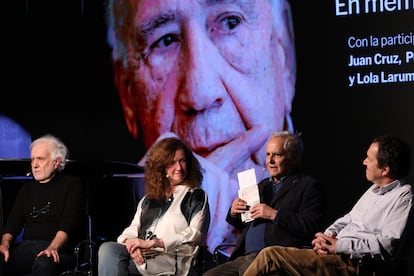
It’s sunset in Madrid, after too many days of darkness, with its usual orange light. And at the same time that, several blocks away, Gabriel Rufián and Emilio Delgado debate the future of the left, Joan Manuel Serrat enters the headquarters of the Cervantes Institute, oblivious and smiling. The reason is perhaps more important: to celebrate the life of his friend Joan Margarit, five years after his death. And do it, furthermore, by reciting and singing his poetry.
“He would love this,” confesses the Catalan singer-songwriter, but this is not a traditional tribute. It’s an evening among friends to try to fix the world. Or at least, make it more beautiful. “The true tribute to a poet is to be read,” claims Ana Belén.
An opinion shared by Mónica Margarit, daughter of the poet and the organizer of this event attended by the Minister of Culture Ernest Urtasun. “It’s not easy to keep the memory, unless you’re Gabriel García Márquez and you’re in high school literature programs. I’m happy that a hardcover edition of his complete work has been made,” he explains.
And so, this afternoon at the end of February, one friend after another (the journalist Juan Cruz, the poets Ramón Andrés and Luis García Montero, the literary critic Jordi Gracia, the editor Emili Rosales and the bookseller Lola Larumbe, among others) draw with shared scraps who Joan Margarit was. The architect who was born in the Civil War. The structural calculation teacher who narrated more than explained. The torn poet who shot straight through the heart. And the music lover.
Because Margarit was, above all, as Serrat remembers, “an extraordinarily musical poet.” And he confesses: “I read his poetry and I am singing it.” The singer-songwriter met his namesake with “a wonderful book, Estació de França (Hiperion, 1999). The admiration was mutual. Maybe that’s why they argued so much. “He was a very passionate man with respect to what was happening around him. Very critical of everything that had to do with abuse, contempt and pride. Very concerned about society.”
And also, a man who loved freedom. Freedom, you know, “is a bookstore.” A form of love. For this reason, he did not belong to any poetic movement, he cultivated free verse and reinterpreted his poems from Catalan to Spanish. An “unusual virtue,” according to its editor Emili Rosales. “Poetry came from deep inside him, which is where his mother tongue is. Sometimes, when he wrote the Spanish version he improved the Catalan version,” remembers his daughter.

It’s late night and it starts to rain. Ana Belén and Serrat recite their poems, in front of the silence of the rest of their friends, acquaintances, journalists, writers and readers in a packed Cervantes auditorium. He recites in Catalan. Her in Spanish. A dialogue between languages, as Margarit liked. First class woman, Self-portrait, Closing the beach apartment, They will want you to die y The highest mountain.
And then the flamenco singer Miguel Poveda, dressed completely in black, sings the poem I won’t see you anymore (I won’t see you again), accompanied on the piano by his arranger Joan Albert Amargós. He put it to music in 2005, on his album Desglaç. “He didn’t really like flamenco. I was young and I was shy, but I found a very affable and very grateful man.” The last to set his poems to music was the Portuguese Salvador Sobral with Love and times.

Margarit conceived much of her work in bricklayers’ bars. He wrote in small notebooks, which accompanied him in his shirt pocket until the last day. In them, he found refuge when his daughter Joana died at the age of 30, due to a disability, to whom he dedicated some of his most beautiful verses, such as The eyes in the rearview mirror. “The peace that your slowness gives me,” he wrote about her, “that is within me.”
But perhaps the great recognitions came too late. He received the National Poetry Prize and that of the Generalitat of Catalonia in 2008 and the Reina Sofía Poetry Prize and the Cervantes Prize in 2019. The same year that the poet deposited his legacy in the Caja de las Letras.
“I will leave loving you and something of mine will try to return,” Ana Belén concludes, with the last verse of the penultimate poem of her posthumous book. forest animal (Poetry Viewer, 2021). Death was present throughout his work. And he said that “making a poem is much more difficult than dying.” Although, curiously, according to his daughter, he wrote his best verses when he saw that darkness was already close.