
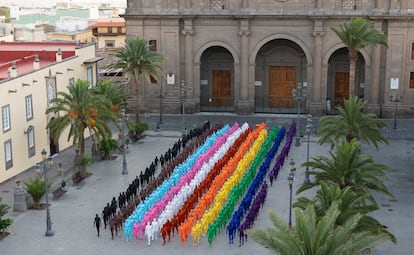
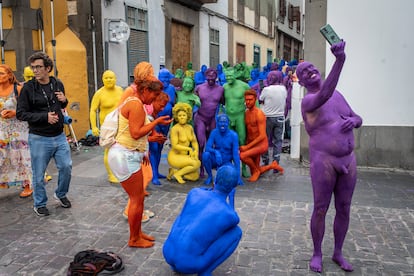
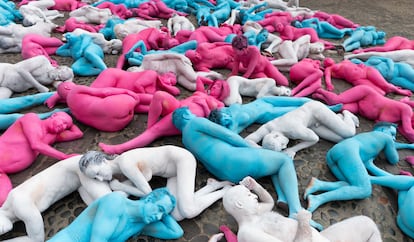
It’s past 7:35 in the morning this Sunday, and between 400 and 500 naked people painted with 11 colors of the Pride of Progress flag begin to parade in front of the Canary Islands cathedral under the orders of photographer Spencer Tunick’s assistants, who observe the scene. walkie talkie in hand from the terrace of the Town Hall of Las Palmas, on the other side of the square. For the next two long hours, the New York artist will direct the participants (“on their backs”, “step to the side”, “lying on their side with their hand on their side”…) to shape Gran Spectrum: an intervention that has taken place in the Plaza de Santa Ana and in front of the nearby Casa de Colón and that aims to vindicate the rights of the LGBTQIA+ community within the framework of the Culture & Business Pride 2026 festival, organized by the Cabildo of Gran Canaria and the Government of the Canary Islands.
“The group needs all the support possible for the future,” the artist said in statements to the media at the end of the photo session. “Any place where naked bodies are accepted in harmony, without separating them, is a great step forward towards the future.” Precisely, the action was carried out a few hours after the attack that occurred this Saturday during the celebrations in the center of Berlin of the Pride march (Christopher Street Day, CSD), in which a woman died and 29 people were injured after being hit by a van at high speed.
Gran Canaria this Sunday was the last stop of a race forged from almost abstract images with naked bodies in the lens. Tunick started out somewhat more modestly in New York in the early nineties. There, he took advantage of the legislation—nude photography on the street was allowed as long as it had artistic purposes—and the early hours of the day to photograph people individually. Over time he gathered contacts—waiters, video store employees—until he accumulated more than 70 phone numbers. With them, he organized his first mass session.
That first group meeting, in front of the UN headquarters, brought together 28 people. “The final image worked: I thought it was not tacky or cheesy, but rather had a strong and serious quality,” he recalled this week in an interview with EL PAÍS. “At that moment I thought, wow, something is happening here.” The rest is already known: an international tour photographing large concentrations of naked bodies, with milestones such as the call in Barcelona in 2003 (between 4,500 and 7,000 participants, depending on the source) and its record in Mexico City in 2007, with between 18,000 and 20,000 people.
Not all of his projects came to fruition: Tenerife, South Korea — where the Government denied permission — and another in Taiwan — canceled when everything was already organized — are among the failures, which he attributes to the existence of governments that he describes as “narrow-minded and restrictive.”
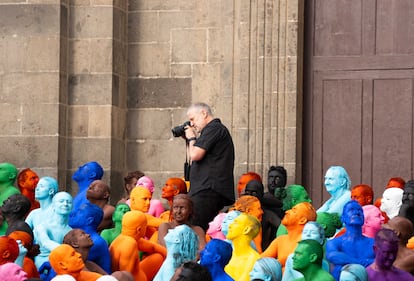
He has not encountered any obstacles in Las Palmas de Gran Canaria. Here, the police cordoned off a good part of the historic center since dawn, both to allow Tunick to expand and so that the participants could undress and prepare themselves without the scrutiny of curious onlookers. What’s more, the action was held in the same setting where Pope Leo XIV held a meeting on June 11 with bishops, priests, deacons, religious, seminarians and pastoral agents from the entire Diocese of the Canary Islands. “There was the possibility of working in both directions (facing the cathedral or with my back to it, with the City Hall in the background), but there was a stage already set up, so I could only work in one direction. They told me about it a week or so before coming,” he says with a slight shrug of his shoulders. “Anyway, I think what has happened is good for the future.”
But the present does not seem to raise any objections to his work on the island either. This Sunday morning, in front of the cathedral, the bishop of the Canary Islands, José Mazuelos, emphasizes in statements to EL PAÍS that he unequivocally approves the action held in front of his house – the Episcopal Palace where he resides is located in the same Plaza de Santa Ana. “I don’t have any problem,” he says. “When we go to the beach we see naked bodies, right?”
The prelate, however, has complained about the street closures, which prevented access to the dean and a dozen parishioners who had come in time to celebrate the ten o’clock mass, precisely, on Saint Anne’s Day. “Today is a special day for us. When people go to the concerts, don’t they arrive earlier to enjoy? Well, we want to be ready to enjoy God,” explain Cita and Evaristo, two retirees who lean against the fences that prevent them from the step
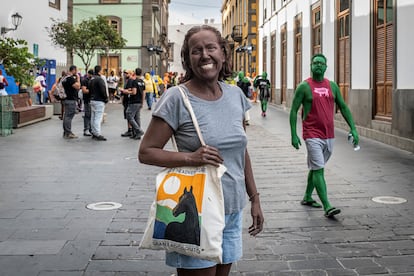
Ten minutes later, the road opens – thanks to police intervention – and the joy of Cita, Evaristo and several dozen parishioners will form a curious image to say the least as it mixes at its entrance with the bustle of the multicolored participants – some still naked – after the photo session. One of these happy people was Patricia Pardo from Donlebún, with a smile from ear to ear that stands out even more with the brown paint. “It was a party at five in the morning, I’m so glad I got up,” he says in the midst of a hubbub of colored bodies. “I arrived and I didn’t know anyone, and in the end you end up putting cream on everyone.” And most importantly: “There was, above all, love for the body. It didn’t matter whether you were fat, short, skinny, tall, your boob here or here… In the end we all have the same thing.”
“I am very happy for all the people who came and participated,” Tunick closes at the end of the installation, “that they came together and could create with me beautiful sculptural works that covered a wide range of themes: identity queeras well as LGBTQIA+ values, that is, inclusion in art, equality and the simple freedom of being in public and among your neighbors.”