
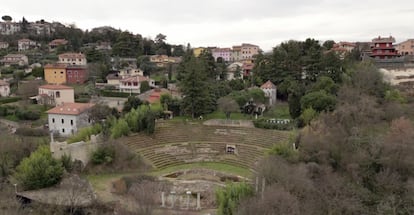
He built a faux Roman theater among the hills of the Italian province of Vicenza using modern stone blocks artificially aged to give them an ancient appearance. He presented it as an archaeological find with vestiges from Ancient Greece, Ancient Rome and even the Neolithic; He organized guided tours and historical representations, charged entrance fees of up to 40 euros for each visitor, slipped into an official tourist guide by mistake and ended up in prison, sentenced to two years and four months in prison. It is the incredible story of Franco Malosso, a 69-year-old Italian who called himself Franz Von Rosenfranz in the artistic circuits and who managed to set up one of the most unusual archaeological hoaxes in Italy.
After 10 years of trial and after the conditional release was rejected and the Supreme Court confirmed the sentence, the author of this colossal farce entered the Ventimiglia prison a few months ago, to serve the sentence imposed for illegal construction and falsification of works of art.
The origin of the story is uncertain, dating back to a few years before 2016, when Malosso began to build the fake ancient theater on the hills of Arcugnano, in the province of Vicenza. On an area of 5,000 square meters, he installed a series of stands built with overlapping stones and worked in such a way that they look ancient. The columns, made of cement, the plaster statues and an artificial pond excavated under the stands, in the sand area, are also fake. The one known as the Berico Amphitheater, which still stands, despite its name, is actually a structure inspired by a Roman theater, with a semicircular plan.
In 2016, after a complaint from the Arcugnano City Council, an investigation was launched that concluded that the entire complex was modern and had been built without the necessary planning and landscape authorizations. At that moment, a complex judicial process full of defense resources began.
The newspaper archive does not allow us to clearly determine whether Malosso’s intention was to reconstruct a supposed ancient theater or simply create a false archaeological site to pass it off as authentic. His version changed over time. At first, he presented the site as an authentic archaeological site with remains from different historical periods. Later, when the investigations began, he maintained that it was actually the reconstruction of a supposed ancient theater that, according to him, would have existed under the hill. That thesis, however, was discarded by the Superintendence of Cultural Heritage, which determined that there was no archaeological vestige in the place and that all the structures were of modern construction.
Throughout these years, Malosso’s defense has always maintained that the falsification had been done in such a “crude” way that it was impossible for anyone to believe that it was a real archaeological vestige, and that therefore the thesis of deception could be discarded.
The sentence includes urban planning crimes and crimes against cultural heritage. The judges considered it proven that the gigantic installation had been presented as an authentic archaeological remains, also generating an economic benefit through visits and activities organized at the site. The case continues to arouse surprise in Italy because of how a fiction of these dimensions could be raised and maintained.
The experts consulted agree that an authentic archaeological site is easily recognizable to a specialist. Jacopo Bonetto, archaeologist and professor at the Department of Cultural Heritage at the University of Padua, explains that identification does not depend only on the visual appearance of a construction, but also on its architectural characteristics, the materials used, the construction techniques and the state of conservation. “It is totally absurd to think that an old building can be confused with a modern one, even if they are built in the same way,” he points out in conversation with this newspaper.
According to the archaeologist, Roman buildings are identified by their architectural characteristics, the materials used, the construction techniques and, above all, by the wear and tear accumulated over centuries, elements that are impossible to faithfully reproduce in a recent construction. Added to this is the cost of a work of these characteristics: “Rebuilding an amphitheater today would entail an enormous expense, difficult for a private citizen to bear,” says the expert.
Bonetto also emphasizes that the very location of the supposed theater was enough to raise suspicions. “The context is essential, since ancient buildings were only built in certain places. Ancient amphitheaters were built, in 99% of cases, on the outskirts of Roman cities. An amphitheater in the countryside, far from an ancient urban center, is naturally false,” he says. The expert highlights that these types of episodes, fortunately, are extraordinarily rare.
Beyond the anecdote, Bonetto considers that the case highlights the importance of scientific rigor in the management of historical heritage. “Competences must be respected and this is not always the case. Too often cultural heritage is left in the hands of people who do not have specific training. European heritage is an enormous wealth that must be preserved and requires qualified specialists,” he defends. In the case of Vicenza, he adds, “an inspection by competent archaeologists was enough to understand that it was a fake.”
The court ruling also obliges Malosso to compensate the City Council for the damages caused, to demolish the theater and the rest of the illegally built buildings and to restore the hill to return it to its original state, although this order is still pending execution.