
Before the painter Lorenzo Aguirre was taken from his cell to be executed with a garrote one morning in October 1942; before the artist tried to calm his executioner by telling him “calm down, you are not responsible: it is your job”; before the repressive machinery of Franco’s regime murdered this set designer, poster designer, illustrator, lyricist, landscape artist and caricaturist committed to the Republic in the Madrid prison of Porlier, who had escaped from Spain due to the Civil War and who later returned from France due to the Nazi occupation; before his body fell inert to the ground and then the regime ordered the deletion of his entry in the Espasa-Calpe Encyclopedia so that no one would ever hear the name of Lorenzo Victoriano Aguirre Sánchez again, that 57-year-old man sentenced to death, accused of aiding the rebellion, persecuted as a communist and a freemason… Before all that, that bald man with a happy temperament prepared to say goodbye to his three daughters in the coldness of a cell. He had already done so by letter from his wife, Paquita.
But how do you say goodbye to three daughters aged 7, 9 and 11? What are the last words of a father to those poor girls who, on their knees, had begged clemency for their father before the Generalissimo’s daughter, Carmencita, on his saint’s day?
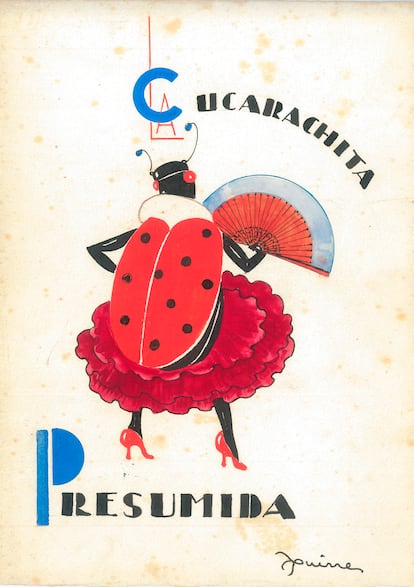
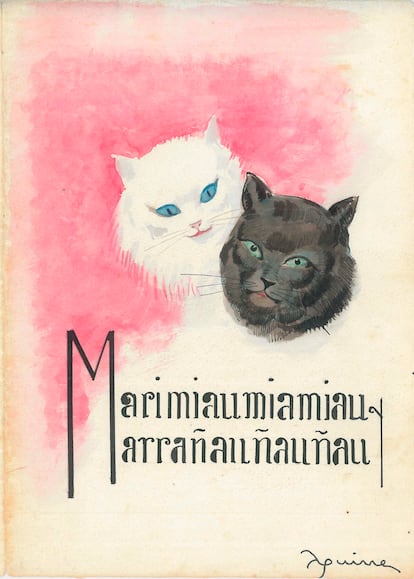
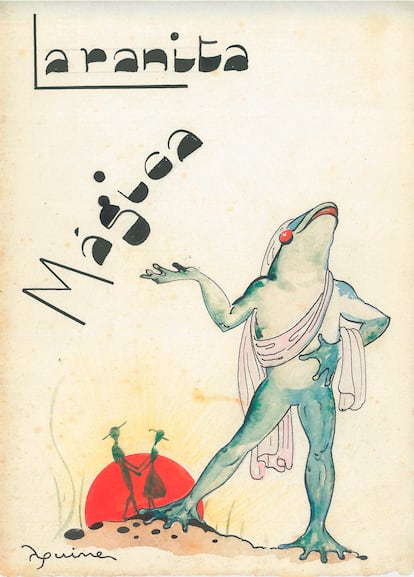
Lorenzo chose the story. A story written, drawn and painted in watercolor for each daughter. For the dreamer, for the brave, for the presumptuous. A story for each one. The cocky cockroachfor Margarita, who teaches that you should not be vain or seek revenge, but always help anyone who needs it, even if they have treated you badly in the past. Marimiaumiaumiau and Marrañauñauñaufor Jesusa, where he claims that the smallest beings, if they unite, can bring down even the most powerful ogre. AND The magic frogfor Paca, which intoxicates with a priori impossible loves but which the force of will makes viable and which speaks of a prince with a name used by the novelist Blasco Ibáñez, an admired friend of his father.
Now, those three stories, after a lifetime of unpublished stories since they were composed in the anguishing solitude that precedes capital punishment, are going to see the light. The Valencian publisher José Camarillas has rescued them, through a daughter and grandson of Lorenzo Aguirre, and is trying to publish them in a hardcover album through a crowdfunding campaign that is advancing drop by drop. The project The presumptuous cockroach and other stories by Porlier (Llibres de l’Encobert) needs 7,000 euros to publish the three stories that Lorenzo Aguirre wrote and illustrated for his daughters, which will also be accompanied by an investigation that reconstructs the artist’s biography and demonstrates, according to Camarillas, some “irregularities” in his judgment.
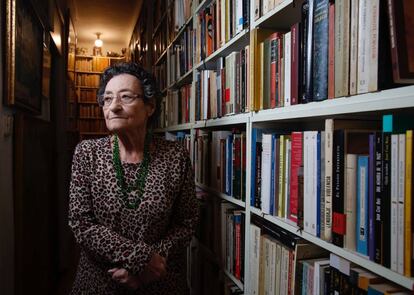
The meanderings of History are curious. When little Paca Aguirre received her father’s story, the one about the little frog, and began to read that in a cabin very far from the city she lived with her mother Rosalinda, a beautiful girl who, after attending to the housework, took the sheep to graze in the fields, it was impossible for that girl to imagine that shortly afterwards she herself would begin to write, and that over the years she would be an immense poet, wife of the poet Félix Grande, secretary of the poet Luis Rosales, and that her work Complete – crossed by memory, loss and the scars of time, which are childhood anguish, horror and golden tears – would be anthologized in the 650 pages of Dress rehearsal. Collected poetry 1966-2017 (Calambur Editorial, 2018), and that almost at the end of his life he would receive the National Poetry Prize and the National Prize for Spanish Literature.
How was Francisca Aguirre going to imagine, when reading the adventure about that fearsome ogre who had to be brought down at the beginning of that fearsome post-war with another ogre that no one could or wanted to take down, how was she going to imagine that one day she would write a poem titled Kneeling memory —she, who in vain knelt before the dictator’s daughter for her father— and who in her verses would say: “Behind time there is always another story, a story that was and was not, like in children’s stories.” Like in the farewell stories that her father gave her and her sisters.
In the opinion of the editor José Camarillas, “these stories are a type of farewell letter for the girls. The form changes, but the final message that Lorenzo Aguirre leaves his daughters is the same that so many other victims of Franco’s regime did with their children through letters or other objects of memory. That message is: do not have resentment; study hard; help everyone, even those who have hurt you, and especially the weakest in society: if you you do, everyone can be free.” That legacy of love and dignity, Camarillas explains, he already saw in the letters of eighty families with whom he worked to compose another of his books: The memory cardswhich compiles the farewell writings of numerous people murdered by Franco’s regime and which are accompanied by the answers that their relatives – daughters, grandchildren, sisters or nephews – wanted to give them. post mortem so many decades later. A delayed emotion bomb.
Apart from being an artist with five paintings in the Reina Sofía and a hundred works guarded by the Gravina Fine Arts Museum in Alicante, Lorenzo Aguirre was also a police officer. That was the origin of his problems with the dictatorship. With the outbreak of war, Aguirre remained loyal to the Republican Government. He had been director of the Spanish Police School and in September 1936 he was appointed Senior Chief of Police of Madrid. The Franco regime accused him of having been behind the murder of the far-right deputy José Calvo Sotelo five days before the military insurrection of July 18. However, in the research for this book, José Camarillas claims that he has found evidence that dismantles the plot alleged to condemn him to death.
“The regime accuses him of having ordered Calvo Sotelo’s bodyguards to let them kill him or finish him off. Although it has been known for decades that this event was revenge for the death of José del Castillo and that Calvo Sotelo was not even the main objective of the assault guards who killed him, I have found new documentation for the case. There are quite a few testimonies of conservative police officers against Lorenzo Aguirre and even old disputes from when he was a drawing teacher at the Police Academy. But the main plot is formed by the Traditionalist Communion deputy Joaquín Bau and the guard Rodolfo Serrano de la Parte, Calvo Sotelo’s escort, and there are payrolls and documentation that show the contradictions of what they attest,” the editor summarizes before his investigation comes to light.
At the end of the war, after passing through Valencia and Barcelona, Lorenzo Aguirre went into exile to France. He returned in 1940 for fear of the Gestapo. Then the Spanish authorities arrested him, tortured him, imprisoned him and, two years later, executed him in Porlier. They executed the artist with a garrote who, according to the report made about him by the Masonic Lodge, The accidental“he was a man of democratic ideas, of broad culture, good character and calm and calculating temperament, good professional honesty and good behavior with his family as well as his moral solvency is good.” None of this was useful under Franco’s law.
Many years later, the poet Félix Grande dedicated a beautiful and long poem to the father-in-law he never met, titled The exile of Espasaand that said: “How did they execute him? Did they exterminate the painter Lorenzo Aguirre, the Free Institution of Education, the Republic, the paper bowties that Miguel de Unamuno taught you to make with your thumbnails and a pin? How did they kill you, three years after the end of the war? What did they gain from that crime? What enjoyment did they get from an entire family of pain? And what was the point? the order to withdraw his name from Espasa?” His name fell from the Espasa and went through long oblivion. His lyrics, however, remained in some stories and in the memories of three girls.