
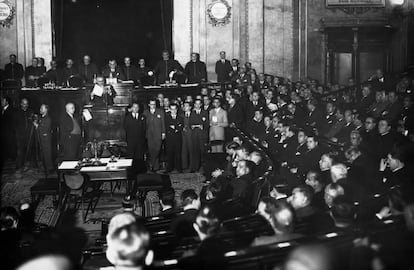
Teachers, lawyers and writers, coming from an enlightened class in most cases, but not in all, defenders in the flesh of the role that women were called to play in a Spain that was trying to take the step into the 20th century and modernize. Some of the names of those nine pioneers, who were political representatives in the Cortes in the 1930s, have gone down in history, but those of others have been relegated; Its history, in any case, has not lost its validity.
The articles and profiles written by Margarita Nelken and collected in Life and women. Articles 1916-1931 (Notebooks of fundamental work, Banco Santander Foundation) and the book Republicans. Revolution, war and exile of nine deputies (Tusquets), by Miguel Ángel Villena, reconstruct the history of the women’s cause in Spain in the 20th century and its public dimension. Villena offers a choral portrait of the nine Spanish women who occupied a seat between 1931 and 1939: Julia Álvarez Resano (1903-1948), Francisca Bohigas (1893-1973), Clara Campoamor (1888-1972), Veneranda García Manzano (1893-1992), Dolores Ibárruri (1895-1989), Victoria Kent (1898-1987), María Lejárraga (1874-1974), Margarita Nelken (1885-1968) and Matilde de la Torre (1884-1946). Precisely the remains of the latter will arrive, as was her wish, this Saturday, March 21, to her hometown, Cabezón de la Sal (Cantabria), from Mexico, where she died in 1946.
“These women were at the forefront, but the book is about an entire generation,” explains the author in a telephone conversation, who continues with this book his investigation into great figures of recent Spanish history after Victoria Kent, a republican passion (Debate, 2007) and Citizen Azaña (Peninsula, 2010). Thus, in this book – which brings together the biographies of the nine republican parliamentarians, all of them from the political arc of the left except one, Francisca Bohigas, the only one who did not go into exile – those of other women such as Constancia de la Mora, María de Maeztu, Zenobia Camprubí, Federica Montseny, María Cambrils, Isabel Oyarzábal or María Teresa León, among others, are intertwined. “They forged friendships, complicities or rivalries in a period in which they revolutionized not only the situation of women, but that of the entire country,” writes Villena. The celebration, promoted by the Ministry of Culture, throughout 2026 and early 2027 of the centenary of the creation of the Lyceum Club Femenino of Madrid will delve into the history of that center and the relationships that arose there, closely linked to the entry of women into politics.
Republicans It deals with the theoretical work on feminism that María Lejárraga and Margarita Nelken undertook in their writings, years before the advent of the new regime of 1931, to the problems that these women faced in an overwhelmingly male political space, without forgetting the divisions that existed between them due to their position regarding the approval of the female vote. The Nelken texts, now edited and prefaced by Alejandra Rodríguez Parragués, include interviews and profiles of women Carmen Baroja or Margarita Xirgu, as well as their reflections on feminism or women and war. “The greatest danger of feminism is that its triumph can be confused with the sole achievement of political rights,” she writes.
“They had to endure structural machismo, insults and humiliation, even from progressive men like Azaña, who was a notable misogynist,” Villena emphasizes about the female deputies. “There were confrontations between them, but the political and ideological rivalries have been greatly exaggerated. Not all of them were friends but they respected each other. There was what today we would call ‘sisterhood.’
Membership in political parties shortly before the proclamation of the Republic or immediately after brought Campoamor, Kent, Lejárraga and Nelken, belonging to a cultural elite, closer to the Cortes. In other regions such as Cantabria in the case of Matilde de la Torre, Navarra in that of Julia Álvarez Resano or Asturias in that of Veneranda García Manzano, her promotion came through the territorial organizations of the PSOE. The Radical Socialist Party included Victoria Kent in its first lists, the PSOE included Margarita Nelken and the Radical Party included Clara Campoamor. All of them were elected, in Cortes that had 470 deputies, and Campoamor would become part of the constitutional commission, the only woman to date who has participated in the drafting of a Magna Carta. In the 1933 elections, in which women had the right to vote, the defender of women’s suffrage Clara Campoamor and her opponent, Victoria Kent, were left out of the chamber, but Nelken did continue and she was joined by Lejárraga, De la Torre, García Manzano and Francisca Bohigas, the latter on the CEDA lists. Neither the latter nor Lejárraga nor García Manzano managed to renew their seats in February 1936. Kent, Ibárruri, De la Torre and Álvarez Resano did achieve a seat.
The coup of July 18 and the civil strife took them to different places, from the front to exile. “During the Republic and the war, they all had great public exposure, but what happened to them afterwards is something little known. They had different trajectories, some very harsh exiles, and only three survived Franco,” recalls Villena, who in addition to consulting the bibliography on this topic—among which he highlights a work by María Dolores Pelayo from 2006—has interviewed descendants of Ibárruri, Kent and Lejárraga. The story that Villena has composed opens the focus and includes the personal history of these women: from the marriage of Julia Álvarez Resano with the also representative Amancio Muñoz Zafra, the decision of Margarita Nelken to be a single mother defying conventions or the homosexuality of Clara Campoamor and Victoria Kent. “Their time in politics took its toll on all of them. In the eight years of the Republic they really turned around a poor country with a high illiteracy rate. The change reached many layers of society and was cut short by the war,” concludes Villena.