
Before being Picasso, pioneer of cubism, decisive figure in 20th century art and confessed atheist, Pablo Ruiz (1881-1973) was a child educated in a deeply Catholic environment. That cultural baggage, internalized since childhood, never left him. The Bible was often a source of inspiration to express his personal and earthly vision of the world. Although in adulthood the artist from Malaga rebelled against religion, his paintings, drawings and sculptures maintained a constant dialogue with tradition, taking his art beyond the limits of his time. This shows it Picasso. Biblical Rootsan exhibition that brings together 44 works by the author in the Cathedral of Burgos, the same one he visited in August 1934 on what would be his last trip to Spain. More than ninety years later, he returns to that temple in an exhibition focused on the religious influence on his work.
Nothing in Picasso’s art “is pure”, on the contrary, “it is very hybrid”, says the curator, Paloma Alarcó, chief curator of Modern Painting at the Thyssen-Bornemisza National Museum. Even so, Alarcó knew that the title “would be paradoxical for many.” “The exhibition — which includes paintings, drawings and sculptures — does not intend to talk about religious art in Picasso,” he explains, but instead proposes a journey through six chapters that show the presence of Christian iconography in his work.
The exhibition, inaugurated this Monday by Queen Sofia, opens with the episode Educationwhen Picasso was 15 years old and learning from the painter of sacred subjects José Garnelo Alda, whose teachings fueled some of the works of his early career. One of those paintings is The altar boy (1896), a boy dressed in a cassock and surplice during a Catholic liturgy. Later, as the decades passed, religious symbols would remain in his work. “These images are reinterpreted by the artist to create his own narratives in a profane modern setting, sometimes for biographical purposes, other times simply experimental, or to pronounce certain aspects of history,” says Alarcó.
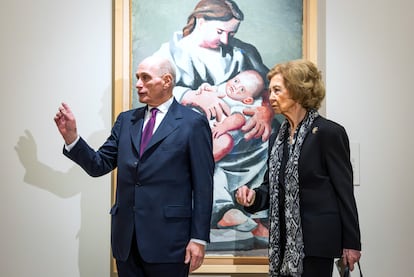
The episode Maternity It is the second title in the Valentín Palencia Room. When his son was born, the painter embarked on a dynamic of representing the mother. His wife, Olga Khokhlova, often posed in portraits in which she appeared as a timeless Virgin with the child in her arms. “That was Picasso’s way of expressing love,” says the grandson of the painter Bernard Ruiz Picasso, in front of the painting. Maternity (1921). The painting is reminiscent of classic representations of the Virgin with Jesus, where Mary appears seated—front or slightly inclined—with the child on her lap. In this case, it is Bernard’s grandmother holding his newborn father in a moment of quiet tenderness.
But life is a transition and “as the world becomes more dramatic,” Alarcó points out, “the skull begins to take on much more importance” in the work of the man from Malaga. In Vanity Still life is addressed, the artist’s main field to reflect on the tension between reality and representation: “Here the skull appears as a symbol of death,” explains the executive advisor of the Picasso Museum Málaga. in the box Still life with skull and three hedgehogs (1947), Picasso takes up the traditional memento mori from an insolently modern perspective and with cubist language: on the table rests a container with three sea urchins and a spectral skull, a metaphor for the passage of time and the fear of death, which has always obsessed him. The question is whether hedgehogs could hide Christian resonances, as a symbol of Christ’s crown of thorns, as some historians suggest.
After remembering the imminent death, the “most violent” room arrives, according to Alarcó. Golgotha (in Aramaic: place of the skull). It refers to the hill outside Jerusalem where Jesus Christ was crucified according to the Gospels. “Many crucifixions have a skull at the feet, a symbology that is used in moments of personal pain,” recalls the commissioner. In the case of the painter, it happens when Carles Casagemas, a close friend of his, commits suicide and paints three or four dead portraits of him like a bloody Christ: in “tremendously dramatic” scenes, inspired by the work Crucifixion by the German Renaissance painter Matthias Grünewald. “Many authors,” with whom Alarcó agrees, “speak that this moment is leading him to the imaginary that he will capture in Guernica”.
Guernica It is a painting full of “religious iconography,” Alarcó points out as he stops in front of Mother with dead child (1937), which concentrates the suffering of the Compassionwhere a mother suffers from the death of a son. “This version of the environment Guernica —with the same dramatic gray colors that he uses in the famous work—, is like the antithesis of the Maternity“. The latter “shows us the love, the tenderness of the mother with the child” and “this is the drama, the tragedy of war.” Alarcó also highlights the timelessness of the artist: “We are seeing this today in the newspapers.” For Picasso, the most terrible victims in war “are women and children.”
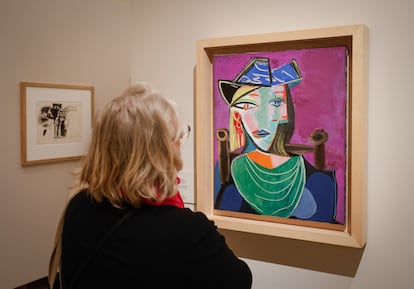
He also painted faces obsessively, especially in his later years. That’s why “a portrait room had to be built,” says Alarcó. Vera Icon brings together the paintings where the sitter disappears due to that geometric plot of cubism. head of a man (1971)—painted in the last years of the man from Malaga—summarizes that style. The artist abandoned traditional expectations of representation, reconfiguring, fragmenting and masking their faces. Like that cloth with which Veronica wiped Christ’s face, portraying became a replica of someone to replace a loss.
The final room is dedicated to the “most political” era. In 1942 and 1943, in the midst of the occupation of Paris by the Nazi army, Picasso began to think about an image that “could provide an idea of salvation in Europe at war,” says Alarcó. He created a series of drawings of a man with a lamb in his arms, as an allegory of peace evoking the image of the Christian “good shepherd”, which he would later model in plaster into a monumental sculpture and then in molten metal. The exhibition also features a series of doves created during the same period, which allude to the story of Noah and a new beginning. One of them, The Pigeon in Flight It was the poster design for the different Peace Congresses held at that time.
“It is true that there is a contradiction between his life, his practice and his way of thinking,” the curator reflects about the artist. “I think he had spiritual concerns, not necessarily religious ones.” It could be stated that the great paradox of Picasso is that he was a very pious atheist crossed by the sacred. And the contradictions, rather than resolving them, he turned them into art. Just entering the room of this world heritage site where the exhibition is on display (until June 29) you can read one of Picasso’s phrases—as if it had been justified since 1923—: “Art is a lie that reveals the truth to us.”