
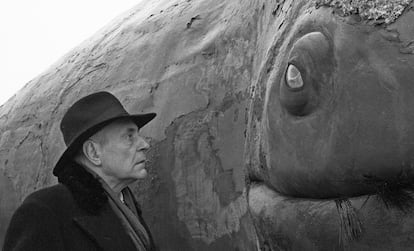
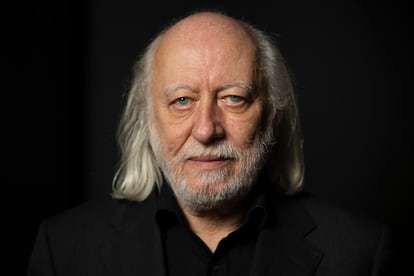
Hailed by the Nobel Prize in Literature and by the locks of white hair that – together with the gray beard and eyes of a blue so pure that they hurt – give him the appearance of an apostle or prophet, the Hungarian writer László Krasznahorkai (Gyula, 72 years old) receives in the bar of the Alma hotel after having had the day before an unusual, for an author as refined and demanding as him, a crowd bath at the Culture Center Contemporary of Barcelona (CCCB). The author of satanic tango y Melancholy of resistance, Dressed completely in black and surprisingly tanned, he is in an excellent mood and appears approachable and affable, although he becomes dark when talking about the political situation in his country. Put a copy of your book on the table Preliminary work for a palace (not yet translated into Spanish), starring a bookseller of Melville’s namesake, serves to start the conversation by recovering a discussion held in 2024 in Marrakesh in the Formentor Literary Conversations about the meaning of the whale that appears in Melancholy of resistance.
Ask. He then denied up to three times that the whale was a symbol of anything, not even Moby Dickneither of Stalinism, nor of greed, nor of chaos…
Answer. And I keep saying it, in my work nothing is symbolic, I don’t like symbols in literature, nor parables, although I have a weakness for French symbolist poetry. To that book, Preliminary workI have a lot of appreciation for it because it features Melville, Malcolm Lowry, who is one of my favorite authors, and the innovative and visionary American experimental architect Lebbeus Woods. Lebeo is a biblical name, by the way.
P. Ask him then if literature is a tango with the devil…
R. It is for the characters of satanic tango. There are happier dances like flamenco, although it is also about passion and the devil is also present, you can feel the influence of the devil in flamenco. But in my novel, the tango is simply the dance they do there while waiting for a miracle. It is that and nothing more.
P. Is it just realism then?
R. Realism is a word associated with a time, it is not what I do. What is realism? The truth is that there is not exactly such a thing, if you think that even in something as objective as a car accident, witnesses will give different versions. When you talk about romantic or emotional relationships like I do, you can’t say what’s real and what’s not. You cannot present a situation from a correct point of view: what would it be? In fact, it is a radical change in the concept of reality, indeed, the disappearance of reality.
P. What are you trying to tell the reader? There are those who are somewhat disconcerted by his books.
R. First, I try to convince them not to read me, and I mean it, honestly. I don’t offer hope, although I don’t take it away either. Mine are not recipe books, obviously. You can’t cook a good meal with them. They are like a paella I made once. It went wrong, I had all the paella ingredients, but the whole thing didn’t work, it even felt terrible to me. But if someone, despite everything, decides to read my books, I advise them not to believe anything that has been said about them. The fact that they are difficult to read. It’s true that I use unusually long sentences (in fact only one in 400 pages in the last one, Herst 07769which will be published by Acantilado, about a character who wants to warn Angela Merkel of the end of the world while working as a graffiti cleaner for an amateur neo-Nazi orchestra conductor). It’s like when you keep a secret for a long time and suddenly you let it out: how I love you Lucía and I will always love you, and all the avalanche that follows; You can’t say it in short sentences. It makes the use of the period impossible, which I usually write from that passion for counting. Anyway, it occurs to me now: is all this of interest to anyone? Who is interested in how a book was made? We would be surprised if Samuel Beckett explained how it came about. Waiting for Godot. I don’t think I had an idea, it came out like that. Honestly, I can’t say more. I have something in my head, I compose it and write. And if the reader has a bad day, they buy the book.
P. Said like this…
R. The important thing is that the reader recognizes himself. How fragile your own dignity is. Let him realize that this dignity is the last thing that can be taken away from him, but it can be taken away. That’s where my friend Béla Tarr and I were different. He believed that a person could not be stripped of their dignity.
P. Do you feel an affinity with the Hungarian world?
R. Hungary… I was born Hungarian, my mother tongue is Hungarian. Hungary, I fight against it as much as possible. Why change being a citizen of the world for being only Hungarian. My relationship with being Hungarian is like the one you have with a stone on the riverbank. We don’t know why this is so. Why wasn’t I born Albanian or Slovak. Far be it from me to ideologize the fact of being from any nation, from Hungary specifically. There are always rises of populism, people who are proud of being Hungarian, of the homeland. Am I proud of the chair I’m sitting in? It is very damaging how people talk about the country in relation to reality. The provenance doesn’t have much to do with anything. Certainly, they hate those who speak like me. I like the Hungarian language, I feel very lucky that my mother tongue is one capable of expressing very fine nuances. But I equally respect other languages and understand that they are cared for, like the Catalan language, in which I have an editor.
P. I understand that it is not very hussars, Esterházys, Abadys, the sabers…
A. (Laughs heartily) You can only laugh at all that. That is, until his supporters catch up with you on the street and beat you up. You ask me about the hussars, the country, and I talk about language constantly. It’s not a coincidence. My Hungary is that of language and not that of hussars. I have distanced myself so much from the Hungarian world, from that concept of Hungarianness infected with stupidity. Horrible things happen in all States exposed to populism, but nothing equal in intensity and brutality to what happens in Hungary. That ability to manipulate, a source of infection. Hungary is no longer a country, it is a madhouse from which the doctors have already left and where the sick play at being doctors on Mondays, Wednesdays and Fridays.
P. With History in hand, Hungary always seems to make mistakes at decisive moments. The Treaty of Trianon has weighed heavily.
A. He always makes mistakes at historical crossroads, he always chooses the wrong path. When I said in an interview that I did not understand that Hungarians are always very proud of their battles, which they always lose, the extreme right attacked me. There’s no point in arguing. Even people who seem very intelligent are prey to ideology. All of this returns us to the animal world, when what we would like is to elevate ourselves as people. It is not about accepting or rejecting traditions; There are few people more conservative than me in accepting them from an intellectual point of view. But, as a Hungarian saying goes, we grind in two very different mills and bread will never come from their flour. And that has built a sick society, those psychological wounds that could be tried to heal in a different way.
P. In your literature, despite your having Jewish roots, the Shoah, the Holocaust, does not appear.
R. It is present. Anti-Semitism, racism, criminal stupidity… they are in my books, in Melancholy of resistancein satanic tango…Petit-bourgeois Nazism…
P. But not explicitly.
R. I have not written specifically about the Shoah because Imre Kertész (his Hungarian predecessor in the Nobel Prize for Literature, in 2002), who was a very good friend of mine, already did. I couldn’t write about it better. And it is very dangerous to do so, there are so many kitsch works about the Shoah…
P. What was it like to win the Nobel Prize?
R. Very unexpected for me. I do not belong to the group of those who are in front of the screen on the first Thursday in October watching the image of a closed door and waiting for it to open and a name to be announced. It was very difficult to take in being placed alongside so many names you admire, Faulkner! I still don’t know what to do with the Krasznahorkai that has the Nobel. It is something that elevates you to a height where there is no oxygen, and my lungs need it, it is a great honor for me. It has been brave to choose me, because I have always told a story of failures in my books.
P. Has Béla Tarr’s cinema influenced the reading of his work? Has your wallet been stolen in any way?
R. No, no, Béla never took anything from me, I gave him everything. Look, a book is a book, a novel is a novel, Béla and I worked together, we decided everything together. I helped him with everything he needed. I even convinced him to take things he didn’t want to use. But on a ship there is a captain and the others. Many writers tolerate this poorly, so they don’t go into cinematography. Cinema has very cruel laws, and they are necessary.
P. Kafka and Malcolm Lowry are special to you.
A. There are many writers that I admire, those are not the only ones by any means, but it is true that without Kafka, without the castleI wouldn’t be a writer. And I also owe a lot to Lowry. It’s not that you have to choose. I encourage everyone to open up and read more authors. A world is coming, if we continue like this, in which individual survival strategies are going to play a definitive role.
P. In some ways, you are also a K.
R. Jajaja, an LK
P. Allow me to be frivolous, do you know that other Lászlo, Almásy, the real Hungarian explorer and the one in the novel and the movie?
A. Yes, although it is better known outside of Hungary. A very special and very colorful type. It would be worth it if Hungarians knew him more, but I’m afraid it wouldn’t help either.