
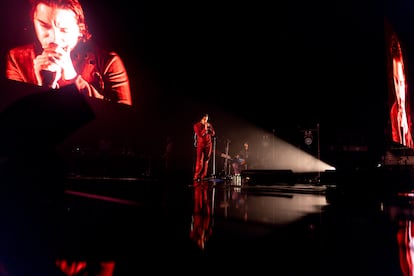
Ralphie Choo opened his concert at the Movistar Arena as if he were going to present a work from the 19th century. No explosions, no giant screens, no pre-recorded bases blaring from the first second. On stage, a band that seemed to have been rescued from an old music room: flute, marimba, piano and an electric violin, along with several electronic synthesizers. As if they had just emerged from a baroque painting, little by little they introduced some bass drums that migrated towards a club session.
The contrast was evident: thousands of twenty-somethings waiting for one of the most restless names of the new national pop and the thing began with an overture worthy of Chopin. Or Ravel. Or any composer who never imagined that, a century and a half later, his spirit would end up mixed with reggaeton and trap. Because that is Supernova (2023), the first (and so far only) album by Juan Casado Fisac (Madrid, 27 years old): an explosion where melodic pop, urban music, techno, reggaeton, rumba and harmonies that are reminiscent of musical Romanticism coexist. The surprising thing is that this mix doesn’t sound forced. In the hands of the Madrid native, the academic and the street flirt as if they had always been best friends.
Ralphie arrived with a small disadvantage: the date of February 20 at the Movistar Arena makes his debut album too old, and with only four new singles. Pop logic indicates that this type of venue is filled with a new album under its belt, and he himself acknowledged it shortly before the final stretch: his idea was to present his next work here, but his perfectionism has delayed it and it is not yet ready.
Still, he left several clues. There were three unreleased songs: one of them with a bachata aroma passed through an almost digital filter; another, a ballad that sounded like Frank Sinatra with autotune; and a last one close to “malianteo” (rawer reggaeton with a forceful percussive base), with which he played to purposely displace the tempo, as if the song were being broken and recomposed in real time. Furthermore, in a piano interlude, a pink label appeared on a blue background: Charmainewhich seems to be the title of that album that hasn’t arrived on time. In French it means elegant, and some of that seems to hint at the new sonic direction. There is much more restraint in the arrangements, less exuberant than on Supernova, and, in addition, Ralphie sang several of the unreleased songs in French and English with surprising ease. Since his collaboration with Rosalía and the international reviews that he and his entourage have received in media such as Pitchfork, his projection no longer seems exclusively national. Seen this way, this loose date seems like a lesser evil.
Fisac is part of Russia IDK, the collective that has redefined the new Spanish alternative pop. They are experts on the internet: they handle memes, double meanings and generational humor. Their networks are full of references that any twenty-something understands instantly and that would be indecipherable for someone who does not inhabit that digital ecosystem. And yet, in his live shows he plays just the opposite: the figure of the enigmatic, almost anonymous author, as if he were an idol from a time before constant overexposure. Ralphie could have turned the Movistar Arena into an infinite screen, replicating the visual bombardment that his teammate Rusowsky did (who stepped on the same stage on September 25), but he opted for containment. Just a disco ball, sober lights and a band as the absolute center of the show. He prefers to maintain that aura of mystery, as if he still had some tricks up his sleeve.
The artist opened the concert with Pirri taking exaggeratedly long steps that did not end up moving forward. As if he wanted to cross the stage in two strides, but stayed in the same place. He walked with that charming clumsiness of a child who imitates adults: he jumped, stuck out his tongue, moved his hands with adolescent nerve. However, the pressure was visible in his eyes. It may be that the venue was too big for him (a Movistar Arena without a new record to present); It may be that we are facing one of the best composers of his generation, although he is not yet an overflowing performer; Or maybe that slightly geeky, somewhat uncomfortable aura is part of the mystery that builds his character. At times he engaged in real battles with his headphones, and although his voice was lost in the mix in some passages, perhaps this gesture was due more to his stage fright than to a technical problem.
Thus, that “surprise effect” that all the artists who fill that venue think they must have was not even in the guests (who are always the same in the collective’s concerts): Mori appeared to sing WCID?; and Rusowsky came out on a couple of occasions to interpret Gata, Dolores y Valentino Rossi.
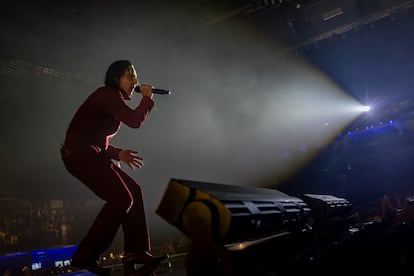
Despite the avant-garde spirit of the project, the first great emotional connection came with D’amor traffickerin the middle of the concert. Acoustic guitar, perfectly recognizable verse and chorus structure, clear melody without harmonic shocks. That is, a song that responds to the classic rules of pop. The scene was repeated with ROOKIEa song that features, along with Drummie (who accompanies him as a flutist), Barry B, a friend and former roommate, who orbits emotionally around Russia IDK but does not participate in the most experimental component of the collective. There is something slightly contradictory about all of this. What defines Ralphie Choo (that irreverent and avant-garde spirit) is precisely what has made him a singular figure within new pop. However, in a large-format venue, the most evident moment of communion came with their most standardized repertoire, the closest to a recognizable pop logic.
Therefore, the high point of the night came when the concert turned towards its more urban aspect. I go with everything y Big ass machine They lit up the venue through a dry bass drum, a powerful bass and less contemplative lyrics. The crowd went from rocking to pushing in a matter of seconds. Choo swings from Romantic to sexy to dirty in less than a minute. It appeals to modern people who consider their taste a very refined thing and also to the dogs who have gone there to twerk. And none of them feel like they are out of place.
Valentino closed the evening, as tradition dictates at Russian IDK concerts. And it’s not a coincidence. Valentino It is, in essence, the collective’s manifesto: machine music, strident bass drum, distorted voice… and, underneath it all, an elegant piano that reminds us that there is classical training here. What began as a nineteenth-century tribute with flute and marimba ended in a collective pogo dancing techno. From Chopin to sweat in an hour and a half.
Maybe that’s the key to why these guys lead the new national pop. Not only do they mix styles, but they belong to a generation that no longer believes in that thing that a few years ago was called an urban tribe. The same kid can be dressed in a modern outfit and twerk without irony five minutes later, and when they say they “listen to everything,” this time it’s true. That generation that many call lost has been able to break down many walls related to cultural hierarchies. Right now, it doesn’t even make sense to talk about a mix: that mix is already so integrated into the language of pop itself that it is the definition of current pop in itself. What was once avant-garde is now the norm. And Ralphie Choo, with all those contradictions, understands it better than anyone.