
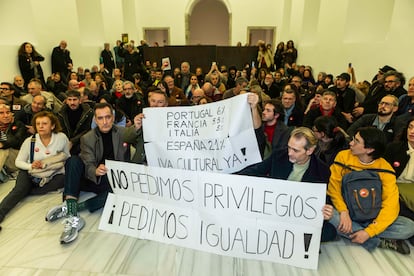
In the room dedicated to Richard Serra at the Reina Sofía Museum, more than a hundred artists, gallery owners and collectors sit on the floor surrounded by Equal-Parallel/Guernica-Benghazi, replica of the piece that vanished from warehouses without a trace: four forgotten 38-ton steel blocks. “The sector is going to disappear just as this piece disappeared,” is heard during the event with which representatives of the visual arts once again demand a reduction in cultural VAT (21%).
The event they are starring in comes after the “silence of the Government” and the closing of galleries on February 2. While other sectors and nearby countries in Europe “enjoy” a reduced VAT. During the sit-in, they said the rates of some in unison: “Portugal, 6%. France, 5.5%. Italy, 5%.” Meanwhile, the art galleries of Spain continue to be “suffocated,” according to the Consortium of Gallery Owners, which has called this Friday for simultaneous mobilization in different museums in the country starting at six in the afternoon.
“They are killing us all,” is heard before heading to the courtroom. Guernica, after 10 minutes. The stickers on the protesters’ clothing that read: “Cultural VAT now,” go completely unnoticed by visitors to the Reina Sofía: “I don’t understand anything,” some exclaim in front of Picasso’s work. The indifference of those who walk through the rooms is not what weighs, but that of the Government, which has maintained the 21% since 2012 – decided by the then Minister of Finance, Cristóbal Montoro.
The sector has been raising its claim for years and only receives the “most absolute silence” from the Government. That is why they shout in front of the work considered the last exile of the Civil War: “Minister of Culture (Ernest Urtasun) resignation and Minister of Finance (María Jesús Montero) resignation.” So far, no administration, including the current one, has applied the 2022 European directive, according to which each Member State can apply reduced VAT rates (minimum 5%) to cultural goods and services. In this way, Italy applies 5%; France 5.5%; Germany 7%, and Portugal, 6%.

“We are not a luxury industry… We are culture,” they claim. The discomfort (or “suffocation”) of the visual arts sector due to unequal competition is not new, but it has intensified this afternoon. Inside the museum, the atmosphere oscillates between indignation and fatigue: “It’s not a market, it’s culture,” they insist. Outside, the city continues its usual rhythm. The question is whether this time the desperate cry will manage to break through the institutional walls or will be, once again, diluted a few weeks before the next edition of ARCO, which will celebrate its 45th edition.
Last year some gallery owners turned off the lights on their stands for a few minutes as a symbolic gesture. This year, the unknown is what will happen at the event that attracts a select list of international collectors, renowned gallery owners, established and emerging artists, and art professionals. Although it is impossible for the situation to change before the International Contemporary Art Fair of Spain that will be held from March 4 to 8, in which Spanish galleries are at a “clear disadvantage”, where the work of the same artist can be valued with a difference of up to 16%.
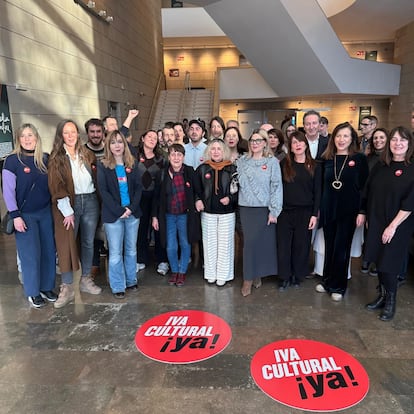
The argument is practical, not ideological. An example that has been mentioned – previously to this newspaper – is that if a Spanish gallery takes an artist to a fair in Paris and offers a work for 10,000 euros net, the 21% VAT increases the final price to 12,100. In France, with 5.5%, the same piece would cost 10,550. A difference of 1,550 euros that can decide a sale. “Anyone who understands that the sector cannot survive with 21% VAT when all the surrounding countries rate transactions between 5 and 8% “are welcome,” says Idoia Fernández, president of the Consortium of Contemporary Art Galleries of Spain.
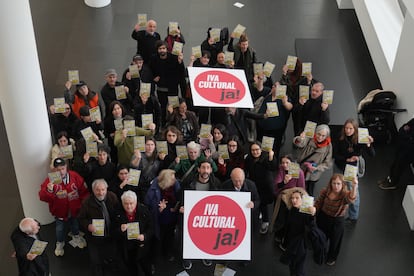
Almost level with the ground, they hold a banner that reads: “We do not ask for privileges, we ask for equality.” And from time to time they remember that “there are no museums without art, nor a country without heritage.” The rest of the protests also took place at the Andalusian Center for Contemporary Art (CAAC) in Seville (6:00 p.m.), the Valencian Institute of Modern Art (IVAM) and the Museum of Contemporary Art of Barcelona (MACBA) (both at 5:00 p.m.).
—Now where are we going? TO The meninas? one protester asked as he rose from the ground.