
On October 29, 2022, a player from rugby and British media celebrity, Levi Davis, 24, disappeared in Barcelona without a trace. He was last seen at The Old Irish Pub, an Irish bar at the bottom of Las Ramblas, near the port, where his documentation was later found. It was suspected that he had drowned, although searching the seabed was unsuccessful. His disappearance remains shrouded in mystery.
The writer Carlos Zanón (Barcelona, 59 years old) is now sitting in The Old Irish Pub with a pint of beer and a portion of nachos. Around, among the dark wood and under the mirror ball, young tourists mill around turnipsdrinking more beers, watching the football green on the screens, listening to the musician belting out great rock hits from the back of the venue. Taking as a starting point the case of Levi Davis—who, who knows, perhaps occupied this same table during his last night—Zanón has written his new novel, Lost objects (Salamandra), about people who are lost, people who are lost and people who search and are sought, and who, only sometimes, are found.
“In this novel I want to point out that we are all two bad decisions away from ending up on the fucking street: divorces, illnesses, family problems… We are closer to the street than to being Amancio Ortega,” says Zanón while taking a quick look at the game. The text, which has a striking style that the writer attributes to his youthful time in the ranks of punk, is dark and disturbing and travels through the underworld of Barcelona, where mafias, drugs and prostitution intertwine, in the Donna Summer club – run by a king of the underworld called Señor Paco -, in the urban peripheries or in the Excalibur hotel, where the protagonist survives poorly, seeing his life from a strange distance. The non-places where loneliness happens.
The protagonist, Álex Gual, is a lawyer who is dedicated to searching for lost people (specifically Andy Cox, a transcript of the real player who disappeared in the port), but who is not allowed to miss the Fat Boy he was in the past and who speaks to him as another character who lives inside his skull. “No matter how far you go in life, we are all the children we were… and you are still afraid of being caught. I was a fat child: now if they tell me that something I have written is okay, I still feel that same insecurity,” says the author.
Zanón—and the boy he was—now dedicate themselves to crime novels, a genre to which his past as a criminal lawyer contributes, a job that, by the way, he carried out almost by chance. Or, rather, for love.
—I wanted to write, so I enrolled in Journalism. But that summer I met a girl who was studying Law… and I switched. That is the vocation I had.
—And what happened to the girl?
—That I married her.
Writing began very young, publishing poetry from the age of 22 (The taste of your drunk mouthin Nínfula editions, is 1989), although it took him a couple of decades to get his novels published (among which are Taxi o I was Johnny Thunders). They are so black that he is currently the director of the BCNegra festival, which celebrates the genre in the city every year. Why so black? “I am very fascinated by people who build very brutal bonds in very dodgy circumstances. It amazes me that sometimes character is the destiny of people, that your way of being, wherever you are born, determines your future,” says Zanón. In his career as a criminal lawyer he treated many of those people who live in the immediate present, who wake up with 10 euros in their pocket and manage to get through the day, and so on, without foresight, over and over again, but always with the irreducible hope that one day something will happen that will make them break out of the cycle and change their lives.
If the novel has darkness and unease, perhaps it is because it arises in dark and unsettling circumstances. Around 2020, in addition to a global pandemic, Zanón suffers a series of calamities: his father dies, he gets divorced and, during a routine check-up, they detect lymphoma. “I was in such a mess that the first thing I thought was: ‘Damn, it’s all over.’ I was tired of living, I wanted to disappear,” he says. What is scary about this disease is its silence: the writer had no symptoms, only a slight anemia in the analysis paper.
They caught him in time: he overcame the cancer thanks to chemotherapy. “My veins were burned, they no longer knew where to click,” he recalls. And he also regained motivation for the little things: he wanted to attend his son’s 25th birthday, listen to Bon Iver’s new album. In the end, they are the everyday issues that make us live every day, even if everything is going to disappear at some point, or at the least expected moment. Perhaps the same little things that make street dwellers and their underworld continue to live, despite adversity. The protagonists of Zanon.
The dark Barcelona
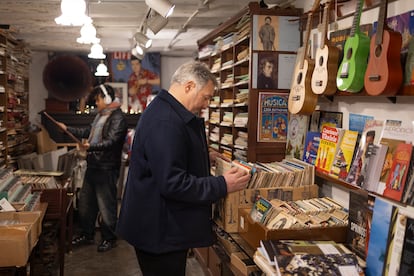
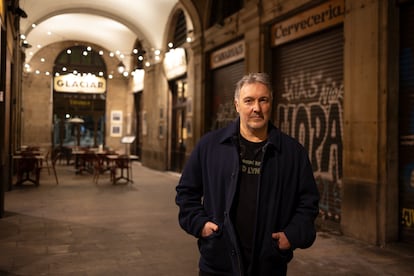
It’s nightfall over Barcelona and Carlos Zanón is now walking along Las Ramblas and visiting other places that appear in his novel, such as Plaza Reial or, in that square, Café Glaciar. We stopped, for example, at Casa Beethoven, a long-standing sheet music and music book store founded in 1880. The writer’s relationship with music is also old (although not that old): he was part of the band Alicia Golpea and, despite the aforementioned punk offshoots, his first book on music was about the angelic Bee Gees. A versatile man. Then came others, like the one about Willy DeVille or his participation in another about politics in music: Political world. Rebellion from the guitars (66 rpm editions).
“I was a withdrawn kid: I listened to the radio a lot and waited for the announcer to say the titles of the songs and, from there, compose a poem. That’s how I started writing,” he says. Then came punk, which imploded him more inside than outside: he was fascinated by the idea that the important thing was not just to say things, but to transmit emotion, and those strange people who barely knew how to play, but they played anyway. “My prose is inherited from punk,” he says. And is the right the new punk, as they say so much now? “I don’t think The Clash has anything to do with Taburete… With this they have stolen our wallet, and we have to steal it from them.”
Gothic and modernist, bourgeois and revolutionary Barcelona is fading away in the global magma of hyper-touristized and gentrified cities, between colorful plastic junk stores and torrents of young people homogenized by Instagram in search of the same specialty coffee. Barcelona, the city, is another of Zanón’s obsessions (see the travel book Barcelonapublished by Tintablanca in 2020, his participation in the compilation black Barcelonapublished by Siruela in 2016 and, finally, the rest of his work, crossed by this city).
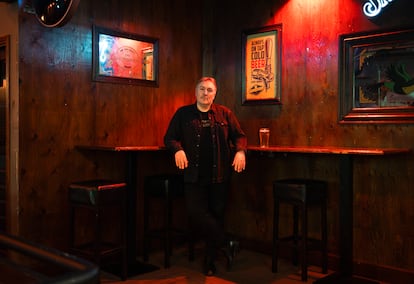
For Zanón, a city, beyond its streets, infrastructure, macro events or stories, is the people who inhabit it at all times, and those people are the ones who star in his work, the ones who collide with each other in the corners of the city trying to get ahead. “I’ve always liked artificial things more than natural things. That someone has created an Irish pub like the one we’ve been to before impresses and excites me more than a redwood tree,” he says.
In the current urban crisis, with the homogenization, the emptying, the destruction of the neighborhood fabric… will it be possible in the future to place fictions in cities? “I believe that novels are moving to the periphery, along the lines of Javier Pérez Andújar, Kiko Amat or Miqui Otero. We look at the center from the neighborhoods, but it is no longer done like Vázquez Montalbán, who located the novel in El Raval. Cities become theme parks in which nothing happens that lasts. At most, a tourist drinks a lot and gets robbed,” adds Zanón, while getting lost, again towards the port area, where people sometimes disappear.