
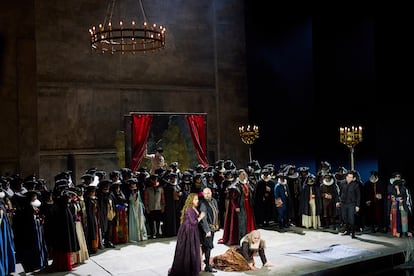
The composer’s fortune Amilcare Ponchielli he usually limits himself to his opera The Mona Lisa (1876) or, more specifically, to his popular Dance of the hoursthe only ballet from an Italian opera that has found a place in the popular repertoire. As a concert piece it already fascinated at the Paris World’s Fair, two years after its premiere, and was enshrined in the film Fancyby Walt Disney, with that endearing sequence of hippos dressed in tutus.
But The Mona Lisa is, above all, a great operatic spectacle that combines the tradition of melodrama Italian with the demands of the grand opera French. A title located after Aidaby Verdi, and prior to the emergence of verismo and Puccini. It is based on Angelo, tyrant of Paduaof Victor Hugowhich Arrigo Boito He moved, in his complex libretto, to 17th century Venice. And it requires six great leading voices, massive choral scenes, a spectacular historical setting, an abundance of contrasts and a central ballet.
Perhaps for this reason it is a frequent title on the stage of the Liceu in Barcelona, where it has already exceeded 150 performances since 1883. In recent decades it could be seen in 2005 and 2019, with a staging by Pier Luigi Pizzi designed for the Arena di Verona, and now it returns in a new production by Romain Gilbert, co-produced with Napoles, where it premiered two years ago. This young and rising manager French combines musical sensitivity with an aesthetic respectful of the libretto and the original setting, to which he adds a particular emphasis on plastic beauty.
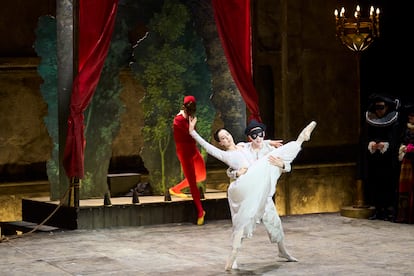
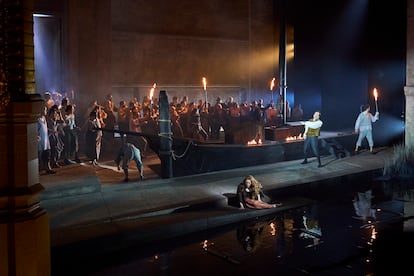
His main success to date has been the modern recreation of the original production of Carmenby Bizetpremiered in 1875, which he made three years ago in Rouen. Your proposal in The Mona Lisa maintains Vincent Chaillet’s choreography, which is ideally integrated with the dramaturgy by converting the Dance of the hours in a nod to the comedy del arte starring Columbine, Harlequín and Pantalón. It also has the historicist and meticulous costumes of Christian Lacroix and adds the scenery of Etienne Pluss, which focuses on an oppressive and dark Venice – with the help of the lighting of Valerio Tiberi -, without hiding the dirt of the mud and progressively degrading as the plot progresses.
Gilbert masters the elements of the stage action with ease, which is quite understandable despite the intricate nature of the libretto. La Gioconda, a street singer, loves the outlaw Enzo Grimaldi, who in turn loves Laura Adorno, wife of the inquisitor Alvise Badoèro. The street singer will help Laura – who has previously saved her mother, La Cieca – but also Enzo; He achieves this by agreeing to hand over his body to the evil spy Barnaba, although he commits suicide just before.
The stage direction proposes brilliant solutions and certain licenses for the end of each act: the burning of Enzo’s boat in the second; the catafalque that Alvise shows under the ground with his supposedly dead wife from the third; or, at the end, the ghost of La Cieca terrorizing Barnaba. But the production suffers in Barcelona from the same low level of directing actors that it already had in its premiere, with a cast full of stars such as Anna Netrebko, Ludovic Tézier and Jonas Kaufmann.
At the Liceu, the big winner of the opening night was the Spanish soprano Session Hernandezwhich debuted in this same theater in 2019 precisely giving life to the Venetian street singer. The Madrid native stood out for her confident vocal management of this difficult role, in which she was able to naturally integrate the lyrical and the dramatic, moving through spinto passages and coloraturas, although she was less convincing when it came to capturing the psychological evolution of the character. He especially stood out in the fourth act, where he received the biggest ovation of the night for the dramatic power of his great aria. Suicide! and kept all the freshness in the final duet with Barnaba, with a seductive nod to the flowery song belcantista.
The Italian baritone Gabriele Viviani chiseled the evil Barnaba with the same mortar as Iago in Otelloat the beginning of the season at the Teatro Real. With a precise and well-projected intonation, but with a monotonous singing and some tightness in the treble, which was evident in his monologue. The monument in the first act.
The other four protagonists debuted in their respective characters. Starting with the American tenor Michael Fabianowho burst in without authority in the first act with a lot of force and in the high register when defending La Cieca. He shone in the most lyrical passages, such as in his duet with Laura in the second act, but, despite handling the half voices well, he did not convince in his famous aria. Sky and seawhere the excess of tension in the rise to the treble marred the final part.
The mezzo-soprano Uzbek Ksenia Dudnikovawhich came from singing Eugene Onegin in Valencia, he composed an excellent Laura Adorno, with powerful vocal means, despite an Italian diction that could be improved. He stood out especially in the prayer of the second act, Stella del marinar.
The American Bass John Relyeawho returned to the Liceu after his Father Guardiano in The force of destiny Last season, he was a solid and resonant Alvise Badoèro at the start of the third act, although his singing was equally monotonous and hardly threatening.
On the other hand, the mezzo-soprano Lithuanian Violeta Urmana She now approaches, from maturity and with details of class in the vocal line, the character of La Cieca, after having played Laura Adorno at the beginning of her career and having recorded the character of La Gioconda (EMI/Warner Classics). The supporting roles were correct and the intervention of the Gran Teatre del Liceu Choir was solid, right from its initial appearance with Parties! Bread!and also in the second act, with those onomatopoeic effects that evoke the sea and to which the Cor Infantil de l’Orfeó Català joined.
From the pit, the Israeli director Daniel Oren asserted his credentials as a specialist in the melodrama Italian at the head of the Gran Teatre del Liceu Symphony Orchestra. It ensured a consistent orchestral flow and attentive accompaniment to the voices. However, preciousness and subtlety were lacking in a reading that at times advanced with a thick line. This is what happened in the famous ballet Dance of the hourswhere he deployed a stolen excessively mannered and prioritized sensationalism, while gesticulating with constant bombast. However, this new Mona Lisa del Liceu leaves an uneven but stimulating balance, with more lights than shadows.
‘The Mona Lisa’
Music de Amilcare Ponchielli. Libretto by Tobia Gorrio (pseudonym of Arrigo Boito) based on the drama by Victor Hugo, Angelo, tyrant of Padua.
Session Hernández, soprano (The Mona Lisa); Ksenia Dudnikova, mezzo-soprano (Laura Adorno); John Relyea, low (Alvise Badoèro); Violeta Urmana, mezzo-soprano (The Blind Woman); Michael Fabiano, tenor (Enzo Grimaldi); Gabriele Viviani, baritone (Barnaba); Guillem Batllori, low (Zuàne), Roberto Covatta, tenor (Hisopo).
Children’s Choir of the Catalan Orfeó.
Choir and Symphony Orchestra of the Gran Teatre del Liceu.
choir director: Pablo Assante.
Musical direction: Daniel Oren.
Stage direction: Romain Gilbert.
Gran Teatre del Liceu, February 17. Until March 2.