

Many more doubts than expected. The 76th edition of the Berlinale, which starts this Thursday, is the second directed by the American Tricia Tuttle, and her commitment to auteur cinema means that the Competition has become a matter of cinematographic faith. Not to say contradictory: Tuttle was hired to replace Carlo Chatrian and Mariette Rissenbeek, co-responsible for five highly authoritative and political editions (the Berlinale has always been a politicized event) and to give a more popular air to the festival. With the list in hand of the films that aspire to the Golden Bear, it does not seem that the direction has changed. If anything, it has intensified.
And it has intensified because the world has become radicalized. In 2025 Tuttle saw how pro-Palestinian demands appeared in the contest, when it was obvious that the programming was lame by showing only the Israeli side of suffering. In Germany, any mention of the Arab-Israeli conflict is obviously marked by the Holocaust. Even more so, after the presentation of his film QueerpanoramaHong Kong filmmaker Jun Li read some words in English sent by one of his actors, the Iranian Erfran Shekarriz, using the expression “From the river to the sea, Palestine will be free.” In it land of Berlin, a city-state in Germany, the first part of the phrase is considered by regional courts to constitute a crime, since it is understood that it denies the existence of the State of Israel. Li went to the police station, although in the end the investigation came to nothing.
And how has 2026 started? Where 2025 ended. In the first press conference, which involved the presentation of the jury led by Wim Wenders, the question that heated up the interventions was: can cinema change the world? Wenders argued: “Cinema takes you out of your universe to travel to another and that is beautiful. Yes, movies can change the world, but not in a political way. No film has really altered the idea of any politician, but it can change people’s idea of how they should live… Cinema has an incredible power to be compassionate and empathetic. The news is not, politics is not. But movies, yes.” The same person in charge of the Berlinale entered into that comfortable dialogue: “Cinema affects you, in the sense that it shows different and novel points of view, which broadens the public’s understanding.” To which the director of Paris, Texas y The sky over Berlin He concluded: “No matter how much you watch the news, you are not really informed. Suddenly you can see other aspects.”
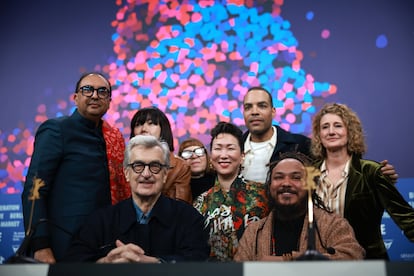
It all sounded nice, until the next question: the Berlinale has supported the Ukrainian people, even with an appearance at President Volodymyr Zelensky’s 2023 inauguration gala via video; has taken the side of the Iranian people all these years, and in this edition a public conversation was scheduled between two winners of the Golden Bear, the Persians Jafar Panahi (who in the midst of the Oscar campaign has been condemned in his country) and Mohammad Rasoulof (exiled since May 2024 in Hamburg), a talk postponed in solidarity with the Iranians. And then, where is the support for the Gazans? Along with Wenders, the rest of his fellow judges were shocked: the South Korean actress Bae Doona, the Polish producer Ewa Puszczyńska, the American director Reinaldo Marcus Green, the Nepalese filmmaker Min Bahadur Bham, the Japanese filmmaker Hikari and the Indian film restorer and historian Shivendra Singh Dungarpur. What’s more, the video signal was cut off (half an hour later, the organization apologized for the technical problems and posted the entire press conference on YouTube).

Puszczyńska immediately argued that the question was unfair. “Films are not political in your sense of the word. Asking this question is a bit unfair. We use the phrase ‘change the world’, but of course we try to talk to each viewer, make them believe that we cannot be responsible for the decision they make: the decision to support Israel or the decision to support Palestine.” And he defended himself: “There are many wars with genocides, and we don’t talk about that. It is a very complex question, and it is a bit unfair to ask us how we support our governments or not, because that is for politicians to decide.”
Wim Wenders came to support him: “We have to stay out of politics. We are the counterweight of politics, the opposite of politicians; we have to do the work of the people, not the work of politicians.” Once again, the Israeli-Palestinian conflict was badly negotiated.
Afghan romantic comedy
The contest starts with No Good Men, a film that plays, without finding its place, with the tones of rom-com (romantic comedy) and the harsh reality of the return of the Taliban to power in Afghanistan in February 2021. It is the third feature by Shahrbanoo Sadat, who although he was born in Tehran 35 years ago, is from an Afghan family and has lived in that country since his adolescence. The filmmaker spent the pandemic in Germany, returned to Afghanistan and was evacuated when the Taliban triumphed. She herself plays the only female television camera on an Afghan network. Tired of making boring entertainment programs, she sneaks into the news and triumphs by achieving what no man can: recording female confessions, taking risks for the perfect shot. There she begins a flirtation with the star journalist of Kabul News while she cannot get rid of her husband, a liability.
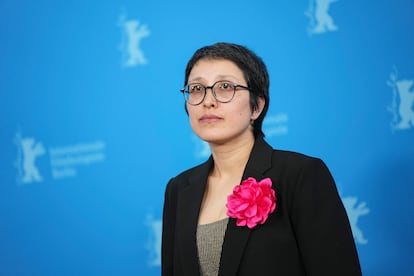
In her presentation to the press this Thursday afternoon, she noted: “My life is not a war drama every day. There is a lot of humor and a lot of comedy. And when I started the project, I was with my boyfriend, so I enjoyed a romance. Afghanistan is also like the rest of the world, so I decided: ‘I’m going to make a romantic comedy. What’s more, I’ve made one rom-com politics.” Regarding the title, Sadat – who has recreated Kabul in studios and locations in Hamburg – explained: “It is very, very difficult to be a good man in Afghan society. They all share the same mentality: women are animals, all the women in your family should fear you. In short, being a strong woman is not enough if the system does not support you.” However, she knows some good men: “That’s why I made a film that is a love letter to all of them.”
No Good Men does not compete for the Golden Bear, so it does not enter the very strange competitive section, with a better-known name such as that of the Hungarian Kornél Mundruczó, who after the success of Fragments of a woman —with which Vanessa Kirby earned an Oscar nomination—turns to Amy Adams for another turbulent drama about women and families in At The Sea. Or that of the Brazilian Karim Aïnouz, who usually films in English and who for Rosebush Pruning has recruited Callum Turner, Riley Keough, Jamie Bell, Elle Fanning and Elena Anaya to analyze the rot of a rich American family locked in a villa in Catalonia. It also has powerful names Queen At Sea, by the American Lance Hammer, in which Juliette Binoche and Tom Courtenay are a daughter and her stepfather who together face the dementia of the person they love most in the world: their mother and wife, respectively. However, the safe bet is Josephine, by Beth de Araújo, and which has just won at Sundance: it shows how a girl witnesses a rape and how that aggression affects her, especially in relation to her father (played by Channing Tatum).
Where will there be fame? In the Berlinale Special section, which is the catch-all where the contest includes series, films out of competition and special screenings. There Gore Verbinski presents the science-fiction comedy Good luck, have a good time and don’t diestarring Sam Rockwell, accompanied by Juno Temple and Zazie Beetz. EITHER The Weight, un wéstern con Ethan Hawke y Russell Crowe. O The Only Living Pickpocket in New York, with John Turturro and Steve Buscemi. That’s where the documentary comes in. The Ballad of Judas Priest, co-directed by Rage Against the Machine guitarist Tom Morello; and the satirical mockumentary The Moment, with British star Charli XCX as co-writer and star.

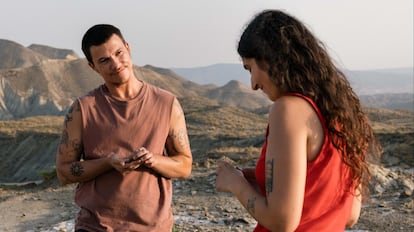
As for Spanish cinema or in Spanish, Tuttle’s selection team does not give much joy to this language, when it was usually a splendid competition with Latin American cinema. In Competition he is, alone, Flies, by the Mexican Fernando Eimbcke (Duck season, Club sandwich). In the Panorama section there will be Spanish cinema: Ian de la Rosa debuts in the feature with the superb Iván & Hadoum, a chronicle of an almost impossible love in the Almeria greenhouses. And in Berlinale Special Series, Ravalearby Pol Rodríguez and Isaki Lacuesta, illustrates, with a tone of thriller, how speculation crushes family businesses in the Barcelona neighborhood of Raval.