
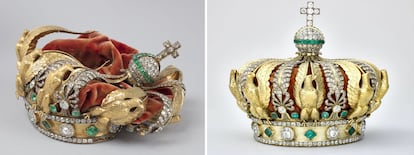
The Louvre Museum published yesterday, Thursday, the first photos of Empress Eugenie’s crown, since it suffered crushing damage and significant deformation during the “brutal” jewel theft of October 19, 2025. The images show that the piece preserved its “almost complete integrity”, which will allow its complete restoration, as the gallery itself announced on Wednesday.
It was, specifically, the main conclusion of the initial report prepared by the director and deputy director of the Louvre’s Decorative Arts department, Olivier Gabet and Anne Dion, the museum said in a statement, in which it details the damage suffered by the “iconic piece” that the thieves left behind in their escape with eight other jewels, whose whereabouts are still unknown.
The restoration of the crown of Empress Eugenie will be entrusted to an accredited conservator, following a tender process, in accordance with the Heritage Code, the Museum Law and the Public Procurement Code, the largest and most visited museum in the world specified in its note. As part of this process, technical and more detailed reports on the state of conservation will be prepared, he added. Gabet assured that they do not know how much the operation will cost, although his first estimate is around 40,000 euros, according to the American newspaper. The New York Times.
Given the “symbolic and unprecedented” nature of such a restoration, and the “remarkable specificity” of the object to be restored, the mission of the selected conservator will be supported by the creation of an expert advisory committee. Chaired by the director of the Louvre, Laurence des Cars, it will be made up of Gabet and Dion, as well as a jewelry historian; a curator in charge of the decorative arts of the Second Empire at the Musée d’Orsay, a mineralogist and an expert in historical metals, who will be joined by a representative from each of the five historic French jewelry houses (Mellerio, Chaumet, Cartier, Boucheron and Van Cleef & Arpels).
Recovered on the street, at the foot of the Apollo Gallery, where the thieves carried out the robbery, the crown of Empress Eugenie survived the “brutal” blow suffered in the Louvre Museum and remained in the possession of the judicial police for a day for investigation purposes. A palmette fragment was found near the display case in which it was displayed and which the thieves broke.

The crown, whose mount is flexible and light, suffered deformation, probably initially due to the stress it endured when being removed from the display case through a relatively narrow opening made with an angle grinder, the Louvre said. This tension caused the rings of the crown to detach, one of which had already been lost in the gallery. A violent impact later likely crushed the piece, according to the report. The crown originally featured eight palmettes of diamonds and emeralds, alternating with eight gold eagles. Currently, only one of the eagles is missing. All the palmettes are present, although four have become detached from the setting, some of them deformed. The diamond and emerald globe is intact and still attached to the crown frame.
Originally composed of 56 emeralds, the crown still retains all of them. Of the 1,354 diamonds, only about 10, very small ones, that adorn the perimeter of the base, are missing, and nine have become detached but have been preserved, the museum said. Its complete restoration will be possible without the need for reconstruction or recreation. “It will simply involve remodeling its framework,” the Louvre said. It was Napoleon III who commissioned Empress Eugenie’s crown from the emperor’s official jeweler, Alexandre Gabriel Lemonnier, who was in charge of creating two, one for the emperor and another for his wife, in order to show them off at the Universal Exhibition of 1855.