
Demetrius just wanted them to know of his existence. That’s why he always carried a marker in his teenage hand, to leave his pseudonym and the number of the street where he lived in any corner of New York. The name TAKI 183 appeared on walls, subway stations and trains throughout the city. With that signature (tag, as it is known in the media) graffiti was born, as a tool of visibility without artistic pretension. But it quickly became a constant debate about the limits between art, legality and authorship. More than half a century later and thousands of kilometers from the streets of New York, the name of that boy with Greek roots opens the exhibition Urban art. From the origins to Banksy, which brings together more than 60 works of the genre. Today, on the walls of the Canal Foundation in Madrid, Demetrius, Such, still exists.
There is no doubt that this movement was born as a form of protest outside the institutional sphere. For this reason, in the presentation of the exhibition to the media this Tuesday, the curator of the exhibition, Patrizia Cattaneo, was asked a question that was repeated: “Urban art in a museum?” She answers without hesitation: “Yes, why not?” The exhibition, which will open to the public from February 4 to May 3, proposes a tour of five rooms that trace the history and evolution of the genre, from its origins to its global consolidation. And, although many things have changed, there are two constants that remain: the presence of issues such as inequality or exclusion and the street as a work space. It is precisely this last one that opens the debate on the final destination of these works.
It was from the 1980s onwards that urban art began to gain a foothold in the contemporary art system. Galleries, museums and collections began to be interested in this practice that had left behind the simplicity and speed of tags —without losing its critical character— because it demonstrated enormous aesthetic and conceptual power. “From the demand it went to art,” Cattaneo explains as he walks through the rooms. Suddenly, works by some of the most influential and established artists of the genre appear, such as Jean-Michel Basquiat, Keith Haring, Invader, OBEY.
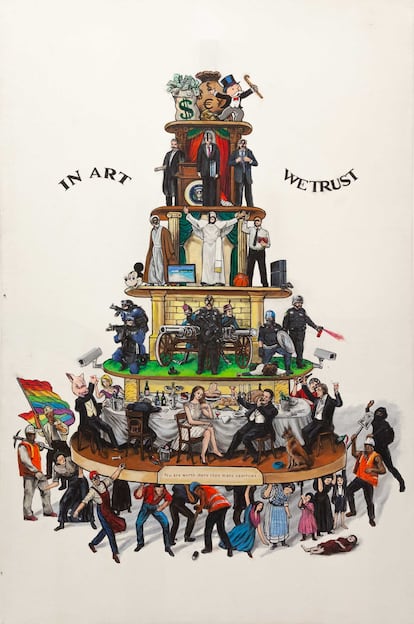
Among the works, Ozmo’s graffiti stands out You are worth more than many sparrowsa piece that condenses criticism and narration in a tower of six steps. At the base are workers and protesters, followed by the leisure class enjoying banquets; higher up, military; then, religious; above, politicians; and at the top, money. The composition includes the phrase: “In art we trust” (In art we trust). Although it may not seem like it, “All these works force us to reflect on the world in a positive way,” says Cattaneo.
When it arrived in Europe, to cities with a strong historical and cultural burden, urban art incorporated new techniques and discourses: the use of stencils, monumental intervention or visual poetry. The walls of Paris, Rome or the Berlin Wall ceased to be only spaces of confrontation and became places of dialogue with architecture, memory and collective identity. In this context, names from the Spanish scene are also beginning to resonate, such as El Xupet Negre, PichiAvo and SUSO33. The latter accompanies the curator during the tour and stops, along with around thirty people, in front of one of her two works on display.
Vandalism or art?
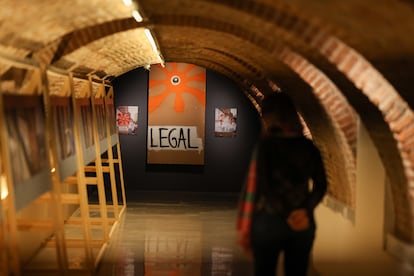
For SUSO33 the border between art and vandalism is not fixed but contextual. Taking an intervention from the street and transferring it to the museum implies an inevitable transformation, a “recontextualization.” The work loses its original meaning and acquires another, conditioned by the new environment. The artist explains it to this newspaper from one of his pieces, made on a lot where the word “illegal” could be read. Part of that mural was removed, leaving only the letter i in the original space, while the rest – with the word “legal” – is now displayed within the walls of the Canal Foundation. “If you take it out of the context where I created it and put it in the exhibition space, it becomes legal,” reflects the artist. “And on the street it is, in some way, defunded.”
Since his beginnings, the Madrid artist has worked in that “ambiguous zone between the legal and the illegal”, understanding urban art as an exercise in visual poetry that invites the viewer to formulate their own reflection. “The fun is undoubtedly and respectfully in the game,” he says.
As the tour progresses, the exhibition displays a diversity of languages and spaces chosen by the artists to capture their message. The legal issue, although it fades, never disappears. Only the question is reformulated: when is an intervention considered vandalism and when is art? For the curator of the exhibition, the answer lies in the artist’s action not compromising the “functionality of the space.” This is exemplified by an intervention on a traffic sign, from which a hyper-realistic face and hands emerge, as a relief. Despite the manipulation, the viewer continues to recognize the restriction on vehicle passage.
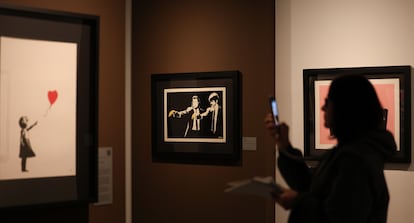
The most decisive change comes from the year 2000. The street stops being just a physical place and expands on the screen. The Internet and social networks multiply the reach of urban art: works no longer exist only in the place where they are made, but are reproduced, shared and reinterpreted, achieving immediate international visibility. Such is the case of Banksy. “It wouldn’t be an urban art exhibition without it,” explains the curator. When the mysterious street artist creates a new work, “everyone talks about him.” At the end of the route, almost like a booth, dozens of paintings that reproduce her works hang on the walls: the famous girl releasing a balloon or the characters from Pulp Fiction “shooting” with bananas.