
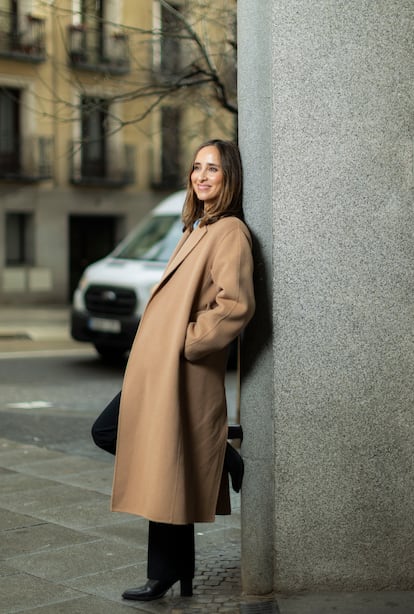
The journalist Julia Varela (Pontevedra, 44 years old) has a pile of books on her nightstand. It is being read Nagori, Ryoko Sekiguchi, acaba de terminar Another version of you, by Inés Martín Rodrigo, and wants to read the new one by Ottessa Moshfegh. “Write that you are dying,” he says. He began his career writing in the newspaper The World and since then he has done radio and television, especially on RTVE, and has been commentating on Eurovision since 2015. But this winter morning he wants to talk about his novel Everything to dopublished by Ediciones B, and tell, among other things, that he is learning to play the piano. “Lately I’ve only been looking for beauty,” he says.
Ask. It is not his first foray into literature. Why a book about grief?
Answer. My mother died of breast cancer, she had just retired after working as a mathematics teacher. That caught me at 40 years old and it was a huge slap in the face, because I believe that grieving for a mother is something insurmountable. That’s for starters. And just at the age of two I was diagnosed with breast carcinoma, more or less at the age at which she had been discovered, and let’s say that I once again went through the grief that I was already going through for her. So I thought: What am I going to do with all this pain? Can you do something nice? By the way, do you know that I’m learning to play the piano? Everything I have experienced has helped me learn to relativize.
P. How are you now?
R. I’m fine, but when you have hormonal breast cancer, as is my case, you have lifelong medication that adds years because you reach menopause earlier… Come on, it’s an interesting journey for the time that I have had to accept. I try to find calm, which I think is the best way to mature.
P. We talk and write more about death, and also about menopause, a melon that was about to open.
R. Luckily there are many women who are speaking out and putting names to the things that happen to us. That has not happened because this stage in women’s lives is always associated with the stigma of aging. There comes an age, you stop being fertile and it seems that you are not useful to society. And it’s not like that. Right now it is one of the longest stages in a woman’s life due to our life expectancy.
P. Are you one of those authors for whom writing is a bit of therapy?
R. With this book I thought so, but that was not the case. I was only able to start writing when I had already covered a large part of the journey through that desert. When I had chewed and digested it, I began to think about making a fiction out of all that. It wasn’t therapy, rather I thought: let’s create a story, see if people can identify with it. I am a very ordinary woman, I claim mediocrity, the happy medium, which Aristotle said. A mother who writes, come on.
P. “I am a mother, and as a mother I have not fulfilled myself as a woman,” she once said.
R. I think it is one more facet that I decided to have, because at first it was not clear at all. Then I fell in love and ventured, but I think it is not the facet that has fulfilled me the most, in fact. It is a very different love, unconditional, but it has made me more fulfilled by creating a family, building it and trying to make it flow.
P. Behind you, through the glass of this cafe, is a huge Spanish flag, so let’s talk about Eurovision. What has it meant for your career and what do you think about Spain not participating in the next edition?
R. My work as a Eurovision commentator, which began in 2015 with José María Iñigo, was quite a challenge at first, because it is the most watched non-sports broadcast on TVE all year. As a work it is fascinating, it is the program that still has that of maintaining old, family television, which brings together different generations in front of a screen. It can only be compared to the Super Bowl. As a show it is tremendous, and seeing how it works inside is a great learning experience, it is exciting when the God bless you. In terms of the whole current situation, I have my opinion. I am very sad that in this edition we do not have a representative from Spain, as a woman who works there and also a bit as a Eurofan that I am. I do believe that RTVE’s position is in line with the position it had before with Israel’s participation in the contest, it is logical, but I can’t help but feel sad. When I started in this, Íñigo always told me one thing that I have assumed. Because it is a contest in which countries, the public television stations of those countries, participate, and voting is not so much based on politics but based on geographical and cultural proximity. If you are Swedish you will like Icelandic rock more, and if you are Spanish you will have more ear for chanson French and the song Italian. But I don’t like Eurovision being politicized like everything is being politicized.