
The philosophy of Robert Rauschenberg (1925-2008) was, as described by his friend the dancer Trisha Brown: “Let’s do things, it’s fun.” He was referring to things as strange as they were groundbreaking for his time: placing a bald eagle glued to a canvas, a goat stuck in a tire on top of another, or a quilt and a pillow splashed with paint, as if dripping blood, hanging from a wall. But his famous combine paintingswhich redefined the limits of sculpture and served as a bridge between abstract expressionism and pop art American, were just one stage of a multifaceted artist who never tired of changing registers. When he mastered a process, he abandoned it and did something else. He eliminated the borders between disciplines, in addition to combining painting with sculpture, collage and objects found on the streets of New York, he played with screen printing, tried his hand as a photographer and, starting in the 1950s, found his great passion in dance.
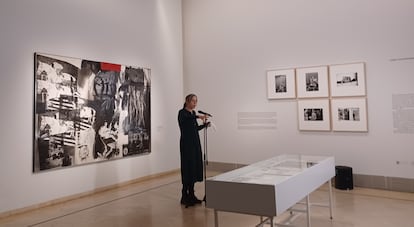
After the success of these aesthetic combinations, the american He began his experimentation with screen printing —under the influence of Andy Warhol—, a new type of technique that became the new basis of his work. Expressone of the masterpieces of that period, is the only one by the famous artist that belongs to the Thyssen Museum in Madrid, and this year the art gallery wanted to celebrate it with an installation: Rauschenberg: Express. On the move, curated by Marta Ruiz del Arbol and which aims to reveal the artist’s creative process and delve into the origins of the painting. “The work is usually placed in the museum in the place where history has placed it, but Robert Rauschenberg is much more than a transition between stages of art. With this presentation we intend to vindicate why it is completely current and why his legacy survives,” says the curator.
What the Madrid museum presents, and which will be open to the public from February 3 to May 24, is part of the international commemoration of the centenary of the artist’s birth that the Robert Rauschenberg Foundation has promoted since last year with different activities around the world, from New York to Honolulu. Spain had already joined the celebration with an exhibition at the Juan March Foundation where all of his plastic work was reviewed to show it as an essentially photographic practice. The Thyssen is, in reality, a small and simple montage in room 48 that shows, above all, a deep research work that aims to reconstruct the author’s creative process to enhance “one of the masterpieces of the museum’s modern collection,” according to its director, Guillermo Solana, in the presentation to the media this Monday.
Express It is a great example of that new technique, silkscreen, that enchanted the American artist. “He visits Andy Warhol’s studio and becomes fascinated with what he is doing. He asks for the Marilyn series and discovers the possibilities that commercial screen printing has applied to the field of Fine Arts. He asks for the supplier and immediately begins to work with this, let’s say, mechanical procedure,” explains curator Ruiz del Arbol. What the American did was configure photographic images printed on silk panels that he then transferred to his canvases, superimposing and mixing them “without any hierarchy,” continues del Arbol, as a kind of collage. Rauschenberg completed the technique that Warhol already used with oil paint. “This is a work of transition. When Rauschenberg begins with a new technique he works in black and white, until suddenly, little by little, he can begin to introduce color. The first color he introduces is usually red. Here we already see that he is introducing red,” says the curator.
Although the exhibition does not reflect it so easily for the viewer – there are only a few photographs and a short video accompanying the large work – what the Tree and his team have done is trace the origin of that jumble of images that make up the painting: a rider on the horse at the moment of jumping a fence, some dancers in action, a climber hanging from his rope, or a nude descending a ladder – a very explicit reference to the famous work by Duchamp, presented at the Armory Show in 1913. The horse is actually Snowman, the Cinderella of American equestrianism, which went from being nothing to being a phenomenon; the nude is taken from the magazine Life; and the photograph of the dancers is one that he took himself.
The latter is, the museum director recognizes, the most important of all. “Many times his works have been interpreted as impossible to interpret, as the representation of the lack of meaning of the contemporary world and human life. But this is more than a shower of stimuli, it is a painting that seems very classic to me in a sense and very constructed and articulated,” says Solana. For him, it is an “apotheosis of dance, a celebration of dance.” “The images he uses are the expression of one thing that avant-garde dance is looking for at the moment: everyday movements, objects, the absurdity of ordinary life, completely breaking the syntax of traditional dance. This kind of exaltation of the human body in movement, including horses that are very human for Rauschenberg, are a new concept of dance,” he concludes.
Screen printing came into the artist’s life at a time when he established a creative relationship with the dancer and choreographer Merce Cunningham, for whose company he worked as a set designer, costume designer and lighting designer. He became so committed to what he did that he relegated his pictorial activity—or sculpture, or photography, or whatever—to the free time he had between tours with the group. In 1963 he made the leap as a choreographer and premiered his first work, The pelican, where in addition to doing the scenery, costumes and lighting, he also appeared spinning on skates with a parachute on his back, dancing in the dark with a flashlight tied to one foot. “I had a lot of extravagant ideas to hide the fact that I wasn’t really a dancer,” he once said. The same year as that premiere, it ended Express.
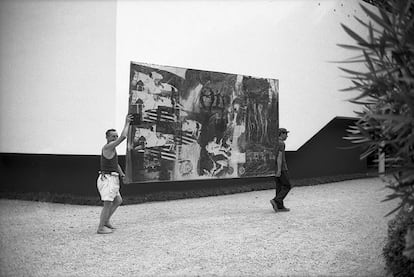
The work was also part, a year after its creation, of the set that the United States presented at the Venice Biennale in which Rauschenberg was controversially awarded the grand prize for painting, becoming the first North American artist to obtain it. “We know that there was interference from the United States Department of Information to ensure that this award was granted. It was a scandal because above all it represented the definitive relief of the cultural supremacy of Europe in favor of the United States,” acknowledges del Arbol. In that exhibition, by the way, due to its size, almost all the works from the United States were exhibited in a palace on the Grand Canal. After the award, some of them, Express included, they moved to the official premises. The Thyssen montage shows photographs as implausible as they are seductive of the enormous painting, today deeply pampered, walking through the canals of Venice, naked and without protection, or the streets in the arms of a pair of men – some in shorts, a sleeveless shirt and barefoot – who drag the dust through which they walk.