
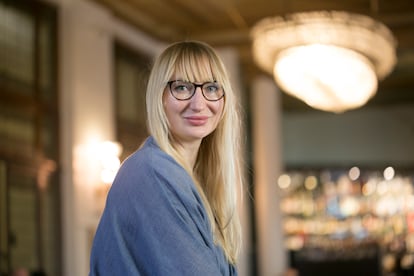
Margo Rejmer (Warsaw, 40 years old) is a writer who for years has given voice to dozens of personal stories that condense the collective experience of countries under communism. Now he turns his gaze to the traumas and oppressions that persist in life in freedom. In his new book, The weight of the skin (La Caja Books, translation by Agata Orzeszek and Ernesto Rubio), the third translated into Spanish, leaves behind the historical report to delve more freely into the human mind and explore the wounds of the present: the weight of living in a world that forces us to make decisions without offering refuge and that pushes us to silence stories of family trauma and violence.
In the manner of the Belarusian writer Svetlana Alexievich, she spent years collecting stories of ordinary lives—poets, teachers, peasants, shoemakers, children and grandchildren of repression—to write two books with first-hand testimonies of those who survived two of the most closed and brutal communist regimes in Europe: those of Albania and Romania. Born while Polish communism was collapsing, its literature has not ceased to dialogue with that past, and that is why one might think that what moves it is a fascination with history and the secrets of authoritarianism. However, his interest is not so much in political systems as in what they do to people. What challenges her most is her curiosity about freedom. “I am interested in internal freedom,” he explains. “Living under an authoritarian system forces you to ask yourself: Will I be opportunistic? A conformist? A rebel? Can I accept the truth of reality or do I prefer to live in a fantasy that makes me feel safe?”
Rejmer turns writing into a long process of immersion. He lives in the places he writes about, learns the language, listens to the history of his people for months and years. She considers herself an heir to the school of Ryszard Kapuściński, which seeks metaphors and symbols capable of representing universal aspects of human nature. But she does not define herself as a reporter, but as a writer with curiosity about people: “You listen to the story of an individual and, suddenly, the great History is reflected in it. You begin to find answers about what freedom is and what happiness is.”
He came to Romania because he needed to disconnect to write another book that was left unfinished, and he had no difficulty learning the language. She was fascinated by the “chaotic” architecture of Bucharest. There was something familiar about that country, something that connected with her. “I felt that if architecture was so diverse, people’s lives had to be too. That chaos had to reflect history and individual biographies.” From that intuition was born Bucharest: dust and blood (La Caja Books, 2019), in which he immersed himself in the dark past of the Nicolae Ceausescu regime, which governed the country from 1965 to 1989. Only after publishing it did he learn, from his mother, that his grandfather had been born in Romania.
He found that same familiar silence again in the stories he heard in Albania. In the capital, Tirana, he encountered extroverted people, but it was difficult for him to understand how to approach people. Everything seemed opaque to him, as if society had developed a system of hidden favors to maneuver in everyday life. In addition to learning the language, he realized that he had to know the two layers of Albanian society: an official one, which functions on the surface, and another that is like the mycelium, the structure of mushrooms under the ground, in reference to a network of corruption and organized crime that, according to him, circulates in the country. A legacy, perhaps, from the dark past of Enver Hoxha, the tyrant who ruled the nation with an iron fist in an isolated regime that lasted from 1944 to 1985. It took Rejmer another six years to write Clay sweeter than honey. Voices from communist Albania (La Caja Books, 2020). Its beginning —“Once upon a time there was a paradise created in the most socialist country in the world”— sought to portray a country that avoided looking in the mirror to recognize what it was.
Rejmer says that, after finishing this book, she became obsessed with trauma: with the way it is inscribed in the body and transmitted; with his silent presence in family dramas; with how it becomes oppression from father to son, from mother to daughter. In The weight of the skina character who survived the war, asks: “Can we bury memories within ourselves, like when we cover a body with earth?” Silence is an element that runs through lives crossed by violence and oppression that filter into the most intimate, family and emotional relationships. It is present in the girl who joins a streaming of self-harm; in the complicity of a community that accepts the physical attacks of a father towards his son; in absent or frustrated motherhood. In all the stories, the human and the carnal are intertwined with the supernatural and the mystical.
The scenes of small everyday horrors take place between Albania, Kosovo and Poland, with a mix of the real and the fantastic. Rejmer, who among contemporary Polish writers has only been surpassed in the number of publications in Spanish by Nobel Prize winner Olga Tokarczuk, explains that her previous work also inspired these stories. “Fiction gave me tools to explore trauma, to create characters who dissociate, who invent another reality in order to survive.” In these stories, different defense mechanisms appear that distort the perception of reality, something that could not be allowed in the report. “In fiction I can start from real events or from people I knew, but diverting the story however I want allows me to extract the essence of the problem,” he says.
The Polish author has spent years looking to the past to understand the present. It seeks to understand why it sometimes brings silence and other times nostalgia, even for a past of oppression. “Each nation is making an effort to understand its identity. We need mirrors, narratives from other countries to see ourselves better. By looking at others we know ourselves.” The past, often idealized, coexists with the harshness of the present. “There are people who say: ‘maybe we were not free, but we had doctors, housing, work.’ A collective myth was created, a feeling that there was security.”
The tension between freedom and security, Rejmer summarizes, explains many of the contemporary malaises. “We don’t know how to carry the weight of freedom in a system that doesn’t care about making us feel safe. It worries about whether we want to have children, but doesn’t ask at what cost.” In his opinion, it is frequently repeated that women no longer want to have children, when in reality it is a symptom of material and vital conditions. “When I arrive in Spain they always tell me about the housing crisis. In the end, this is the basic need, to have a roof over your head to feel safe and to be able to think about having a child, a family. In Poland we have the same problem.”
Furthermore, in his country abortion is criminalized, and Rejmer explores this situation in the story of a couple who crosses the border with Slovakia to abort a fetus with malformations incompatible with a dignified life. “She carries a son inside her, neither alive nor dead, just like her,” she writes about the protagonist. She says that it was essential for her to write this story because she perceives that Polish women are highly educated, enterprising, assume multiple responsibilities and, even so, “they do not have this basic right to decide about their own bodies,” and that, despite this, “children are still not born.” Between the couple that crosses the border there is silence, the weight of resentments and unrealized hopes. “I see an increasingly different sensitivity between women and men,” he concludes. “We are moving in opposite directions, with a lot of incomprehension. The weight of the skin Try to put your finger on that wound.”
The author understands that her country has today become a field of dispute between two great narratives: that of the radical right and the liberal one. He is interested in observing how the former impacts society and, in particular, men. For Rejmer, the rise of the radical right responds to the fact that it offers a clear story in a context of uncertainty. It appeals to family, marriage and children as a promise of protection against the chaos of a present crossed by the threat of war on the border, a pandemic and economic crises. That narrative, he maintains, connects directly with the feeling of insecurity of many people. “Poland is changing, but it also reflects all the trends that are very visible in the United States or even here in Spain,” he concludes.