
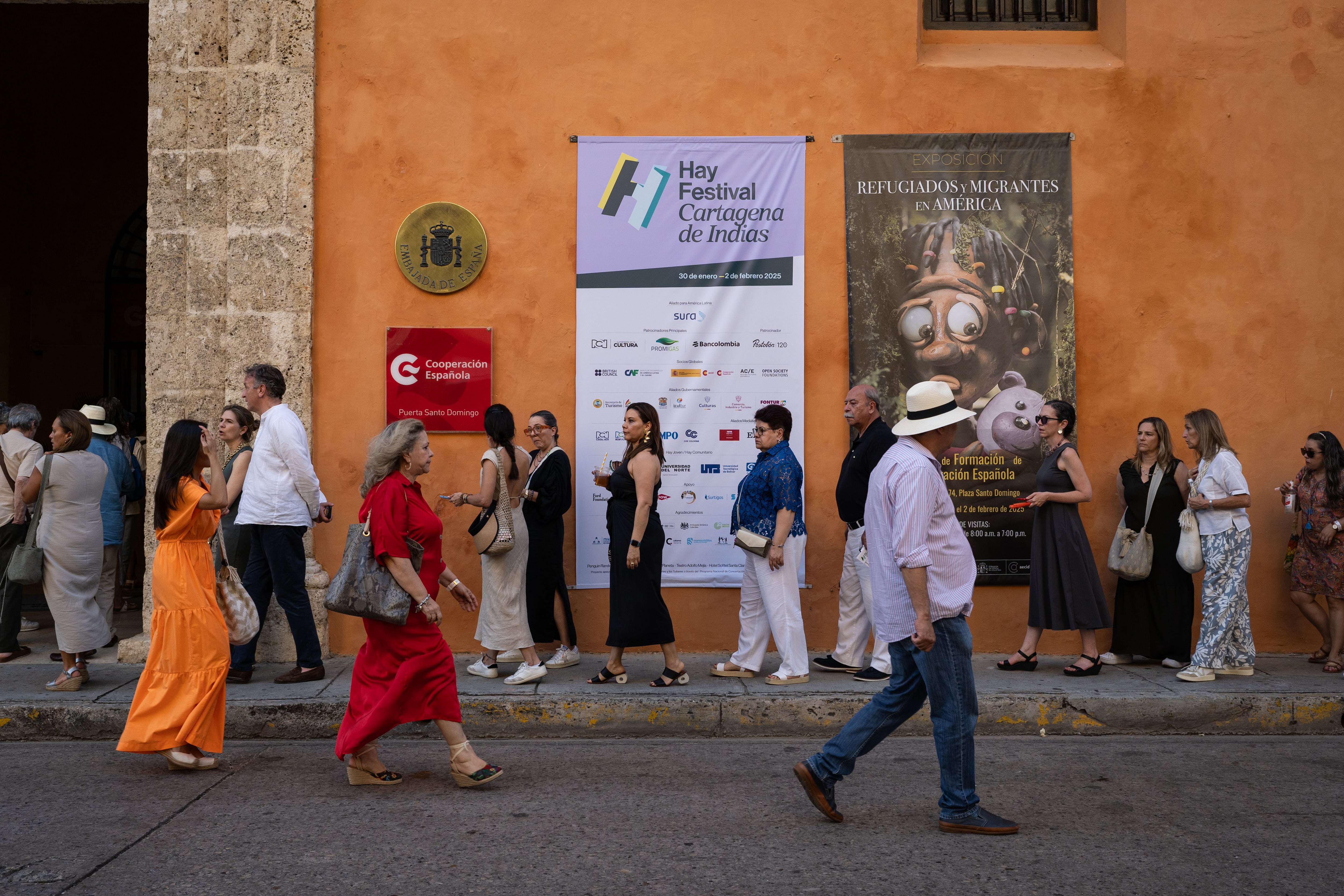
One of the most important cultural events for Colombia, the Hay Festival, held annually, opens its doors this Thursday in its 21st edition in the midst of a delicate geopolitical crisis. In front of the Caribbean Sea of the walled city, where 180 guests from all over the world will arrive, the United States Government has bombed several boats in the last semester with the argument that they were trafficking drugs. Then, in the neighboring country, there is a tense calm since Washington bombed Caracas three weeks ago and captured the regime’s leader, Nicolás Maduro. The guests also arrive with doubts about the future for Greenland, Europe, Gaza. “We are living in complex times, of total change, and that is why I would say that this festival is very much about that: geopolitics,” says Cristina Fuentes La Roche, international director of the festival. “I think that because of all these crises, more than ever, there is a need to meet, to take debates out of virtuality and listen to each other,” he adds.
EL PAÍS will have a special celebration this year at the festival, since on May 4 this newspaper celebrates 50 years since its founding at a key moment in the history of democracy in Spain, just six months after the death of Francisco Franco. Jan Martínez Ahrens, director of EL PAÍS, will speak on Sunday with Carlos Chamorro, director of the Nicaraguan media Confidential, y Denise Maerker, Renowned Mexican journalist who presents on N+. The talk will be moderated by Diana Calderón, director of the program Hour 20 on Caracol Radio.
Several columnists from El PAÍS will also meet in a conversation in which the Argentine Leila Guerriero, the Cuban Leonardo Padura and the Colombian Juan Gabriel Vásquez will be present, moderated by Javier Moreno, director of the UAM-EL PAÍS School of Journalism. Vásquez will in turn present his new book, a compilation of his best columns in the last five years, and titled This has happened.
One of the strong points of the festival is a talk with the Nobel Peace Prize winner and leader of the Venezuelan opposition, Maria Corina Machado, who will speak on Friday night with Michael Stott, editor of the Financial Times. Participants will be able to send questions to her in advance, and their participation will be followed by a conversation between the Venezuelan journalist Luz Mely Reyes and the deputy director of EL PAÍS América, Javier Lafuente.
When Machado’s participation was announced last November, she had already won the Nobel, but Washington had not yet captured Nicolás Maduro. Some Colombian writers, such as the well-known Laura Restrepo, canceled their participation in the Hay to protest that the Nobel Peace Prize winner welcomed a military intervention in their country. Questions about the future for Venezuela have changed radically since then and, although Machado has met with Donald Trump to offer him his Nobel medal, it is not yet clear what his role will be in a transition to democracy in the neighboring country. “Reality has changed overwhelmingly,” says Fuentes La Roche. “Although we do not support any political idea, our position is to create a plural space to talk.”
But Venezuela is not the only crisis in the middle of the festival. The Indian essayist and novelist Pankaj Mishra will also be in conversation with Javier Lafuente about his latest book, The world after Gaza, published in 2025. Nesrine Malik, a British journalist of Sudanese origin, will talk about the war in Sudan and about her renowned book that deals with the misleading myths that the West has created in geopolitics (We need new stories. Challenging the toxic myths behind our age of discontent). Frenchwoman Mireille Fanon, anti-racist activist and daughter of the well-known theorist and psychiatrist Franz Fanon, will also participate in a conversation on anti-colonialism.
Javier Moreno will talk about his book Who’s in charge here? Helplessness in the face of the spiral of violence in Latin America, in a conversation with Fernando Carrillo, first vice president of PRISA, the publishing group of EL PAÍS. Also participating in the talk will be Ana María Salazar, who was Secretary of Defense during Bill Clinton’s Administration, and Érika Rodriguez Pinzón, security expert and director of the Carolina Foundation in Spain. María Martín, El PAÍS correspondent for the Andean region, will moderate a conversation about geopolitics with Fernando Arancón, director of the digital medium The world order; Marcela Meléndez, economist at the World Bank, and Carlos Alberto Patiño, author of The invisible global war. Ukraine, the world and the return of empires.
It’s not all geopolitics, however. Karen Hao, a prominent journalist specializing in the development of artificial intelligence, will be talking about her latest book, The AI empire. The musician Silvio Rodríguez will present digitally Silvio Rodríguez, diary of a troubadoura biographical book created by the Argentine photographer Daniel Mordzinski, who has followed the Cuban’s career with his lens (it will have 143 photographs of the artist). The Mozambican author Mia Couto will talk about her work digitally with Cali native Pilar Quintana, who in turn will present her latest novel in Cartagena, black night.
At the local level there will also be the first indigenous and Afro-Colombian women to enter the Colombian Academy of Language, Bárbara Muelas and Mary Grueso, talking about the need to renew the language and its inclusion in said institution last year. And the sound will be provided by La Pambelé, a salsa brava orchestra in Bogotá that will have a concert on Thursday night to open the 21st edition of a festival for conversation in the midst of confusion.