
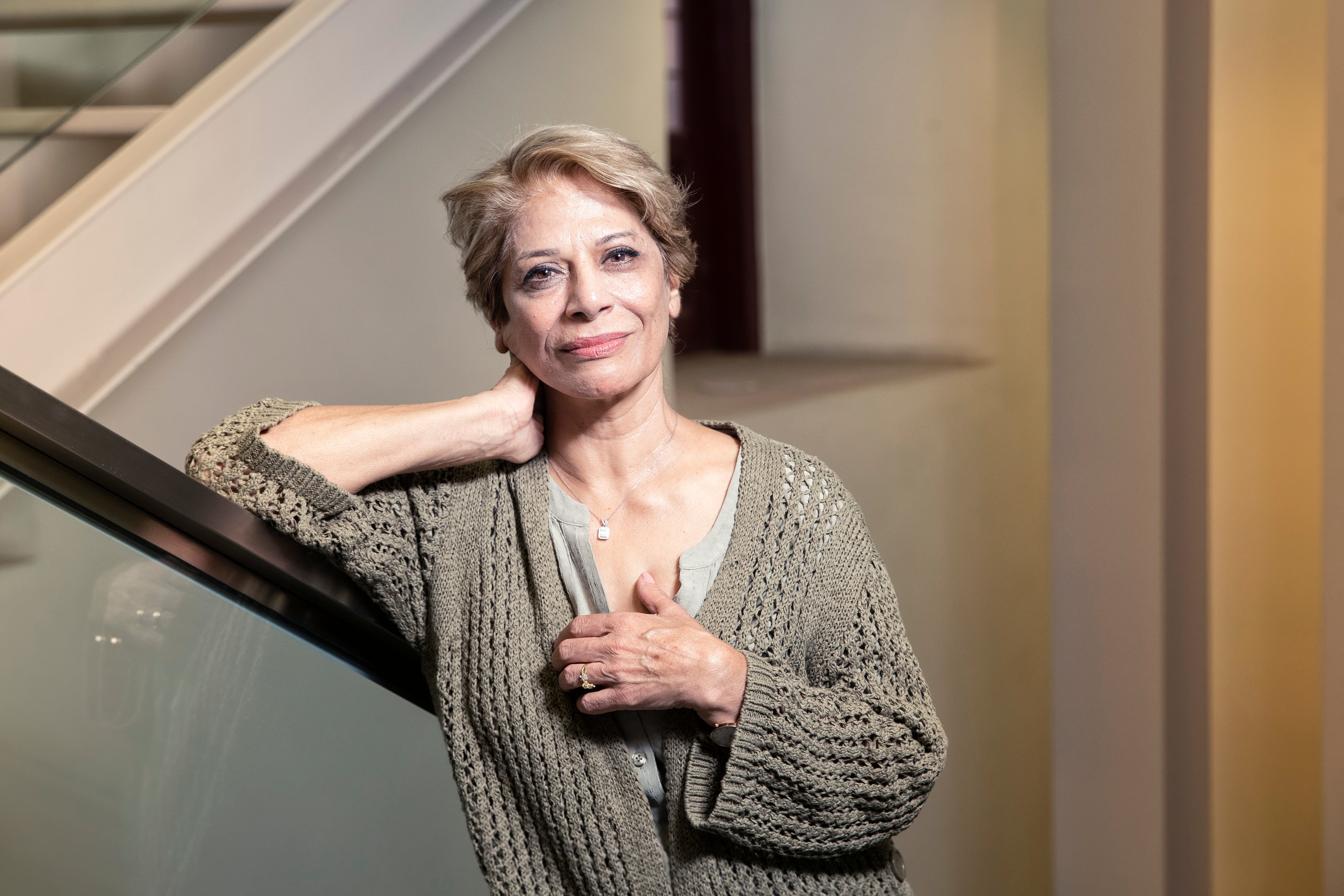
“People have psychologically reached the limit of their tolerance. They can no longer silence their screams; even in the face of the bullets of this brutal regime they remain firm and shout to recover their lost rights with their voices and achieve their demands,” Parinoush Saniee tells EL PAÍS about the current situation in Iran. A sociologist and psychologist by training, a novelist by necessity, Saniee has become the most read and translated Iranian author in the world, while her books remain strictly prohibited in her country. Now, the Spanish reissue of a hidden voice y The book of my destiny (Alianza) returns to the center of the debate a work that dialogues directly with the protests that for years, and especially in recent weeks, have shaken the streets of the country.
Given the current situation in Iran, the interview is managed via email, despite the fact that, given the progression of the protests, the Iranian regime cut off the internet throughout the territory. For a few days, total silence: the editorial, which acts as a liaison, explained: “We have lost all contact with Parinoush. We have not heard anything from her in the last week. The blackout has apparently been very strong. Assuming it is just that, because we are worried.” Fortunately, communication can be recovered via mail and in their written responses the same tension that runs through their novels resonates: the exact moment in which silence stops being an option, because silence becomes a form of violence against oneself.
Born in Tehran 77 years ago, Saniee belongs to a generation that has seen Iran change its face several times in just half a century. Before, during and after the Islamic Revolution, the writer has observed—and analyzed—the impact of political transformations on daily life, especially that of women. For years she worked as a researcher, conducting social studies and handling statistics to understand human behavior, but there came a point where she found academic reports insufficient: “I could have written a research report, like so many others I had written that only reached a limited audience, but the topic of women’s lives was different and deserved a deeper narrative,” she explains about the genesis of The book of my destinyhis most acclaimed work, originally published in 2003.
International ‘best seller’
The novel, translated into 26 languages, tells the story of the young Masumeh, is a portrait of life in Tehran from before the 1979 revolution to this century and condenses the experience of thousands of Iranian women whose lives have been shaped by external forces: family, religion, the State, public morality. Saniee built it by combining historical studies, questionnaires and real testimonies. “One of the most important cultural conflicts after the Revolution was the tension between religion and modernity,” he recalls, and explains that that is why he decided that Masumeh was born in Qom, the most religious city in Iran, and moved to Tehran, a symbol of modernity. Even his name—which means “innocent”—is a political statement: “There is no individual guilt in structural oppression.”
Throughout the novel, Masumeh’s life spans five decades of Iranian history, showing how personal achievements can be annulled at the stroke of a pen by a regime change. “After the establishment of the Islamic Republic, many hard-won freedoms were taken away, forcing women to fight again for rights as basic as deciding how to dress,” explains Saniee, who recalls that this struggle was not always visible. “In the early years of the Islamic Republic, women carried out activities in favor of freedom and helping those in need clandestinely, without public demonstrations,” she says. The resistance, then, was organized in houses, discreet associations, invisible networks. That personal experience emerges in an anecdote of her own: shortly after the publication of her books, Saniee discovered that in a single month she had received invitations from 18 women’s associations from different parts of Iran “whose names she didn’t even know and, sometimes, she didn’t even know what cities they were from,” she recalls. Each visit surprised him by “the magnitude, perseverance and value of the work they did.” Those women, invisible to the official story, supported a network of support and awareness that undoubtedly explains, in part, the strength of the current protests.
Imposed silence
And The book of my destiny It is a novel about the weight of history, a hidden voice It delves into a more intimate and psychological territory. Inspired by a real case—the story of Shahab, a boy who decides not to speak—and originally published in 2004, it works as a powerful metaphor for imposed silence. The child’s mutism is not a disability, but a choice, a form of resistance against rejection. For Saniee, this gesture connects directly with the experience of women in patriarchal societies: “In most traditional societies, the dominant culture is a form of patriarchy that not only does not tolerate dissent, but harshly represses and stifles it,” she says. Silence, in this context, is a survival strategy. But it is not eternal: “There comes a point when silence becomes a deafening scream that no one can contain. Like what is happening today in my country.”
The protests that broke out after the death of Mahsa Amini in 2022 marked a before and after in Iran. Although they were not the first mobilizations, they did show a deep generational rupture that continues until today’s protests. Saniee observes this difference with amazement: “The difference is so great and profound that it is hard to believe that so much change has occurred in just fifty years.” He attributes this acceleration to the digital world, the media and a youth that has lost fear. Compared to the Masumeh of her novel, forced to negotiate every small space of freedom, today’s young women occupy public space with their bodies and voices. In this process, education occupies a central place in the writer’s thinking: “In my opinion, education is one of the most important tools to combat fanaticism and backwardness,” she maintains. And literature, for her, is part of that expanded education: “It can put people in each other’s shoes, show different perspectives and generate the empathy necessary to resolve conflicts.”
Unfortunately, writing in Iran has a price: all books go through censorship filters and many are outright banned. Saniee knows this well. His latest book has been blocked at the Ministry of Culture for 17 years without receiving authorization to be published. “The story of getting permission for my books would be enough to write another book,” he explains. Even so, he insists on continuing writing. Leaving a record, he believes, is a form of long-term resistance: “It is a guide for future generations.” “I’m proud of them and I enjoy seeing them,” she says, when finally asked what she would say to current protesters, especially women. “I know how consciously and determinedly they move toward their goals and their freedom. I hope they succeed. And I hope they succeed.”