
It is very celebrated that the physical book, the one you touch and smell, has not been displaced by the digital format (as, alas, happened to the poor records…). But the physical book weighs a lot and takes up a lot of space, and that space where books are stored, displayed and sold (they are called bookstores) increasingly requires greater investment, due to the constant rise in real estate prices, often associated with processes of gentrification and tourism. The physiognomy of cities is changing (some say that the city, as we know it, is being destroyed) and some bookstores are being overwhelmed by the roller of this hypothetical success urban.
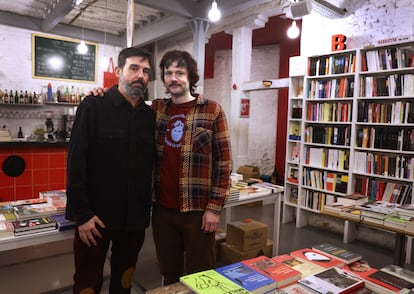
The Tipos Infames bookstore, located in the heart of Madrid’s Malasaña neighborhood and the epicenter of an intense cultural life, has been the last to announce its end, an announcement that this week fell like a thermonuclear bomb on the editorial circuits and readers. “Gentrification forces us to close,” Alfonso Tordesillas, one of the three partners, along with Gonzalo Queipo and Curro Llorca (now editor at Las Afueras), who founded the now legendary bookstore 15 years ago, said in a video for social networks. Curiously, cultural spaces such as bookstores, alternative theaters or art galleries were pointed out as an expression of the gentrification of neighborhoods when, around 2010, this phenomenon began to worsen in Spain and became the subject of public debate and strong academic study.
Over time, massive touristification processes would be added, perhaps even more aggressive when it comes to expelling the neighborhood, operating urban changes and obtaining profitability from places of coexistence. And some of the aforementioned cultural businesses are also beginning to be expelled. “The Malasaña neighborhood was very different 15 years ago than it is today, although there were already hipsters. Gentrification is a process that affects many businesses, not just cultural ones, and that turns a neighborhood into a hostile place for many. Up to this point we have been able to defend ourselves,” says bookseller Gonzalo Queipo, reports Andrea Aguilar.
“In these cases we could talk about waves of gentrification,” explains sociologist Daniel Sorando, author, together with Álvaro Ardura, of the essay First we take Manhattan. The creative destruction of cities (Cataract). The “pioneers” are bookstores, alternative theaters or art galleries that accompany new neighbors with liberal or creative professions on their arrival to traditionally popular and even stigmatized neighborhoods (and, very importantly, with low prices). Some experts, such as Richard Florida, applauded the emergence of creative citiesas a mode of economic development and urban regeneration… although years later, in view of the growth of inequality and expulsion, Florida retracted its initial optimism.
These processes, in addition to raising prices (both of land and sparkling water), have subsequently favored, with the layer of touristification added, the appearance of businesses more linked to tourism than to culture (modern cafes, bakeries and specialty coffee, or souvenir shops) and all types of franchises. “With the integration of these neighborhoods into the commercial, economic and symbolic dynamics, their value increases, and they no longer only attract poets and artists: they are beginning to be places for tourism and other types of profiles that not only have cultural but also economic capital,” says Sorando.
Thus, prices rise more and more, especially when there is no regulation for rents, and the businesses that proliferate are those that produce greater profitability and can pay a higher rent. Some bookstores are facing closure, such as Tipos Infames or Caótica, in Seville. Others, such as Desperate Literature and Central de Callao, both in Madrid, are forced to change locations, as also happened to 80 Mundos in Alicante. Some, like Traficantes de Sueños in Madrid or El Lokal in Barcelona, take action and buy the property. And, be careful, some new bookstores open their doors and try their luck, even in central and tense neighborhoods: this is the case of Madrid’s Parenthesis, in Lavapiés, or Verbena, La Latina.
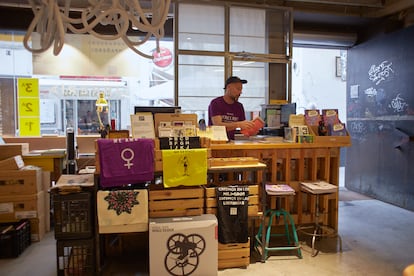
As if that were not enough, the pressure on bookstores is increased by distance selling on platforms such as Amazon and competition with large chains. “With the profit margins they provide, bookstores cannot afford the rent increases that are occurring due to the wave of real estate speculation, which sometimes amounts to up to double the price,” says Álvaro Manso, spokesperson for the Spanish Confederation of Guilds and Associations of Booksellers (CEGAL, which brings together more than 1,100 bookstores in Spain) and bookseller at Luz y vida, in Burgos. At CEGAL they work to collect and provide information on the available aid and so that independent bookstores that generate activity in their environment and are a focus of cultural life have a unique characterization before the administration that allows them, for example, to enjoy tax advantages or rental aid. “The disappearance of bookstores creates a cultural vacuum in the neighborhoods that is not replaced,” says Manso.
Fewer and fewer books are purchased in traditional bookstores: 4% less than last year, which represents the same decrease that occurred between 2017 and 2024, according to the Barometer of Reading and Book Purchasing Habits in Spain in 2025presented this week. Large chains, on the other hand, grew by 3%. A bookstore, furthermore, loses part of its meaning when neighbors are expelled from the neighborhood, as is so frequently seen today. “Bookstores or galleries are not responsible for gentrification,” Sorando concludes, “they are a stage in a broader process whose main responsibility falls on the owners who modulate the tone of the neighborhood according to their ambitions for profitability, without caring about the social content of the businesses.”
Buy, renew or die
The combative Traficantes de Sueños bookstore, also an intense critical and cultural space, in Madrid, felt the sword of Damocles on its head in 2024, when the property decided to sell the building due to having to face expensive structural works. “Our street (near Plaza de Tirso de Molina, in Madrid) is very attractive for hotels and the tourist economy,” says Beatriz García, a member of the group. So they decided to take the bull by the horns, moving from resistance to direct action against gentrification. That is to say: to buy the building.
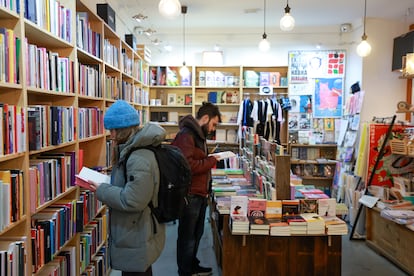
With the work included, the operation amounted to one and a half million euros, which was financed by the ethical financial services cooperative Coop57, with the contribution of the workers and with the support of its large community, which put some 150,000 euros in donations and interest-free loans. It is a project that also includes the other tenants, the Senda de Cares and Red Interlavapiés associations. “Now we are owners,” says García, “we have to pay the debt for 20 years.” A similar move is what managed to save the El Lokal bookstore, linked to counterculture, self-management and libertarianism, after 37 years in the Barcelona neighborhood of El Raval, and after the contract expired on January 1, 2025 and it was put up for sale. It was also achieved with the support of Coop57 and its grassroots community.
There are those who look for other alternatives. The 80 Mundos bookstore in Alicante, opened in 1973, had to close its historic headquarters last summer, although it managed to return in the fall in what was the space of the Pynchon & Co bookstore. “It has been a happy ending for the bookstore, but not for the city: they gave us a kick to build a tourist apartment building,” says partner Carmen Juan. The case received tremendous media attention in the city and caused pressure that, according to the bookseller, caused the City Council (PP) to put a two-year moratorium on licenses for change of use to tourist apartments. After much “panic” and uncertainty, the bookstores received the offer from the Pynchon bookstore.
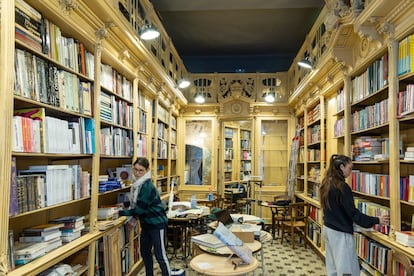
“They wanted to cease their activity, but, as owners of the premises, they did not want to contribute to gentrification, they did not want it to become a hostile space for citizens, but rather a neighborhood and cultural space,” says Juan. The solution was optimal, because the premises were already set up as a bookstore and they could maintain the cafeteria. It’s curious, and nice: the current 80 Mundos bookstores had started, and had met, working at Pynchon, whose spirit they also want to preserve. “I am quite devastated by the news about Tipos Infames. It has been a reference for the construction of many independent bookstores,” says Juan. The La Central de Callao bookstore, which occupied an incredible palace in the heart of Madrid, had to leave it against its will and occupy a smaller space right in front. The famous Sant Jordi bookstore, in the Gothic quarter of Barcelona, also managed to reopen last December with certain adjustments: adding a small restaurant in the back room and a calendar of events to liven up the life of this historic place. Now you can have vermouth and tapas.
Many times the ending is more abrupt, as seems in the announced closure of Infamous Types. Although, in a strange twist of the script that the internet produces, the star chef José Andrés, on social networks, has offered to save her…