
“To Eugene Oneginthis is what I need.” Pyotr Ilyich Tchaikovsky was blunt about the conditions he demanded for the premiere of his new opera in a letter as affectionate as it was firm to the theater inspector, Karl Albrecht, dated in Venice in December 1877. The composer wanted the work to see the light in the Moscow Conservatory, far from the great imperial theaters: “I do not need a large stage with its routine and its conventionality, its talentless stage directors. and the signal machines that direct the orchestra.”
Tchaikovsky listed five conditions. Voices of “average quality”, singers capable of acting “in a simple way”, a staging without luxury but “strictly adjusted to the time” (the early years of the 1820s), a choir integrated into the action – and not “a flock of sheep” – and, above all, a conductor who was not a machine, but “a true leader of the orchestra”.
This combination of vocal intimacy, scenic truth and musical vitality convinced – although not without caveats – on January 20 at the Palau de Les Arts. The Valencian theater took the first two conditions literally by entrusting the leading role to the young baritone Mattia Olivieri, a student at its Center de Perfectionament. The bet was risky, despite the fact that the Italian singer had already successfully embodied Rossini and Mozart’s Figaro at La Scala in Milan and at Covent Garden in London, in 2021 and 2023.
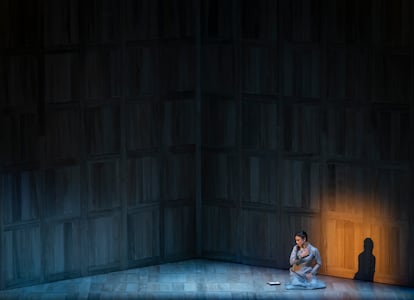
His youth and physique played in his favor, but neither his voice nor his stage manners fully embodied the cold Russian skepticism of Pushkin’s and Tchaikovsky’s Onegin. However, it improved appreciably in the third act, when the distant dandy transforms into a desperate man: it opened with a good airy and closed with a final scene of notable intensity alongside Corinne Winters’ Tatiana. The American soprano once again showed herself as a formidable actress, although without leaving a mark on the vocal level. Added to his limited psychological evolution was a persistent hardness of tone that prevented him from finding true expressive nuances in the famous letter scene in the first act.
The other couple, formed by Tatiana’s younger sister and Onegin’s poet friend, were clearly more convincing. The Russian mezzo-soprano Ksenia Dudnikova was a real luxury as the conventional Olga, whom she endowed with great vocal power and a flexible, dense and dark timbre; turned his brief airy initial in the first flash of the night.
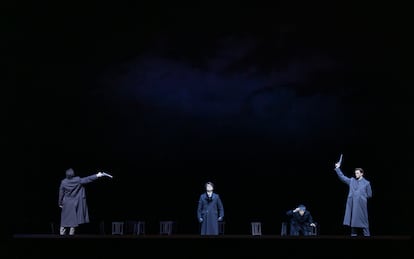
In the case of Lenski, tenor Iván Ayón-Rivas replaced in the extremes at the premiere performance to Dmitry Korchak, unwell due to illness. The Russian is an accomplished specialist in the character, with which he already triumphed in Valencia in 2011, but the Peruvian opted for a decidedly Italian vocal approach, as he did three years ago at the Vienna State Opera. His sunny timbre and exquisite phrasing made the famous pre-duel aria, Kuda, kuda, vi udalilisin another of the stellar moments of the evening.
Along with them, the Georgian bass Giorgi Manoshvili stood out as Prince Gremin, who sang his beautiful aria from the third act, Lyubvi vse vozrasti pokornithanks to an admirable combination of vocal solidity and austere expressive nobility. Another small luxury was having the British tenor Mark Milhofer, who sang with studied refinement the couplets by Monsieur Triquet. The mezzos Alison Kettlewell and Margarita Nekrasova, respectively mother Larina and nurse Filípievna, also stood out from the rest of the cast, very competent in their interventions and ensembles in the first and second acts.
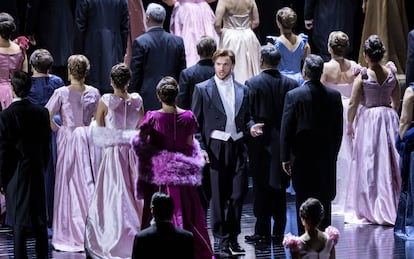
Austere and effective, Laurent Pelly’s staging is a success from start to finish. This production, premiered in 2023 at La Monnaie in Brussels and later presented at the Royal Danish Opera in Copenhagen, focuses on the psychology of the opera without altering anything of the original. He does this by intensifying the direction of actors through a meticulous dramatic study of each character and their evolution, but also through the costumes designed by Pelly himself, which underlines the development of Tatiana and Onegin and turns the chorus into a deliberately uniform mass.
Massimo Troncanetti’s minimalist set design proposes precise movements, perfectly connected to the action: from the elevated and rotating platform at the beginning – which articulates the entry and exit of the two couples or separates the chorus from the soloists – to the letter scene, when the walls are transformed into a triangular space that traps Tatiana as if she were trapped between the pages of a book. Added to this is the almost dreamlike lighting by Marco Giusti, which intelligently reinforces the different atmospheres of the plot, and the choreography by Lionel Hoche, which contrasts the naturalness of the rural world with the rigidity of the urban one.
In this contrast, the Cor de la Generalitat Valenciana was ideally integrated into the action, as was clear in the popular round of the first act, in the provincial waltz of the second and in the aristocratic polonaise of the third. But the most striking element of this production was Timur Zangiev’s musical direction, firm, confident and very personal.
The 38-year-old Russian maestro, from Vladikavkaz, came to the international spotlight in March 2022, following the dismissal of Valeri Gergiev—for refusing to condemn the invasion of Ukraine—from the production of The queen of spades at La Scala in Milan. Zangiev, until then his assistant, assumed direction of all post-premiere performances. The following year he debuted with Eugene Onegin at the Vienna State Opera and, in 2024, achieved notable success at the helm of the new production of The players by Prokofiev signed by Peter Sellars at the Salzburg Festival.
Zangiev was a leader at the head of the Orquestra de la Comunitat Valenciana and not a machine, as Tchaikovsky wanted, but he also imposed a purely Russian sound approach that made the orchestra less confident than usual. Fluidity and precision were combined with a particular sound density, the result of a darker string, acidic woods and sharp metals. The result was a less brilliant and emotional Tchaikovsky, who gained interest as the evening went on.
It was perceived in the slower and heavier start of the first act, in the restraint of the most lyrical moments and in the specific tendency to cover the voices. The initial coldness gave way to a better constructed and elegant second act, where the ensemble scenes flowed more naturally between stage and pit. But the best came in the third, when the director approached the Russian ideal of combining passion and precision. It was then that the claws of this young maestro appeared, who is already emerging as one of the most interesting heirs of the great Russian directorial tradition.
Eugene Onegin
Music by Piotr Ilyich Tchaikovsky. Libretto by Piotr Ilich Chaikovski and Konstantin Shilovski from the novel of the same name by Alexander Pushkin.
Alison Kettlewell, mezzo-soprano (Larina); Corinne Winters, soprano (Tatiana); Ksenia Dudnikova, mezzo-soprano (Olga); Margarita Nekrasova, mezzo-soprano (Filipievna); Matthew Olivieri baritone (Eugene Onegin); Iván Ayón-Rivas, tenor (Lensky); Giorgi Manoshvili, low (Prince Gremin); Xavier Galan, tenor (A captain); Agshin Khudaverdiyev, baritone (Zaretski); Mark Milhofer, tenor (Triquet); Philip Modestov, tenor (Foreman).
Heart of the Valencian Government. Body Director: Jordi Blanch Tordera.
Valencian Community Orchestra. Musical direction: Timur Zangiev. Stage direction: Laurent Pelly.
Palau de Les Arts, January 20. Until February 1st.