
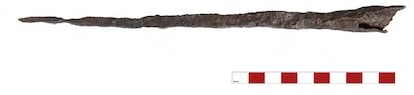
The battle of Las Navas de Tolosa (Santa Elena, Jaén, July 16, 1212), considered the most decisive combat of the Reconquista, has left an important written historiographical mark, but not archaeological, since hardly any research has been carried out on the ground in recent decades. However, since 2022, a multidisciplinary team from the Medieval History Area and the Institute of Iberian Archeology of the University of Jaén, National Heritage (Royal Armory) and the Complutense University of Madrid has been studying the battlefield where the enormous Christian and Andalusian armies clashed. The results, which have been made public in the report The battle of Las Navas de Tolosa: archeology of a historiographical milestone, have revealed the recovery of 5,593 historical objects – 80% directly related to the battle -, some of the routes used by the armies before the combat, the location of the Christian camp and, possibly, the Muslim one, and the confirmation that Castro Ferral, where the first attack took place, is a larger fortification than expected. To achieve these results, different means of remote sensing and archaeological microprospecting have been used, with metal detectors and GPS georeferencing.
What is one of the “most relevant milestones in the peninsular medieval history, due to its significance for the subsequent advance of the Christian kingdoms on the territory of al-Andalus,” the study points out, was declared a crusade by Pope Innocent III. The troops of three kings – Peter II of Aragon, Alfonso VIII of Castile and Sancho VII of Navarre – joined contingents from England, Germany, Italy and France to confront the troops of the Almohad caliph Muhammad al-Nasir, Miramamolin. For its part, eIt had “soldiers from all regions of the empire, including the entire Maghreb and the sub-Saharan areas of influence starting from the capital in Marrakech, which would also be joined by Arab and Turkish contingents.”
The team of archaeologists – led by Irene Montilla and Juan Carlos Castillo, and with Juan Pedro Bellón, Miguel Ángel Lechuga, Marcos Soto, Vicente Salvatierra, Mercedes Navarro, Álvaro Soler del Campo and Manuel Retuerce – not only searched for the material remains of the battle itself on July 16, but also of the previous and subsequent days between the 12th and 19th, in which very serious war actions took place. important. Among them, the crossing of the Sierra Morena by the Christian army, the taking of the Islamic fortress of El Ferral, the Christian settlement on the Mesa del Rey hill or the final sacking of the Almohad camp. The works have been financed by the Provincial Council of Jaén and the Government of Andalusia with the European Regional Development Funds.
Over the course of the three archaeological campaigns (2022, 2023 and 2024), 79 hectares were analyzed. Of the more than 5,500 objects recovered, 22% could not be identified with complete certainty due to their poor condition. 95% of the material is iron and 80% are “pieces recognizable with the battle or with moments immediately before or after,” says the article published by the magazine. Notebooks of Prehistory and Archeology of the University of Granada.
Although the battle and its strategic movements took place in an area of about 50 square kilometers, the archaeologists focused their efforts on three strategic points: the Ferral castle or fort, the Mesa del Rey hill and the Olivares hill.
As soon as they crossed Sierra Morena, and waiting for the fight, the Christians attacked Castro Ferral, which was always considered “a mere Andalusian checkpoint for the passage between the Plateau and Andalusia.” However, the work has shown that it had a “larger entity, considerably exceeding the delimitation that was established until now.” That is, it was a castle or fortress. In fact, experts have discovered two parallel sections of wall almost two meters high. In addition, the structure of a tower or bastion and another circular masonry structure have been located. In its surroundings, 127 objects have been identified, mainly nails, harnesses, pins, arrowheads, horseshoes and “two iron sheets with rivets that could be related to two launas of crow or coracina (small breastplate with metal sheets) of possible Islamic origin with later parallels in the Mamluk period.”
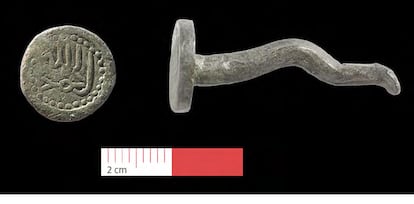
Along with these military objects, two objects with epigraphy in Arabic were also found. One of them, currently under study, is made of lead and circular. The other is a nail whose head reads: “Praise God.” It can belong to a piece of furniture or a shield. Three coins of Alfonso VIII have also been located, two inside the fortification and another outside, perhaps where the camp was after the siege.
For its part, in Mesa del Rey, where the Christians and more specifically Alfonso VIII camped, 60% of its 15 hectares were prospected. 1,306 items related to the confrontation were located, including 11 coins, seven from Alfonso VIII, another from Pedro I of Aragon and two Almohad dirhams.
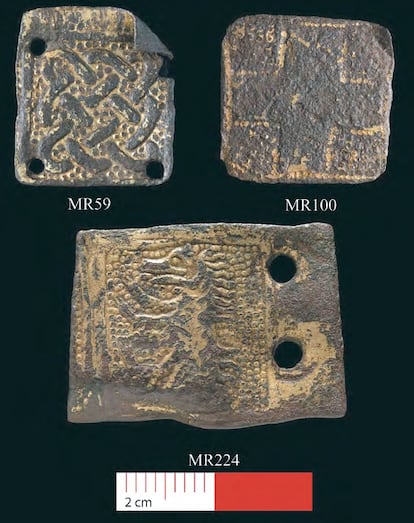
For clothing, gilt brass garnishes were found – decorated with architectural, geometric, vegetal and figurative motifs -, buckles of different sizes and types, two fragments of chain mail and studs. Also found were “the fittings of a bone or ivory casket, a coat of mail and a pinjante (pendant) in the shape of a cross for the browband of a horse’s head, like those represented on various occasions in the miniatures of the Rico Codex of the Cantigas of Santa María of Alfonso
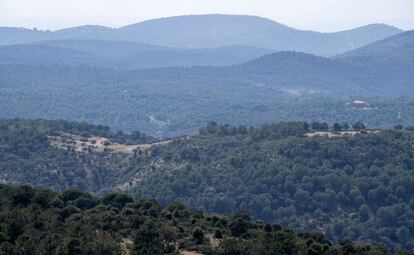
Al-Nasir is supposed to have established his royal estate on the Olivares hill, and he was able to divide his army into five camps to “avoid the problems that could be caused by the presence of tribes and contingents from very diverse places and ethnicities with the local population.” It is a hill that has a height of 814 meters, very similar to that of Mesa del Rey, which is 867 meters away, so from both you would have an unbeatable view of the battlefield. This hill has not been able to be fully surveyed because the La Olivilla Iberian Lynx Breeding Center is currently located there. “This meant reducing working hours as much as possible, as well as maintaining a certain distance from the cages, so many areas could not be sampled,” say the experts.
The list of written Christian sources related to the battle is extensive, ranging from simple mentions to detailed accounts, while the Muslim ones are much more limited. Among all of them, the testimonies of the protagonists stand out: Alfonso VIII, Archbishop Rodrigo Jiménez de Rada and Arnaldo Amalarico, Archbishop of Narbona. All three participated in the battle and used the same toponyms for the places now excavated. “In all these scenarios and their surroundings, archaeological materials compatible with the battle have been recorded, from which it follows that, regardless of the lights and shadows intrinsic to all the literary sources, in the case of Las Navas de Tolosa they do seem to offer a general framework that coincides with reality,” they emphasize.