
The Royal Spanish Academy (RAE), a tricentennial institution in charge of “cleaning, fixing and giving splendor” to the language, is going through one of the most turbulent moments in its recent history. What began as a hidden disagreement about the direction of linguistic policy has led to an open crisis, with public reproaches, internal wounds and an underlying debate about who should determine the destiny of the common language of more than 600 million speakers. This adds to the exchange of accusations between the institution and the director of the Cervantes Institute, Luis García Montero, that occurred at the end of last year, a disagreement that has led to controversy over the designation of the headquarters that will host the next Language Congress in 2028.
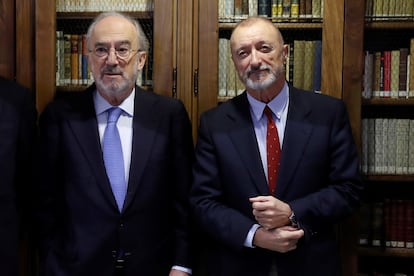
The spark that caused the last fire was a tribune by Arturo Pérez-Reverte (academic since 2003 and one of the most read Spanish writers) published in The World on Sunday the 11th, in which he launched a frontal attack against the RAE and its current director, Santiago Muñoz Machado (at the helm since 2018). The writer accused the institution of having surrendered to media and political pressures, of practicing “lax and ambiguous” regulations and of having broken the historical balance between philologists and literary creators.
In his text, Pérez-Reverte attacked what he calls the “anything goes Taliban” and denounced that the Academy limits itself to registering uses driven by social networks or political correctness, instead of defending it firmly and with clear rules. He cited as examples the lack of forcefulness in debates such as inclusive language, the accentuation of solo o script or the use of capital letters. “Today anything goes,” he wrote, “and any bold cathet can prevail, if he perseveres, over Cervantes, Galdós or García Márquez.”
The publication fell like a bomb within the institution. Several academics consulted express opinions that can be summarized in a phrase uttered by one of them: “It is the most serious attack since there is memory.” They point out that it is not so much because of the content—opinionable—as because of the form: a public criticism, without prior notice, outside corporate channels. The unrest was aggravated by the context: the platform appeared on the eve of the Zenda awards ceremony, promoted by Pérez-Reverte himself. Several academics had confirmed their attendance at the event and suddenly found themselves in the middle of crossfire. Muñoz Machado did not attend.
The RAE’s response was contained, but firm. The institution stressed that it is “a personal and respectable opinion” and announced that it would “rigorously” analyze the criticism in the corresponding departments, inviting the writer to defend his arguments in plenary session. Pérez-Reverte, for his part, considered the debate closed: at the cocktail party after the Zenda Awards, he spoke with EL PAÍS, had a conversation about the commotion caused, but preferred not to dwell on his complaints: “Everything I wanted to say, I have said in the article.”
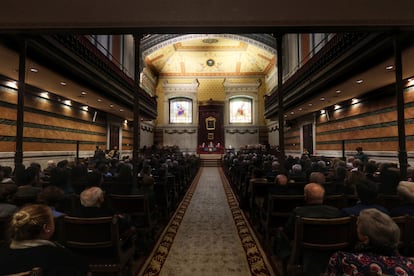
This Thursday there was a plenary session, like every Thursday. It came, evidently, preceded by the controversy accumulated in recent days. Several academics consulted by this medium maintained that they did not remember a plenary session that was preceded by so much tension. Arturo Pérez-Reverte attended the meeting. He presented, in summary, the same complaints as in his article. The development of the plenary session was calm, but several speakers, as EL PAÍS has learned, showed their “rejection” for an academic to express himself as Pérez-Reverte did in a media outlet. Some reproached him for his “ignorance” of the daily work of the Academy and several valued the work of the current director very positively. Time choked the session and not everyone could participate, so the debate will continue next week.
On the defensive
Not all, but within the RAE there are many who, after the publication of the article, these days defended a vision different from that of the novelist. Several academics (who prefer not to give their names) flatly reject the idea of a frivolous Academy or one dominated by dogmatic philologists. And they remember that the institution functions as a “confederal regime”, in coordination with the American Academies (also the Philippines and Equatorial Guinea), and that no word is approved lightly: first it is studied in delegated commissions of six or seven academics, then the pan-Hispanic sphere is consulted and only in case of conflict is it discussed in a delegated plenary session. “There is no bias,” several academics insist. The RAE—they emphasize—has been structured for decades into three unofficial thirds: literary creators, philologists and a heterogeneous group that includes jurists, doctors or scientists. “Nothing has changed,” they say. The RAE consists of 46 full academics, elected by an absolute majority of the voters of the plenary session. The last person elected is Cristina Sánchez López (elected last March), and the last member to enter after giving her speech, Javier Cercas. Symptom of blockage in the institution or not, the truth is that last May Luis Alberto de Cuenca and Luis Fernández-Galiano competed for the chair obut neither of the two candidates obtained the necessary votes, so the place remained vacant (the seat is also free L).
Some internal voices have been harsher with Pérez-Reverte these days. A member of the Academy accuses him of being provocative in his article and of offering an “obsolete” vision of the Academy and linguistic change. “There is no war here between writers and philologists,” others emphasize. “What there is are personal philias and phobias.” The truth is that we would have to go back to 1968, when Dámaso Alonso was elected, to reach an RAE directed by a writer. The following directors of the institution (Fernando Lázaro Carreter, 1991; Víctor García de la Concha, 1998; José Manuel Blecua, 2010; Darío Villanueva, 2014) were philologists. Muñoz Machado, who came to the management in 2018 and who helped with crucial financing after a reduction in state funds that seriously affected the institution (especially during the Government of Mariano Rajoy), is a jurist.
The Cervantes front
The turbulence that the RAE is experiencing is not limited to the clash with Pérez-Reverte. For months, the organization has maintained an open battle with the Cervantes Institute, headed by the professor and poet Luis García Montero. In October 2025, García Montero publicly criticized the fact that the Academy is directed by a professor of Administrative Law and not by a philologist, suggesting a technocratic drift and a disconnection with the linguistic essence of the institution. The reaction of the RAE was immediate: the plenary session approved a declaration of “absolute rejection” of the poet’s words. Many interpreted his statements as a political attack – García Montero was a candidate for Izquierda Unida in Madrid in 2018 – rather than as a technical criticism. Precisely, Pérez-reverte was one of them.
Beyond the personal, the conflict moved to the international level during the 10th International Congress of the Spanish Language (CILE), held in Arequipa from October 14 to 17, where the friction between both institutions became visible. Since then, Cervantes has reproached the RAE for the “one-way” choice of Panama as the venue (in 2028) of the next congress. The Institute wields a document, to which EL PAÍS has had access, signed by previous heads of the RAE (then the director was José Manuel Blecua) and that regulates a joint procedure for the election of the CILE headquarters. At the Academy they reply: “The first thing of all is for a country to make a proposal to host the CILE. And so far the only formal proposal is that of Panama.” Despite everything, García Montero has softened his speech and has assured that he has not broken “any bridge” with the RAE.
It is easy to explain: the incompetence of successive Foreign Ministers, especially the last one, has caused us to lose Hispanic America. The only link of diplomatic prestige that is still maintained with it, thanks to the RAE, is the Spanish language. Exteriors,…
— Arturo Pérez-Reverte (@perezreverte) October 15, 2025
In the midst of the storm, Muñoz Machado has received the support of academies on the other side of the Atlantic and institutions such as the Royal Academy of Moral and Political Sciences, which has described external criticism as “unjustified and out of place.” Several academics deny any government interference, something that has also been suggested in recent months: “We know that the Government does not attack the Academy; on the contrary, we have always noticed its support.”
“Although it may not seem like it, peace normally reigns here,” several members point out. Still, the wounds are evident. “There are many people hurt,” admit others, who lament the reputational damage and the feeling of tearing in a house used to resolving its disputes behind closed doors. All this also comes at a key moment: in December the next director of the RAE will be elected. Muñoz Machado himself could run, but for a second re-election two-thirds of the votes are required, something very difficult to achieve. The institution that aspires to fix the language today faces a more urgent and delicate task: recomposing its own story and deciding what balance it wants to maintain between tradition, use and authority in this 21st century. As of today, no candidate has yet officially presented himself to lead the Academy in its next stage.