
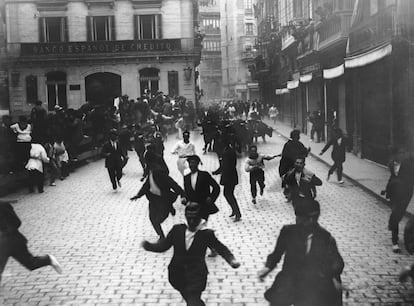
a group of friends turnips He travels from Paris to the Sanfermines and drunkenness and entanglements ensue. Their excesses and fights take place in a setting, the Pamplona festivals, which confronts them with violence and the existential emptiness that consumes them. There is a boy, the narrator, and a girl who really like each other, although the truth is that everyone is crazy about her. They are quite dilettante, daddy’s sons. They behave badly. They carry some trauma or other. They have not yet found a clear meaning in their lives and they party a lot. This plot, which would serve to put together a good story today, is the same one that has been engaging readers of the first novel by Ernest Hemingway (Chicago, 1899- Idaho, 1961), with which he conquered critics and exploded sales. Fiesta It crowned its author as a totemic figure of American literature in the 20th century, it gave a name to the unease that consumed young people between the wars—“the lost generation” as Gertrude Stein called them—and renewed the Spanish cliché for foreigners.
Become an instant classic since its arrival in American bookstores in October 1926, Hemingway’s novel debut marked a milestone in making modernist narrative techniques a mass phenomenon in the English-speaking world. It has never been out of print and remains one of the great American novels of the 20th century. The title in the United States (The Sun Also Risesthe sun also rises) changed to Fiesta (one of those that the author handled) in the English edition of 1927. In Spanish it was published for the first time in Argentina in 1944 and in Franco’s Spain in 1948. The first translation was quite wrong and Spanish critics did not appreciate the work, but censorship allowed its publication, probably because of the tourist vision it presented of the country.
“The book had a cataclysmic effect on the Anglo-Saxon world,” says critic and writer Rodrigo Fresán, author of Sun and shadow and Partya study of Hemingway’s novel that will be published next October in Debate, and that completes the work that began with Little Gatsbythe essay he dedicated to the legendary book by Scott Fitzgerald. “They are twin works in some ways, they make a forensic observation of people who behave badly. But in The Great Gatsby They continue drinking champagne, the hangover that Hemingway shows in his characters has not yet arrived. AND Fiesta “It also inaugurates adventure tourism, and that exaggerated love for Spain.”
The modernist features of the novel have to do with its structure, with the dialogues that replicated the fresh orality of the young protagonists—“Evelyn Waugh said that Hemingway had an unmatched talent for transcribing drunken conversations,” Fresán points out—. Also with those short phrases almost without adjectives that marked a dry style, more in line with the automation of the modern world and the rhythm of our lives than the baroque phrasing of previous generations. Fitzgerald’s novel spoke of a modern world, but he told it in a classical way. Hemingway, whom the author of Soft is the night supported by introducing him to his editor and helped trim Fiestabroke the deck.
“From his arrival in Paris, Hemingway was ready to dominate the literary world, but the inhabitants of that kingdom were not yet ready to succumb,” explains Lesley MM Blume, author of Everyone behaves badly (Everyone Behaves Badly), a wonderful and well-documented chronicle of the intra-history of Fiesta. “The author and his novel are the fruit of ruthless ambition. Fiesta It is gossip turned into high literature,” says Blume in a telephone conversation from Los Angeles.
Although he had the support of Gertrude Stein and Ezra Pound in Paris and there he forged his friendship with Fitzgerald, magazines rejected his stories and fame eluded him. I had started three novels that came to nothing, so I wrote chronicles for The Toronto Star and that was how he arrived at the Pamplona festivities in 1923. The following year he returned with his first wife, Elizabeth Hadley, and several writers including John Dos Passos and Robert McAlmon.
In July 1925 he returned to the Pamplona festivals with another group. The photo of all of them on a terrace in the Navarrese city was what instigated Lesley MM Blume’s work. And it turned out that the characters of Fiesta They were barely concealed and faithfully corresponded to that same circle of Americans and British with whom Hemingway went on a spree. Only the writer’s wife was left out of the story, and there is another fundamental fictional detail in the book’s story: the narrator, alter ego of the author, is helpless from war wounds, while Hemingway was seriously wounded on the front lines in Italy during World War I, while working as an ambulance driver. “Someone who became a hypermasculine icon played with a certain ambiguity here to enhance the story,” Blume notes.
The beautiful Lady Brett Ashley Fiesta She was the British aristocrat Lady Duff Twysden. Robert Cohn, the rich Jewish graduate of Princeton and tennis player with whom he starts Fiesta It was Harold Loeb —“Hemingway shows fierce anti-Semitism towards him,” Blume notes. Comedy writer Bill Gorton was actually screenwriter Donald Ogden Stewart (Oscar winner for Philadelphia Stories), who after reading the novel said that it was not fiction, but a detailed report of what happened in Pamplona and ironically defined it as “journalism.” Cohn’s girlfriend, Frances Clyne, was Kitty Cannell, and she talked about the BS life and the AS life (before and after Sun), making clear the shock that the novel had on its real protagonists, according to Blume in his book.
After the San Fermines of 1925 Hemingway continued his journey through Valencia, Madrid and Hendaye with his wife, while he transferred everything that happened in Pamplona to his novel. “He wrote in a trance, he had the first draft ready in September. Every insult and outburst, every unrequited affection became literary material,” says Blume. “He was not the first to expose the adventures and escapades of foreigners in Paris: the Latin Quarter was in those years a glass box in which everyone threw stones. Nor was it the first time that the dissolute life of people who drank a lot and slept with the wrong people appeared on the page, but Hemingway did it in a different way.” His secret? “He understood something deeper about the human condition, longing and nostalgia. There is a decadence that refers to a generation that lost its moral compass. And he managed to please all audiences with this book.”