
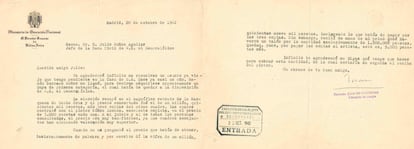
On October 20, 1942, a letter arrived at the Civil House of the Generalissimo in which a debt of 9,000 pesetas was claimed from Francisco Franco for not paying three copies that he had ordered of a painting by Goya, specifically, the portrait of The Marchioness of Santa Cruz which the dictator bought with the intention of giving it to Hitler. Franco liked the painting so much that he ordered those versions to give as gifts, but when the time came to pay, he did not do so, as is now revealed in the document that the gallery owner and art historian José de la Mano, passionate about the painter, bought at the end of 2025 at El Rastro in Madrid.
The Marquis of Lozoya, Juan de Contreras, in charge of Franco to look for the gift for Hitler, requested in the letter, in the kindest way he knew how, to Julio Muñoz Aguilar, the dictator’s assistant, a solution for “an old issue,” as he describes it. “Almost a year ago, Ramón Serrano Súñer (Franco’s brother-in-law and minister) called me to tell me to urgently acquire a first-class Goya, which should be at the disposal of HE the Generalissimo,” he writes. “The choice fell on the magnificent portrait of the Marchioness of Santa Cruz and the agreed price was one million, five hundred thousand pesetas, plus three copies of the same painting, which I contracted with the painter Nuñez Losada, an excellent copyist, for the price of 3,000 pesetas each,” he continues. “I received from my cousin José Navarro a check for the amount of only 1,500,000 pesetas. Therefore, the three copies of the artist remain to be paid, that is, 9,000 pesetas more.”
“We knew the history of this painting well, but we knew that a piece was missing about what Franco’s purchase was like in 1941,” explain those responsible for the DELAMANO Old Masters gallery. “With this letter what is proven is the amount that the dictator paid, it was always believed that it was less, one million pesetas, it is also confirmed that he ordered three copies to give to the family that owns the painting (the marchioness’s heirs), not one, and who is the painter who made them,” the gallery owners point out. It is difficult to calculate the equivalent price today; if the CPI is taken as a reference, the cost in 2026 would be between 2.5 and three million euros. In asset terms, it can be considered an operation reserved only for an economic elite capable of acquiring a masterpiece worth more than the current 10 million euros.
The story of the Goya painting that Franco wanted to give to Hitler has gone from urban legend to proven fact in a series of chapters that have been revealed for almost a decade. Several books and scientific studies have tried to reconstruct the journey of a piece that has passed through the hands and homes of noble Spanish families and those of the dictator; that it was illegally exported; and finally rescued by the State until returning to the Prado in 1986.
The new installment of this novel is not limited to the letter. Weeks after they bought it at El Rastro, one of the copies that Franco left behind appeared. “I am obsessed with Goya, twice a week I search specialized websites in search of all kinds of materials about the artist. Furthermore, for my work, I have to review all the auctions held in the world,” says De la Mano. “In one of these reviews, I found in the auction catalog of a mansion in the south of France a portrait of the Marchioness of Santa Cruz. There I said to myself: ‘This is one of Franco’s copies.’
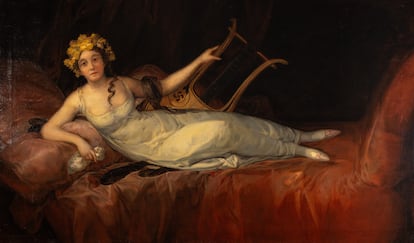
He bought the painting “blindly,” he says, because the work was classified as from the 19th century and its provenance was attributed to the supposed heirs of the marchioness. “I bid over the phone and took it,” says the gallerist. Upon receiving the piece he was able to verify that Nuñez Losada, the painter referred to by the Marquis of Lozoya in the letter in which he claims his debt, copied Goya’s signature, but underneath he noted that it was a copy of the Aragonese original. Bingo! It was one of those versions. “I don’t usually have this luck,” the art historian acknowledges with a laugh.
“The work has a yellowish tone because it copies Goya’s original painting with its oxidized varnish, that is, when the piece was still dirty,” they explain from the gallery. “The precariousness of painting materials after the Civil War has caused the painting to have extensive cracking that makes it look even older.”
How much is a work of this type worth? “It is of a great quality that shows that it was copied before the original trying to interpret the qualities of Goya,” they say, although they do not want to reveal the price. “It has more symbolic than commercial value, after all, it is a copy of a Goya painting.” In 1941, an average annual salary in Spain was below 4,000 pesetas, which accounts for the value of copies at that time.
The perfect gift
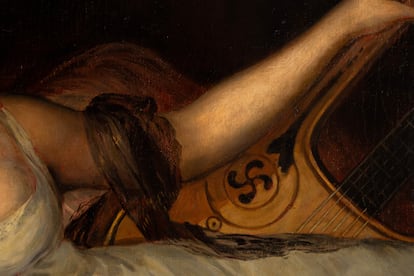
The first chapter of this bizarre story begins in 1805, when Goya paints the portrait in which he disguises the young Marchioness of Terpsichore, muse of dance, poetry and song. In his hand he places a lyre on which he draws a quadruped, a Basque symbol that consists of a four-headed cross, which will be one of the keys for which Franco will choose this work as a gift.
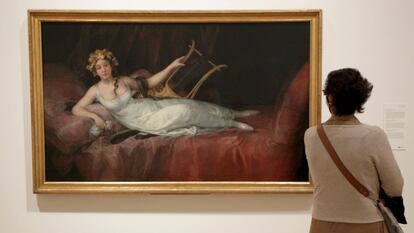
In 1939, the dictator, who knew well that one of Hitler’s weaknesses was art, gave him three paintings by Zuloaga, as historian Arturo Colorado recounted in 2018 in his book Art, revenge and propaganda (Chair). But it did not seem like enough, so to continue with the courtship towards the one who seemed to be the owner of the world, Franco created a committee in charge of searching for a more important artistic jewel, a goya. “Further proof of the instrumentation of the heritage that he made at his convenience. He used it when it suited him as a secret negotiation weapon or as propaganda,” Colorado explained in an interview in this newspaper.
The archaeologist Julio Martínez Santaolalla, the Marquis of Lozoya, and Serrano Suñer took on the task, with the advice, among others, of the artist José María Sert. They decided to The Marchioness of Santa Cruz for its neoclassical style and they were convinced when they found the similarity between the four heads of the lyre and the Nazi swastika. The perfect icing on the cake.
During the Civil War the painting had been moved from Madrid to Valencia. From there he traveled to Barcelona until he finally arrived in Geneva, from where he returned to the capital of Spain when the war ended under the orders of the Franco authorities. In 1941, as proven by the letter acquired by De la Mano, Franco finally bought it for 1.5 million pesetas, not the million that was believed until now.
The dictator already had his artistic jewel, but decided to wait. The course of World War II changed, Spain declared itself neutral and finally did not give the painting to Hitler.
In 1944, the work returned to the Prado Museum. Its owner is Franco, but this information disappears from official documents. And it is at this moment when the story of the marchioness’s painting becomes tangled. There are certain theories that maintain that the work hung in the Palacio del Pardo until February 19, 1947, when it passed into the hands of its next owner, Félix Fernández-Valdés. The trace of the money confirms that the Basque collector also paid one and a half million pesetas for the fabric, according to a receipt from the Banco de Vizcaya in Madrid included in the publication. Masterpieces from the Valdés Collectionpublished by the Bilbao Fine Arts Museum between 2020 and 2021.
The painting remained in the Valdés collection until 1981 or 1982, when it is estimated that his heirs sold it – several studies suggest that it cost around 600 million pesetas – and the new owners illegally removed it from Spain. The Marchioness appeared in 1983 at the Getty Foundation in Los Angeles. The painting was for sale for 12 million dollars, about 39 million today.
Representatives of the Ministry of Culture, then led by Javier Solana, and the lawyer Ramón Uría traveled to the west coast of the United States, in whose memoirs, the writer Mercedes Cabrera, recounts for almost 20 pages a fascinating road movie through different capitals of the world chasing the painting. Art dealers and collectors appear with few scruples and a lot of money; and even the lawyer of Queen Isabel II, key in achieving the judicial milestone that allowed the work to return to the Prado Museum in 1986.
This 2026 marks 40 years of this record and the art gallery is preparing an initiative to commemorate the return. “It served to recover a fundamental work and increase the country’s self-esteem, winning a process in international courts,” said Miguel Falomir, director of the museum, in an interview in EL PAÍS in 2018.
In less than two months, the DELAMANO Oldmasters gallery has solved another chapter of this story, but in their obsession to continue investigating, they showed Prado experts their findings. It was at the museum that the curators asked the gallery owners if the copy they had bought in the south of France was that of Imelda Marcos, the excessive wife of the Filipino dictator Ferdinad Marcos. The response was the experts’ surprised faces. They had just been given a new clue. “I have not found Imelda’s work, but after further investigation, she had a painting of the Marchioness with the same measurements as the copy I bought,” says the gallerist, marking the way to a new discovery.