
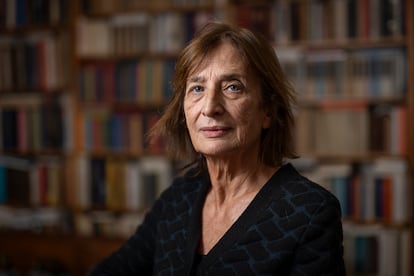
It will be because one has the series fresh in one’s retina. Nibelungs: the war of the kingdomsbut Victoria Cirlot looks like Brunhilda in her Barcelona apartment this afternoon. She has always had something wild in her profile and in her look and if you add that she wears black from top to bottom and with leather pants the comparison with the queen and Valkyrie is made. Fortunately you don’t have to go through fire to get to it. There are many swords in his house – like the iconic ones of his father, the poet Juan Eduardo Cirlot – and from where we speak you can see one in his office that seems to float in the air like in the Arthurian legends, in which Victoria Cirlot (Barcelona, 70 years old), professor of Romance philology at the Pompeu Fabra University, is a great expert. The medievalist has just published Marginalia(Vaso Roto, 2025), a miscellany of texts that cover an enormous variety of cultural topics (myths, Wagner, Tapiès, medieval mystics, architecture, Calasso, the seraphim) and also some writings of a personal nature, with exquisite prose. During the interview, Gurdjieff’s sacred music plays in the background.
Ask. That mutilated lead figurine of a medieval knight will not be a warning to visitors…
Answer. No, I always have it there on the table; Poor diminished gentleman, every day he lacks something.
P. It makes you think of Monty Python and also of the Cowardly Knight, which you have written about.
R. It is a very beautiful story, that opposing knight who rides mounted on his back and with his armor upside down, and who refuses to fight; He does well, because his destiny is to be killed.
P. Have you already seen the Tristan and Isolde from high school?
R. No, I’m going on the 23rd. I love Wagner, he is the great author of the Middle Ages, he controls the original myth so well…, it’s a joy how he updates it.
P. You will have seen the series about the Song of the Nibelungs.
R. No, is it good?
P. Special. It’s focused on the bad guy, Hagen.
R. (sings) Hagen, what are you doing?Hagen, what have you done? I love that scene from Act III. The twilight of the gods in which Hagen stabs Siegfried with his spear and, before dying, he recovers his memories of Brunnhilde. Wagner interrupted writing so as not to disfigure the tetralogy with that love theme and then made Tristan and Isolde before returning to it. Tristan, Siegfried… I really like heroes!
P. She is a fan of the Arthurian world, the legend of the Round Table, the Grail, what is it about those stories that move us so much?
R. They live inside me, inside us. They are a treasure of Western culture, part of our heritage.
P. Who do you identify with most in the cycle, Guinevere, the Lady of the Lake, Morgana?
R. With none of them. I identify with the knights and especially with Lanzarote. An archetype of animuswhat Jung would say, the eternal masculine in the unconscious of women. I find the role of women in the Arthurian world a little boring. And there is Nimué, Merlin’s young climbing assistant who takes advantage of the old man: she horrifies me.
P. Well, Lancelot has many shadows, a traitor to Arthur, an adulterer…
R. But he has the courage to get on the wagon, a degrading act for a gentleman, out of love for Guinevere. It is told by Chrétien de Troyes.
P. Lately the Lanzarote-Geneva relationship has been discussed, do you think there was sex?
R. Of course! Guinevere takes him to her bed and Chrétien speaks very clearly of joy and pleasure. In any case, the most beautiful thing about myths are the variations.
P. Do you see some myth in Trump?
R. He plays the bad guy, but not the one from medieval legends—Hagen or Mordred—but rather the villain of Superman or Batman.
P. What film adaptations of the Arthurian cycle do you recommend?
R. They never fully respond to what you imagine, however scale by John Bormann, the Lancelot of the Lake by Robert Bresson or the Perceval by Eric Rohmer have very good things.
P. In marginalia, In addition to some beautiful passages (“I never returned to that garden where the statues stood silently coexisting with a sometimes devouring nature”), it refers to how much is inexplicable and incomprehensible in our lives.
R. I cannot think that we live in a solely material world, I believe that there are others and that imagination is not vain. At least it’s good to think about it. There is a need to look at other realities. Make the invisible visible.
P. And how do you live today with your interests and your ideas?
R. I find very like-minded people, which makes me very happy. Many people who dream and imagine and do interesting things, and know how to read well and converse.
P. They often discuss the word “fairy” with me, can you believe it?
R. No! “from the fairies”, I use it a lot, it is a wonderful word. It must be vindicated.