
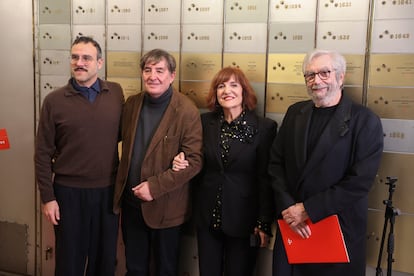
Elvira Lindo’s legacy is found inside a small golden box. It was “very difficult for her to let go of them” this Monday afternoon, but the writer took to the Cervantes Institute a sample of the things that make her spend her life “in the best possible way”: drawings, stories, notebooks and photographs of her loved ones. “It is a legacy that has to do with childhood,” said the one who won the National Prize for Children’s and Youth Literature in 1998. Among the objects are two books from when she was little. The work Tom Sawyer across the world, by Mark Twain, and a novel by William Brown.
“There are so many things” that the journalist does not know if anything is left out. “There is a radio script because I wanted to show the places where I have worked and I love so much,” admits Lindo. “There is cinema, literature… What I know how to do the worst is drawing, it is exactly what I have had the most fun with. So if in the future they do an exhibition about me, let it not just be an edition of a book, but rather something more about how I am: a little childish,” she expressed, accompanied by her husband, also a writer and Princess of Asturias Award for Literature Antonio Muñoz Molina, and her son.
A collection of drawings that she herself made of artists from when they were little “because that is when anyone deserves love and compassion, from Michael Jackson, Lucia Berlin, Frida Kahlo, David Bowie… to Antonio Muñoz Molina on a fairground donkey.” A photograph of both of them in Paris — “one of the first they took of us publicly” — and the book open heart in Dutch with a photo of Lindo’s parents on the cover. As well as a very “peculiar” photograph of his son “lost in a drawer” and which was revealed a few days ago.
After signing the documentation, Elvira Lindo took her drawings, looked at them for the “last time” and placed them inside the box with the number 1,610 engraved on the door. The small space gave the impression that there would be no room for the folder. From the hands of the director of the Cervantes Institute, Luis García Montero, Lindo received the objects of his legacy one by one and placed them in the box. “Oh, my first glasses,” the author exclaimed, as if they had been missing for so long until that moment. He paused for a few seconds with each memory. Appeared Sleepless nights, that it was not an edition for bookstores, but “for friends.” The script of The unexpected life, movie filmed in New York “and that it cost so much to shoot,” along with an unpublished text by Muñoz Molina about the writer’s relationship with that city.
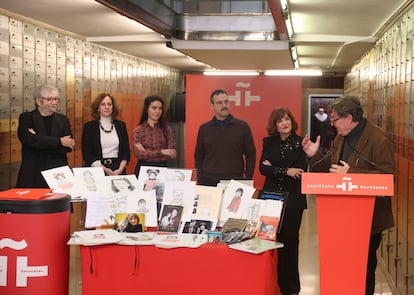
Each box has two keys: one for the Instituto Cervantes and another, in this case, for Elvira Lindo, who asked if she could take the things out or the key was just for the souvenir. Laughing, the director of the institution replied: “You can even put more things in.” On her door it reads: “Elvira Lindo, writer. Bequeathed on 01/12/2026.”
At the event, the director of the Cervantes celebrated “the literary strength” of Elvira Lindo, who managed to turn an already very popular radio character, as Manolito Gafotas was in the beginning, into a literary one. And do it with humor, “without sarcasm”, overcoming “the temptation of the politically correct” when exploring the territories of the family, the neighborhood (Carabanchel Alto specifically), friends and “an imbecile brother.” García Montero also highlighted the “large doses of poetry and humor” found in Lindo’s “adult narrative,” and mentioned works such as The other neighborhood, A word from you, What I have left to live o With an open heart, as well as his journalistic articles and essays. “Comic without remedy” and “resilient in her daily struggle against any censorious voice,” the director of the Cervantes highlighted her “intelligence, innocent look and desire for mischief” of the author.
At the end of the actor the documentary was screened Elvira Lindo, for example, an example…, directed by Iván Marín González.
The Caja de las Letras keeps in its safe deposit boxes the legacies that since 2007—the writer Francisco Ayala, winner of the 1991 Cervantes Prize, inaugurated this cultural ritual—have been deposited by cultural personalities in Spanish. Renowned writers—including all the Cervantes Prize winners since that year—and prominent names in cinema, art, music, dance, theater and science have left traces of their life and professional careers in this old vault of the Cervantes Institute in Madrid. Due to their dimensions, it is difficult to imagine that they could accommodate any object larger than the typewriter left by the Chilean Nicanor Parra. The Caja de las Letras treasures these symbolic legacies under lock and key as a living memory of the culture of Spain and the Spanish-speaking countries.