
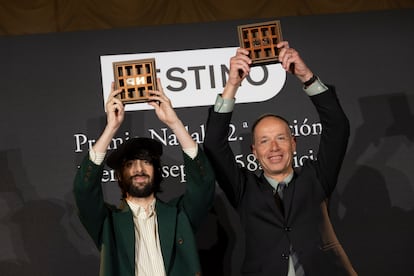
David Uclés had already publicly announced that he was writing a book about Barcelona in which Mercè Rodoreda appeared, but what was not known was that he would win the Nadal Prize for novels, on a cold night on Three Kings’ Day for this work, titled The city of dead lights. The award, granted by the Destino publishing house, part of the Planeta group, is worth 30,000 euros. It is Uclés’s first novel after the success of The peninsula of empty houses, published by Siruela in 2024, which has turned the author into a literary phenomenon and has removed him from anonymity in record time. With the award, Destino also snatches one of its star brands from Siruela.
As is customary, the Palace Hotel in Barcelona hosted the gala ceremony for this historic award on January 6, which is now in its 82nd edition. Last year, when Jorge Fernández Díaz won the award, Uclés premiered at the Palace and caught many eyes in a traditional evening of Barcelona literary life. In the same ceremony, the Josep Pla Prize, intended for prose in Catalan, which reaches its 58th edition and is endowed with 10,000 euros, was awarded to the philosopher Francesc Torralba for the essay Anatomy of hope. Both awards, for which 1,207 unpublished works had been submitted in Spanish and 42 in Catalan, will be published on February 4.
Without taking off his usual beret, David Uclés excitedly collected the award and said that he had entered Nadal from 2010 to 2020 every year, until he gave up his efforts. But this summer he was encouraged again and tried it with this choral work that brings together those intellectuals who were born here or made Barcelona their city. Among the writers who have inspired her, she has mentioned Mercè Rodoreda, Montserrat Roig and Carmen Laforet. “Without them and their literature, this novel would not exist,” he emphasized while the audience burst into applause. He also said that he was able to write the book thanks to the support of the Montserrat Roig scholarship.
The author has also thanked the support of his family, his parents and his sister, with whom he has formed a “very beautiful core of love thanks to this strange dream.” And he has thanked his three agents, whom he has compared to the holy trinity, and the Siruela publishing house. “I am the writer I am thanks to them; I love them, they are also my family,” he stated.
It is curious that she is Carmen Laforet, the writer who won the first Nadal Prize in 1944 with her novel Nothingone of the protagonists of this work by David Uclés (Úbeda, 35 years old), which is set in the same historical period as that of Laforet and follows the path of magical realism using characters from the cultural world as he already did with The peninsula of empty houses.
The novel takes place in a post-war Barcelona that has been left in darkness, and a young Laforet could be responsible for such darkness. At a crossroads of times, it will be characters like Ana María Matute, Antoni Gaudí, Freddie Mercury, Roberto Bolaño or Mercè Rodoreda who will have to find a way to unite their arts to return light to the city. The presence of Rodoreda, who already appeared in The peninsula of empty houses and of which Uclés has confessed himself devoted, at a time when the work of the Catalan writer, author of Diamond Square o The death and the spring, It is being revalued with tributes, rereadings and translations around the world.
Not only are characters from different eras found in this story, which was presented with the fictional title Another summer day roars and under the pseudonym Oriol Arce, but they coexist with buildings that would not correspond to them due to the date of construction. In this way, the city becomes a crossroads of eras and citizens that turn the novel into an imaginary story where nothing that happens could have been, but part of what appears has taken place.
The assault on a competing author through the granting of an award is a strategy that has been practiced on previous occasions in the publishing world. It happened, for example, in the 2019 edition of Planeta, when Javier Cercas and Manuel Vilas left the Penguin Random House group to lift the competition trophy. The same thing happened in 2021 when Jorge Díaz, Agustín Martínez and Antonio Mercero, the trio of authors who sign under the pseudonym Carmen Mola, won the same award.
In the case of Uclés, Planeta takes over another best-selling author. Committed to the historical memory of Spain, the author took 15 years to write The peninsula of empty houses and traveled 20,000 kilometers to learn about the geography of the Civil War, according to what he said in an interview with EL PAÍS last October. A 700-page novel that goes through the conflict and where the fantastic mixes with the real, where an extensive clan of olive growers from Jándula crosses their destinies with those of Alberti, Lorca and Unamuno, Hemingway, Orwell, Picasso or the aforementioned author of broken mirror.
The novel came out in the spring of 2024, but it was not until the approach of Christmas that it began to become a phenomenon. A success that caught him off guard because of everything it entails. His greatest ambition was to have a good review in and get to the second edition, he acknowledged. It exceeded all their expectations: it was the second most voted title on the list of of the best books of that year and is now in its 29th edition.
In the subsequent press conference, Uclés told a little more about the plot of the novel, which has 300 pages, although he did not want to reveal most of it for readers to discover. In addition to the fact that it starts with Carmen Laforet and a blackout in Barcelona, he explained that almost a hundred relevant figures from the cultural and even scientific world of the city appear, as is the case of Ramon y Cajal.
With touches of humor and Kafkaesque at the same time, the author has given as an example of the style a passage in which Gabriel García Márquez and Carlos Fuentes try to convince Vargas Llosa not to have heart surgery, since his intention is none other than to change it, or another in which he has Salvador Dalí varnish the streets of the city to try to restore that lost light. More recent personalities such as the playwright Josep Maria Miró or the singer Rosalía also have a place in history.
“It is even more dreamlike and surreal than the previous one,” he said. Totally fascinated with Barcelona and its culture, Uclés has spoken of it as a “love letter” to the city and has stated that currently Death and spring by Rodoreda is his favorite novel. It is this time that he has dedicated to discovering Catalan culture, he has also marveled at the sea, by Blai Bonet. He has praised Montserrat Roig’s essays and Maria Mercè Marçal’s poetry, in addition to the style of Pere Calders, also close to magical realism.
Regarding the change of publisher, the writer has been calm. “I have been able to speak with Siruela, everything is fine.” Will continue working with them because The peninsula of empty houses continues, there are presentations and translations into other languages. “They are my family, I don’t feel like it’s a mourning,” he added, while considering that “each work has its place and time.” And this is the one The city of dead lights with Destiny.
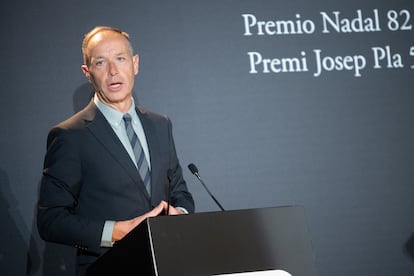
Josep Pla once again awards the essay
If last year David Bueno won the Josep Pla Prize for prose in the Catalan language with the work The art of serving humanswhich connects science and humanism, Destino continues to focus on the essay, awarding Francesc Torralba (Barcelona, 58 years old) for Anatomy of hopean exploration of the mechanisms that sustain the spirit when all seems lost. With deep and clear prose, the philosopher shows how horizons can be built and meaning rediscovered in times of uncertainty. The jury has considered it an essential map to orient yourself in the face of uncertainty.
Torralba has received the award “very honored and pleased”, not only because of the name it bears, dedicated to the Empordà writer, but “because of the list of winners” who have preceded him. Briefly, he said that it is an essay about hope “with a speech with foundations” because “without hope it is impossible to live, build and project futures.” The philosopher has argued that this is a countercultural argument in a world where the future is told through apocalyptic and dystopian stories.
Torralba, who has a doctorate in Philosophy, Theology, Pedagogy and History, is a prolific author with more than 100 books published, many of them related to spirituality and ethics. He lost his son in a mountain accident in 2023 and, from this painful experience, he wrote There are no words. Accept the death of a child (Ara Llibres, 2024). With this new title, its focus remains on hope.
In the subsequent meeting with the press, the author defended that “hope is more necessary in contexts of darkness.” At all times he has referred to the discourse of the essay as “transgressive and disruptive” because the general dynamic is one of catastrophism, but he has left it to the readers’ judgment to confirm whether it is a good essay.