
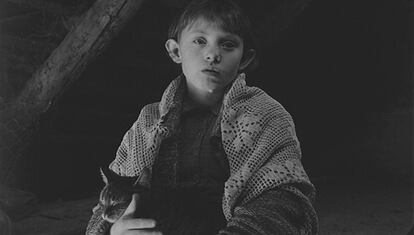
When Béla Tarr found out that the tickets to see Satan Tango They were exhausted, he suggested that I change his return ticket to Budapest, because he wanted to stay and present it. That happened a couple of years ago, on the occasion of the retrospective we dedicated to him at the Filmoteca de Catalunya. The room, indeed, was packed and at one in the morning I ended the discussion with the more than 200 survivors of that marathon session that had begun at four in the afternoon on a Sunday in which, as the Hungarian filmmaker recalled, Barça was playing against Madrid and many of the spectators had not been born when he filmed his magnum opus in 1994. It was an adaptation of the novel of the same name by László Karsznahorkai, the last Nobel Prize winner in Literature and one of the mainstays of his cinema, along with the composer Mihaly Vig.
A few days before he had also presented, with a full room, Werckmeister harmonies (2000) y The Turin Horse (2011), which he had decided would be his last film. He considered that, with this story of the animal that would have aroused Nietzsche’s compassion after seeing how his coachman savagely beat him, he could stop filming. “After that, what more can I say?” he said after the screening of a film that ends with the father and daughter who, by the light of a candle, coexist with an abused horse in a desolate rural landscape shaken by the wind. From his professional origins under the communist regime to his rejection of Orban’s far-right government, Béla Tarr had refined a very personal style based on the distant gaze, the long shot and cold, gray photography that had earned him the honorary award from the European Film Academy.
The week he was in Barcelona was intense, full of experiences like those his films make him live. In addition to the sessions at the Filmoteca, he presented another at the Zumzeig cinema and gave a master class in a film school that took place in an improvised shoot at the Chinese restaurant on the corner. Thanks to the private school that he ran in Sarajevo, which produced students like Pilar Palomero and Manel Raga, Tarr felt a special attachment to young people. Hence, reciprocally, they became interested in a cinema that does not exactly follow usual paths.
After the marathon session of Satan tangostill topped with a bottle of wine in the deserted lobby of a hotel, the filmmaker wrote to me: “I’m back in Budapest, gray and cold. I miss you, and Barcelona. Thank you for everything! I love you and the people. I had a great time with you and I felt really happy there. It’s not usual. I hope we can see each other again very soon.”
A little over a year later, he kept his promise, again in Barcelona. I was no longer directing the Film Library and, once the commitments for which I had been invited had been settled, he called me to meet. He asked for my collaboration to build a facility that he had not been able to develop with the municipal government of Ada Colau. It was about highlighting the dignity of the homeless inside a container. I found an ideal location for it, but there was no time for me to resume the project. He looked much older than he really was, although he knew that he had already given everything. And it was a lot.