
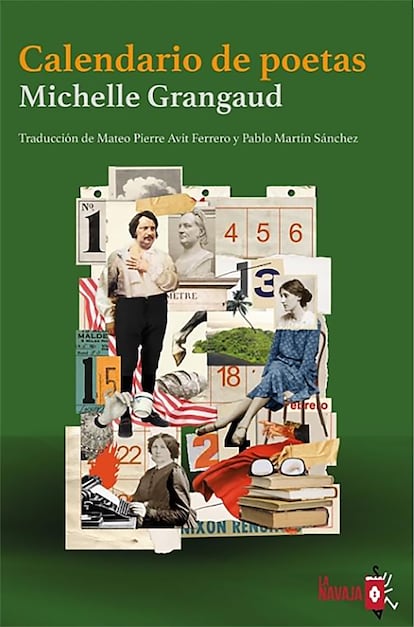
I remember the nights when I would look for what my horoscope had predicted for the day that had already passed and, using my method of reading and free interpretation, I would always manage to make the prediction fit with what had happened to me during the day. That method always worked so optimally that in the first hours of this year I decided to apply it to reading Poets calendarthe book in which the Algerian Michelle Grangaud (1941-2022) proposes a hyperactive compilation of anniversaries from the artistic field of the last four centuries.
The large and small anecdotal events appear ingeniously distributed throughout the diary of the entire year with which it deals. For example, on November 22 we are told that Nerval goes out every night in search of adventure in Vienna and feels in love not with one woman, but with all women.
The anniversary of January 1st Calendar I read about Grangaud in the early hours of this year: “Valery Larbaud, who writes, asks himself why he writes and answers that it is only to start the year writing.”
I immediately sensed that this would be the only phrase in the entire book that would not require free interpretation, since it meant the same thing in the Calendar of Grangaud than in the personal calendar that I was preparing to build for my own consumption. As if that were not enough, the sensation of fullness of the first hours of the year was suddenly contributed by the unbeatable soundtrack that came to me from the television: the happy clapping of the audience of the Vienna Opera who, standing up, accompanied the Radetzky March at that hour.
It was as if that standing audience were supporting my initiative to go, day by day, interpreting the anniversaries of the Poets calendar to discover what awaited my life over time, specifically over the course of this year.
There are not many Calendars like the one we are dealing with and that even provide one, if one so wishes, with the possibility of losing one’s sanity, just as the Oulipista Grangaud suggests that Apollinaire could have lost it when on June 24 on Orient Street he premiered his first play, Tiresias’s titscausing the word “surrealism” to enter the French language.
Poets calendar (Paris, 2001) has been edited these days among us by La Navaja Swiss and translated by Mateo Pierre Avit Ferrero and Pablo Martín Sánchez (the only Spanish member of the Oulipo workshop) and has become an essential book for me, since it allows me, for example, to know that tomorrow the 7th I will be able to relive a moment as minimal as it is dazzling in the history of the almost forgotten avant-garde of the last century. I’m talking about a moment without which surrealism would not have existed, the movement that replaced Dadaism. I’m talking about that January 7th when, at half past six in the afternoon, on the terrace of La Terrasse, in Zurich, Tristán Tzara finally found the word he was looking for: “Dada”. I will say it louder: whether eternal return exists or not, I hope to find that word there tomorrow as well.