
“He who sings his evils scares away,” says the saying. However, it took a lot of courage to do it in a Nazi concentration camp, even quietly, clandestinely. “You are tall and thin/ like your mother/ Salty brunette/ like your mother.” Or the Havana The dove: “If a dove comes to your window/ treat it with affection because it is my person.” They were two of the songs that the Spanish women imprisoned in the hell of Ravensbrück sang to encourage themselves and remain “thinking beings,” they said. That barely known episode in the recent history of Spain, that of those deported to the horror of the German prison system, wants to be recovered with a musical project that has already borne fruit in concerts and with an album, titled Forgottenfrom the Ensemble Cantaderas vocal group.
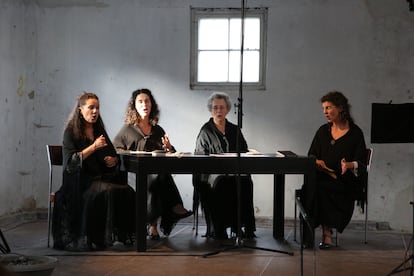
The need to recognize the suffering of those women arose, significantly, from a commission from the German State of Brandenburg to Ensemble Cantaderas, a group dedicated to recovering forgotten songbooks from the late 19th and early 20th centuries, although they also include medieval music in their repertoire. The group, which was born about 10 years ago, is made up of Ana Arnaz de Hoyos, Paloma Gutiérrez del Arroyo, June Telletxea García and Anne Marie Lablaude.
“Every three years, the Brandenburg Ministry of Culture organizes a concert in tribute to the women of a country who were imprisoned in Ravensbrück. In 2023 it will be the turn of the Spanish women,” explains Telletxea by phone. The scarce documentation makes it difficult to establish how many Spanish women were sentenced there. Gutmaro Gómez Bravo, professor of Contemporary History at the Complutense University of Madrid, says that based on the official Nazi lists and according to his latest studies, from 2024, the figure would be around 210. “The problem with establishing a specific number is that the Spanish women were detained in France and many gave false names or were married to French people and said that their nationality was French, and that was what the Germans transcribed, so “There were probably a few more,” adds Gómez Bravo, author, along with Diego Martínez López, of Deported and forgotten. The Spaniards in the Nazi concentration camps (The Sphere of Books, 2024).
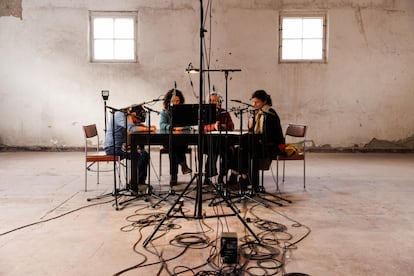
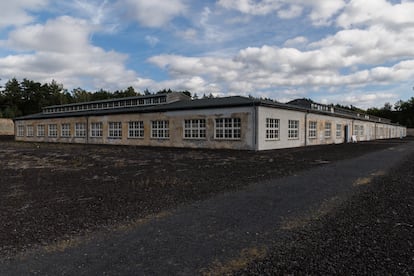
Cantaderas carried out her own musical and historical research, which included a stay of several days of rehearsals in the facilities of the old camp to give a concert, on September 23, 2023, in the same textile factory where the Spanish women had suffered forced labor. “I, who live in Berlin, was unaware of that episode in Spanish history. It meant discovering the struggle for survival of those women, their strength and their ability to be united, and how music, singing, helped them,” adds Telletxea.
When could prisoners sing? Telletxea points out that “since upon arriving at the field they had to undergo a quarantine, they did it there.” “And from the testimonies we collected we knew that, for example, on Sundays there was less surveillance, so they had more opportunity.”
In September 2024 the CD was recorded in that same place. Telletxea describes what that process was like: “Space conditions you and changes your perception of everything. When we listened to fragments of the recording, I was surprised by the weight that each piece had, it was moving. It made you remember the emotion of these stories and the feeling of healing wounds.”
The album, presented last May at the Institución Libre de Enseñanza, in Madrid, contains 29 songs. To those who documented that those women sang through direct and indirect testimonies, they added harvest songs, wedding songs, lullabies… those that were heard in Spain at the time. The Ensemble Cantaderas performers used their own hands as percussion to accompany their voices, in addition to stones collected in the lagerthimbles, spoons and a drum. As Telletxea says, “for those women, singing was a weapon against brutalization.” On July 3 they repeated their performance in Ravensbrück. That day the Spanish Government inaugurated a plaque on a wall of remembrance in the countryside.
During the presentation of the album, the historian Amalia Rosado Orquín, author of Spanish women in Nazi camps (Catarata, 2024), an essay for which she consulted archives from 14 countries, declared that, in addition to torture, women suffered rape and were turned into sexual slaves. Rosado recalled that they were given injections to eliminate menstruation so they could work every day. “They managed to do it with some, and with those who didn’t, they made them walk around naked to humiliate them.”
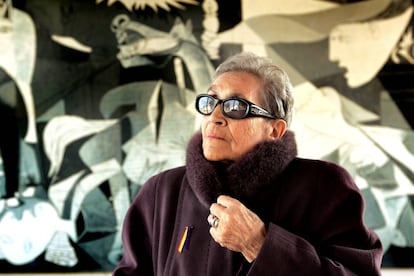
The CD is titled Forgotten because, as they explain in the magnificent libretto, “their country forgot them; the Franco regime declared the exiles stateless and they had to be welcomed in France.” Furthermore, many of them “were even forgotten by their families out of shame, and people did not begin to talk about the Spaniards deported to Nazi camps until the end of the dictatorship.” As Neus Català, the best-known Spanish woman who suffered that horror, who died at the age of 103, in April 2019, said, they were “the forgotten among the forgotten.”
Català had fled Barcelona when Franco’s troops entered at the end of the Civil War and went to France, where she joined the Resistance, but was arrested in November 1943. Tortured by the Nazis, she was sentenced to hard labor in Ravensbrück. in his book Of Resistance and Deportation. 50 testimonies of Spanish womenfrom 1984, described what her arrival at that place was like, an impression that continued to overwhelm her years later: “With a temperature of more than twenty below zero, at three in the morning on February 3, 1944, a thousand women from all the prisons and camps in France arrived at Ravensbrück (…) with its black streets, its black-green barracks, its black roofs, its leaden sky, its innumerable crows attracted by the smell of burnt and cadaverous flesh of those tortured women who, without respite, day and night, came out with chilling smoke from the four crematory ovens.”
This fighter collected, among others, the testimony of Alfonsina Bueno Vela: “One night she was singing The dove; When I see an Aufseherin (field guardian) arrive, I shut my mouth. ‘How will he punish me,’ I thought. But, astonished, I heard him say to me in Spanish: ‘Sing, sing, woman!’, and I asked him how he spoke Spanish and he answered: ‘I have come from Argentina to help Hitler. can sing The dove‘. And I said to myself: ‘What a pigeon you are, damn!’
The script of Forgotten It includes revelations such as that of Antonia Frexedes about Josefina González, known as La Maña, “who was beaten so badly that she was stunned.” “As soon as she heard the slightest noise she would start to shake; we had to rock her and sing to her to calm her down.”
Another example of how a melody could help stay alive is shown in the book die for freedomby Eduardo Pons Prades (El Garaje Ediciones, 1995), in which Ángeles Martínez spoke about María Dolores García Echevarrieta, alias Charlie. “She was like a mother, helping me survive in that hell. Once, when I was sentenced to 14 days in a punishment cell, accused of clandestine activities, she walked next to me, without stopping repeating to me: ‘Your confinement will be hard, very hard, but you must come out alive. When you feel sad, sing. Sing and you will live!’. I followed her advice and that’s how I was able to endure the ordeal.”
Who were these Spanish women? Mostly from humble class, although some had held positions during the Second Republic. What they did share was political awareness; they had fought against Franco and then joined the Resistance in France against Hitler’s advance. Català said in his book that “there were communists, socialists, women of the bourgeoisie, intellectuals, although the majority came from workers and peasants.”
Mercedes Núñez Targa, who wrote the book The value of Memory (Renaissance, 2016). “Along the way we see very cute little houses with starched curtains, with flowers, with blonde children with cheeks like red apples (…) Those happy little houses are the homes of our executioners, the SS of the countryside; those children, the children of the monsters.” Núñez also referred to the singing qualities of the prisoners: “Polish, Soviet and Hungarian women sing in chorus wonderfully. The French women are a little weaker (…). The strong point of the Spanish women is Constanza, who has a very fresh and well-pitched voice.” Eighty years later, Ensemble Cantaderas tries to ensure that “those forgotten people stop being forgotten thanks to music.”