
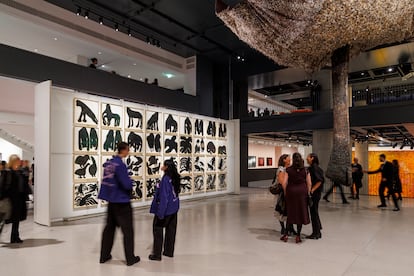
Something is moving in the cultural sector in Paris, which is resurrected as an artistic capital thanks to a new preeminence of private initiative. Over the past few months, the city’s ecosystem has entered a new phase, certainly more vibrant than in recent decades. But also more oriented towards art as a form of luxury, increasingly further away from the public model that used to be hegemonic in the French capital.
This is demonstrated by several milestones recorded in recent months. To begin with, the million-dollar results of the Art Basel Paris fair, a branch of which is held every June in Switzerland, where works worth 90 million euros were sold in the first four hours alone. Then, the inauguration of the new headquarters of the Cartier Foundation in front of the Louvre, in a former antiques shopping center transformed by Jean Nouvel. Around these two new poles, a new artistic Paris is being drawn, more spectacular and international. But, for critical voices, also more exposed to a conversion of culture into a mere financial asset.
There are doors that open, but also others that close. For example, those of the Pompidou Center, which has just closed to begin renovation works until 2030. The old Fiac fair, which since the seventies brought together French galleries in the Grand Palais, has been replaced by the Swiss giant Art Basel, which already organizes professional events in Basel, Miami, Hong Kong and Qatar, in addition to Paris. The glass-enclosed headquarters of the Cartier Foundation in Montparnasse, where the workshops as an artist at the beginning of the 20th century, is now history. The institution has moved to the center of Paris, to a building of a larger museographic scale, capable of displaying a larger part of a collection of more than 5,000 works, and equipped with an innovative system of mobile platforms that allows the space to be reconfigured according to each exhibition.
Its location aspires to seduce a tourist with high purchasing power who hardly leaves the center. The new headquarters is attached to a Louvre that is still recovering from the robbery of the century, in what was another sign, for some, of the decline of public museums, victims of tourist overcrowding and relative financial precariousness, compared to that of their new neighbors.
The landscape is in full transformation. The new building joins a cultural map in which since 2014 the Louis Vuitton Foundation, flagship of the magnate Bernard Arnault, whose fortune exceeds 200,000 million euros, has occupied a central position in a building owned by the late Frank Gehry, which has organized exhibitions that have made history, such as the one dedicated to the Russian collector Sergei Shchukin, patron of the avant-garde, the most visited in recent years in all of Paris. In 2021, the Bourse de Commerce was added, a showcase for the Kering empire, which owns brands such as Saint Laurent and Gucci. The building, remodeled by the Japanese architect Tadao Ando, brings together the collection of 10,000 works of its owner, François Pinault, in museum-caliber exhibitions, such as the one now dedicated to minimalism, which would once have housed the Pompidou Center.
Next to the more modest 19M, a cultural center owned by Chanel, dedicated to luxury crafts and new talents in art, the pieces are beginning to fit together in other ways. Paris leaves behind the model of cultural democratization designed in the Mitterrand years, which supported large public facilities and culture as a State service available to everyone, which set a trend in Europe and the world. Now another logic is consolidated: a new circuit of showcase museums that dazzle with their artistic ambition and financial power, but which are also more restrictive on a sociological level. There is evident enthusiasm in Paris, but also a certain vertigo at what is being left behind, perhaps irreversibly.
In mid-October, Art Basel Paris opened its new edition with a new exclusive event for a handful of collectors supervip. It settled at pre-pandemic prices: two canvases by Gerhard Richter, now exhibited by Vuitton in one of the largest exhibitions in history dedicated to the German painter, sold for 25 and 23 million euros, while two other oil paintings by Picasso reached 50 million each. The comparison with London, until now the unbeatable capital of the art market on the continent, made it clear that something is changing: the Frieze fair, held a week earlier, moved into a more modest price range, between 1 and 3 million euros. “Art Basel has not created this moment, but it has known how to accompany and amplify it,” said Clément Delépine, director of Art Basel Paris, a position he will leave to take charge of another private foundation, Lafayette Anticipations, owned by the department store of the same name. “The city has recovered its status as cultural capital that it already had at the beginning of the 20th century and that it lost in favor of London and New York.”
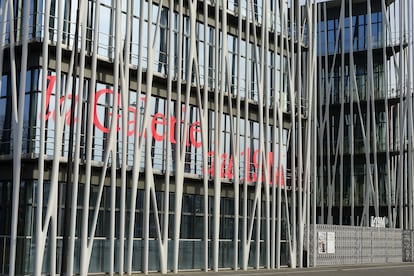
France remains the fourth largest market in the world, after the United States, China and the United Kingdom, but it has doubled its share in the last 20 years and has fiscal instruments, such as a reduced VAT and legislation favorable to patronage, that help it preserve masterpieces on its territory. Paris has also taken advantage of the Brexit situation to gain points over London. Since the United Kingdom left the EU, several international galleries have opened or reinforced their spaces in the city, as a new headquarters. Hauser & Wirth, David Zwirner, Esther Schipper, White Cube, Jessica Silverman and Jack Shainman, while the French capital attracted more and more top-level collectors and dealers.
Véronique Jaeger, president of the Jeanne Bucher Jaeger gallery, one of the historic galleries on the left bank of the Seine, which accompanied avant-garde artists and which has just celebrated its centenary, welcomes the current acceleration, but issues a warning. “I hope that the arrival of major international brands contributes to the dynamism of the capital without denaturalizing the charm of a city that has always been defined more by its spirit than by its market,” he points out.
In reality, not all looks are euphoric. The critic and essayist Pierre Bal-Blanc, member of the Documenta 14 curatorial team, echoes the same criticism. What is presented as a renaissance would, in reality, be a transformation of the relationship between art and capital. “It illustrates the way in which the business world and the art market have assumed the ability to model a relationship with culture subordinated to the production of surplus value,” he maintains. “The vertigo that one can feel comes from a confusion between vitality and speculation. The proliferation of foundations, the privatization of patronage, the transformation of the Pompidou Center or the Cartier Foundation are not signs of good health, but rather the symptoms of an appropriation of a common heritage by capital,” says Bal-Blanc, who fears that art will end up “reduced to its decorative function.”
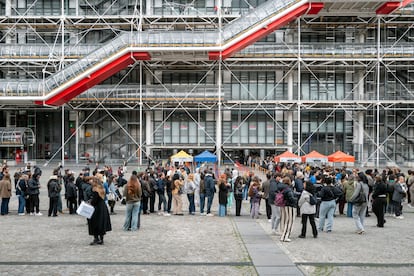
From the Pompidou Centre, curator Alicia Knock organized Black Parishis last major exhibition before the closure, which recalled the cosmopolitan character that the French capital always had, where the African diaspora would find an intellectual refuge. A supporter of the public, Knock highlights the role that state museums must preserve in the coming years. “In this new constellation they have to continue being a place of conversation: a space where collective stories and critical perspectives are built.” The challenge, he suggests, is not to compete in spectacularity with private foundations, but to contribute what always defined them: offering thought and an open offer to everyone.
Even so, not everything private fits into the label of mere speculation. Along with a centrifugal force that gravitates towards historical Paris, another is detected that pushes outwards and occupies territories of the suburbsometimes abandoned by the State. The periphery is filling up with centers emerging from private initiative, which transform old factories and industrial facilities into spaces for creation and exhibition: the Fondation Fiminco in Romainville, the Poush center in Aubervilliers or the new artistic hub of the Île Seguin, a large cultural project by the Emerige real estate group designed by the Catalan studio RCR Arquitectes in Boulogne-Billancourt, at the gates of Paris.
“An authentic dense, plural and living ecosystem is emerging throughout the year, where we observe a better dialogue between public institutions and private actors,” confirms Jean-Michel Crovesi, director of another of these centers, Hangar Y, installed in a former aeronautical warehouse rehabilitated in Meudon, 10 kilometers from the center of Paris. With its lights and shadows, this displacement not only reconfigures the Parisian cultural map, but also points to a change of era that could be a school in other European latitudes.