
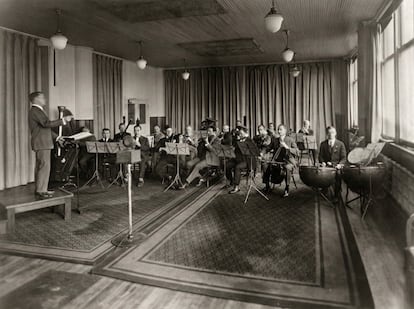
In the first decades of phonography, listening to a symphony orchestra on record meant accepting a sound fiction: a reduced ensemble, without real bass or dynamic contrasts, very far removed from the concert experience. All that changed a hundred years ago, when electrical recording made it possible, for the first time, to capture the real sound of an orchestra.
In December 1925, the His Master’s Voice (HMV) label issued the first complete symphony recorded with microphones: the Fourth Symphony by Tchaikovsky, conducted by Landon Ronald conducting the Royal Albert Hall Orchestra. A century later, the historic record can be heard again in optimal conditions thanks to a careful commemorative edition by Pristine Classical, which allows us to understand the extent to which that advance forever transformed the history of sound recording.
Until then, recording a symphony orchestra had been an almost impossible task. The acoustic procedure, in use until the mid-1920s, relied exclusively on the mechanical energy of sound to move the needle over a wax-coated record. The orchestras had to be reduced to just over twenty musicians, crowded around a conical horn similar to a megaphone, arranged not according to musical criteria, but by pure physical necessity.
Violinists resorted to Stroh models, equipped with a metal bell that directed the sound; the cellos were placed at the height of the horn and required reinforcement from the bassoon; The low frequencies of the double basses were replaced by a tuba, and the horn player had to play with his back to the conductor, orienting his head towards the horn and using a mirror to follow the baton. Extreme dynamics were unfeasible: the pianissimo was buried by superficial noise and the fortissimo could make the needle jump and ruin the take. The use of large percussion was also not recommended.
All these details appear documented in Roland Gelatt’s classic study, The Fabulous Phonograph (1954; revised in 1977), and can be seen in photographs of the time, such as the famous image of Rosario Bourdon conducting the Victor Symphony Orchestra around 1920. The testimonies gathered by Gelatt underline the lack of artistic reliability of those recordings. Arturo Toscanini was particularly severe when referring to the famous acoustic version of the Fifth Symphony of Beethoven recorded by Artur Nikisch with the Berlin Philharmonic: “Not only does it present poor sound, but it constitutes an absolute misrepresentation of his art.”
Paradoxically, Toscanini began his phonographic career in December 1920 with an astonishing acoustic recording: the last movement of Beethoven’s Fifth, conducting the La Scala Orchestra during a tour of the United States for the Victor company. Just a month earlier, in November, the first electrical recording experiment had been carried out in London: about five minutes of band music and religious hymns recorded during the burial of the Unknown Soldier in Westminster Abbey, using a telephone receiver as a microphone.
These pioneering records, brought together today in the launch 1925: Milestones of the dawn of electrical recordingfrom Pristine Classical, were remastered by Mark Obert-Thorn. The edition also includes an experiment carried out in the United States in 1922 by engineer Orlando R. Marsh, who managed to capture with remarkable clarity the sound of the organ played by Jesse Crawford in the sumptuous Chicago Theater theater.
However, it was the Western Electric company—linked to the manufacturing of telephone equipment—that ended up prevailing by introducing electric microphones into the recording process starting in 1924. Since then, sound began to be captured, amplified, filtered and balanced by electronic means, although the signal continued to be recorded on wax discs. The advantages were decisive: the frequency range was considerably expanded, extreme dynamics could be recorded and, for the first time, a symphony orchestra could be recorded in a concert hall without altering its size, instrumentation or natural arrangement.
The new system was adopted in 1925 by the two large American companies. Columbia was the first to use it, in February, with the pianist Art Gillham, a precursor of the croonerand achieved unprecedented commercial success with Be faithfulrecorded a month later with 4,850 voices at the Metropolitan Opera in New York. Victor, however, signed the most relevant artistic milestones: in March he recorded the pianist Alfred Cortot performing works by Schubert and Chopin and, in April, he reached a turning point with Leopold Stokowski conducting the Philadelphia Orchestra in the symphonic poem Dance of Macabre by Saint-Saëns.
Technicians were initially cautious. For that recording, the orchestra was reduced to about forty musicians, with the double basses replaced by a tuba and the timpani replaced by a contrabassoon. In the following years, Stokowski became increasingly interested in the recording process and ended up developing his unmistakable Philadelphia Soundwhich would lead to the first experiments in stereophony and multichannel recording used in Fancy by Walt Disney in 1940.
The Western Electric system reached Europe in mid-1925 through the British subsidiaries of Victor and Columbia. The Gramophone Company, associated with Victor, then achieved a historic milestone: the first complete symphony recorded with electric microphones, published by HMV. It was about the Fourth Symphony by Tchaikovsky, conducted by Landon Ronald with the now defunct Royal Albert Hall Orchestra. According to Obert-Thorn, the recording was made in July 1925 in the London suburb of Hayes and published in December of that same year.
Although a tuba was still used to reinforce the double basses, timpani were used, clearly audible in the final rolls of the first and fourth movements. The result remains surprisingly satisfactory today. In December 1925, the magazine critic Gramophone William Robert Anderson, under the pseudonym KK, praised precisely that ending: “it seems to me just the kind of roar that Tchaikovsky would have wanted.” Not everyone shared the enthusiasm. In the following issue, editor Compton Mackenzie attacked the album for a hitherto unknown sonic intensity, capable of “making the listener’s hair stand on end.”
It took time to get used to this new orchestral sound on the recordings. It was the influential critic Ernest Newman who, from The Sunday Times in July 1926, he ended up consecrating the breakthrough after listening to another HMV release: the magic fire music at the end of The valkyrie by Wagner, conducted by Albert Coates at the head of the London Symphony. “It is finally possible to sit at home and enjoy the excitement of real music as it is known in the concert hall,” he wrote. “Finally an orchestra really sounds like an orchestra.”