
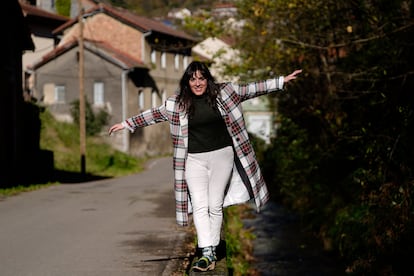
Aitana Castaño, 45 years old, lives in the town of La Barraca, near the famous María Luisa well, in her native Langreo, one of the hearts of the mining basin. In addition to practicing journalism, he has developed a literary career focused on the world of coal workers, in his so-called Mining Trilogy (Children of smoke, Carboneras y Traces of ash), which is published by Pez de Plata. His Asturian accent can be heard in the section Northern commandalong with Nacho Carretero, from today of Cadena SER. Your new book, The godmothersalways with illustrations by Alfonso Zapico (another illustrious son of coal), focuses on emigration to Belgium in the 60s, although along the way the protagonist deviates and ends up in the anti-Franco struggle in Madrid.
P. It is difficult to remove the carbon footprint.
R. Those of us who are from the mining basins will never be able to stop being from the mining basins. They told the children who went to study in Oviedo “here come those who smell like smoke.” Now there are almost no mines or factories, but the smoke remains inside.
P. In literature it gives a lot of play.
R. In every corner I find stories, old and new. Now we are receiving many people from outside, migrants like our mining grandparents were. People came from all over. In each neighborhood there was a Galician woman who made turnip tops. Cod is still popular by the Portuguese. The Andalusians caused surprise by having bread and tomato for breakfast. People from all over who founded a nationality of the basins. And that’s why it was a very open society.
P. The extreme right?
R. It is not having the success it has in other declining industrial areas. There is class consciousness, but also of the emigrant class. As my grandfather said: “You have to be very poor to work in the mine.”
P. A job famous for its hardness.
R. It was a bad job for a long time and then, thanks to the workers’ struggles, a bad, well-paid job. The few mines that remain are having fatal accidents, in the 60s and 70s there were thousands of miners, accidents daily and deaths very frequently.
P. The woman and the mine is one of its themes.
R. The basin was a masculinized society but not as sexist as we believe: the miner was the center, but women always had a lot of power, both in the homes and in the anti-Franco underground.
P. Did they provide emotional support?
R. My mother and my aunt tell me when my grandfather Antonio came home devastated because a very young Portuguese boy had killed himself next to him. Destroyed by the boy’s death, devastated because he had to return to the mine the next day. And my grandmother had to hold him.
P. You claim that part of the mining society that the miners were not.
R. Yes, the women, the children, but also the doctors, the shopkeepers… Everything was part of the same mechanism. In the strikes of the 1960s, which could last months, merchants wrote down what each family owed and then it was paid little by little. The priests: their role was very peculiar, the Church realized that they had to send nice priests, to see if they took people to church, not to mention the figure of the worker priest. There were also a lot of bastards.
P. His latest book is based on emigration to Belgium.
R. I always think what it would be like to leave my country, without knowing the language, without knowing anything. I have four uncles and aunts who went to Belgium. When I went, the bars were called Cangas de Onís or Breogán. Their union saved them, playing the bagpipes, seeing Juanito Valderrama.
P. It’s as if we didn’t understand what we were.
R. Now they tell us that migrants only deal with each other: well, it was always like that. Or when the fachosphere gets nervous because Yamine Lamal comes out with a Moroccan flag. My cousins in Belgium also display the Spanish flag. The Asturian center in Brussels has 14,000 members. We must put emigration in context now that we are the ones receiving it.
P. The children recognize him on the street.
R. Yes, because my books are read in the basin’s high schools. They feature me on TikTok. And he’s very nice, because when I go to high schools and ask who has a mining father, no one raises their hand. Any early retired parents? Two or three raise their hands. But when I ask who has a miner grandfather, almost everyone raises their hand. That’s what unites us all, wherever we come from.
P. We talk about the working class… And the Asturian bourgeoisie?
R. More than an entrepreneur, like the Catalan or Basque woman, she was an owner. The Bernaldo de Quirós or the Figaredo, who are the family of Rodrigo Rato and the Vox deputy José María Figaredo. Here they came to undertake what was abroad, those from here became rich by renting or selling the land where the mines were. Pedro Duro, founder of Duro Felguera, came from La Rioja; Numa Gilhou, who founded the Mieres Factory, came from France.
P. That world sounds old, but you lived it firsthand.
R. I grew up between strikes and demands. I belong to a very active Communist Party family, so I saw it as something natural to be surrounded by tortured or exiled communists in Russia. There was a photo in my house of a great-grandfather of mine, very bearded, or so I thought. When I started seeing it in other places I understood, they explained to me that it was Karl Marx. But he even looked like my father!
P. How did all that end?
R. The process of deindustrialization also began. People came to work and left when the wells closed. Now I would say that depopulation has stopped: people come because there are cheap apartments, nature and good public services for a small population. Even a retired neighbor who lived in Ibiza has returned. I don’t want to go anywhere else.
P. Did it deindustrialize well?
R. The closure of the mining industry was inevitable, what screwed us was that the work ended, not the mine, which polluted the lungs and nature. There were two ways to do it: the English model, in which Thatcher put a lock and that was it (and now we have to see how the English basins are); and the German model, with early retirements, mining funds, etc. Here the latter was attempted for social peace. The fighting power of the miners was very great. Furthermore, mining was essential for socialism.
P. It didn’t go well.
R. Most of it was done wrong. So much money was sent that we didn’t know what to do with it. And there is the figure of José Ángel Fernández Villa, the charismatic leader of the SOMA-UGT union. He was not the leader of all the miners, not everyone adored him and if you got along with him he could have problems, he had a lot of power. He was the mafia, but others considered him a reference for the labor movement. When its corruption was discovered it was a disappointment: its militants were its main victims.
P. What is left of the working class?
R. Do you need your hands, legs or head to live? Well if so, you are working class, whether you are a waiter, a sweeper or a neurosurgeon. You are not middle class if you lose your job and can no longer pay for the apartment. Now you see working people defend employers when they oppose reducing working hours. As if the company were yours!
P. Antonio Garamendi, leader of the CEOE employers’ association, says that we must stop connecting living better with working less.
R. Life isn’t just about working to pay the rent. Life is that if you have a girl you can go for a walk with her. But they make us lose class consciousness by speaking badly about unions, parties, and all the measures that can benefit workers. And some ordinary workers end up defending the interests of businessmen.