
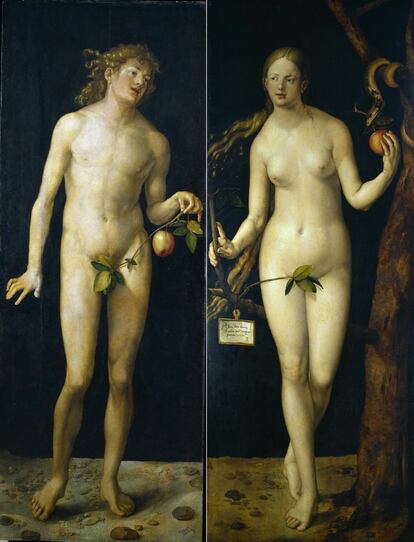
Charles III’s order was devastating: all paintings in the Royal Collections that showed nudity had to be burned. That included some of the best works in the history of art that are exhibited today in the Prado Museum. The story of how those canvases were saved is imprecise, because the mandate was signed in 1762, but it was not until 1795, three decades later, when the painter Alejandro de la Cruz, a disciple of Antonio Rafael Mengs (1728-1779), one of the most reputable painters of that time active in Italy, to whom the Prado is now dedicating—until March 1—an anthological exhibition, told how his teacher changed the fate of those pieces.
When Charles III issued the order, Mengs was in Madrid after being requested by the king to decorate the Buen Retiro Palace and the Royal Palace. The art historian Javier Portús, head of Conservation of Spanish Baroque Painting at the Prado Museum, reveals the trick that saved the treasure in his text Of paintings of recluses and jailer kings. 1762-1792: “Mengs appeared before the king telling him that it was less risky for the professors to have an original so well painted for their imitation than to undress a woman, in whom it would be difficult to find the perfections of these paintings.” That is, better to copy a painting than a person. The feminine original, in his words, could have imperfections.
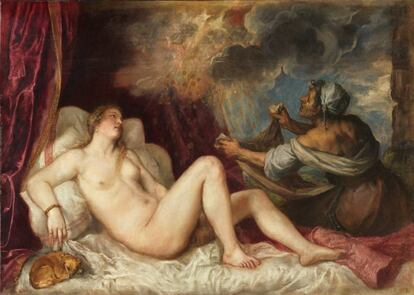
With this reflection, the monarch revoked the order. In this way, the Danae by Titian; Adam and Eve, by Dürer; Dian’s bathsa, de Titian; there Bacchanal by Rubens; the famous Venus sleepingalso by Titian; The Judgment of Paris de Francesco Albani; there Leda de Corregio and, before being plundered from the Buenavista Palace (Madrid) by the English army, in 1813, Venus in the mirror by Velázquez (today in the National Gallery in London).
According to Mengs, these canvases were very useful for pedagogy and the artistic process. But although his reflection initially convinced Charles III, the painter knew that the king could change his mind at any moment. The Inquisitor General had a lot of influence on him and also Father Eleta, known as Friar Alpargatilla. A safe haven had to be found for them and that was the Buen Retiro Palace, which hoped to recover its splendor after the burning of the Alcázar of Madrid in 1634. They were also stored in Mengs’ own studio, which was located in the Casa de Rebeque, a building built in the current Plaza de Oriente in Madrid that owed its peculiar name to the fact that during the beginning of the 18th century it housed the princess of Robecq. There the paintings of works from the Royal Collections that had to be restored were kept and nudes were allowed to be copied, under supervision. At the same time, it served as the painter’s workshop.
Carlos III was a very religious person. After the death of his wife, Maria Amalia of Saxony, when the monarch was 44 years old, he took these feelings to the extreme. Nor was he a sovereign very close to culture. He fell asleep during musical performances and the only canvases he appreciated were religious ones. At the same time, in accordance with the thinking of the time, it was a enlightened monarch who fought to strip the Church of many powers. The Enlightenment ideology defended that the work of art had to be utilitarian and morally beneficial. And it wasn’t just the images, but also the story. For example, Lot and his daughters, where they lie with the father to ensure their lineage, they also had to burn.
Mengs developed his career between Dresden, Rome and Madrid at a time when European monarchs competed with large amounts of money to acquire the best artists of the time. In 1761, a year before ordering the burning of the nudes, Charles III called the two great painters active in Italy to Madrid: Mengs himself and Tiepolo, accompanied by his sons Domenico and Lorenzo. At first, Mengs resisted, citing his advanced age. “But, under pressure, he complied with the king’s wishes and decorated the Throne Room of the Royal Palace,” says Andrés Úbeda de los Cobos, head of the 18th-century Painting and Goya Collection at the Prado Museum and curator of the exhibition dedicated to Mengs, which offers a complete vision of the painter, a key figure in the birth of Neoclassicism and one of the most influential artists of the 18th century, in dialogue with the great masters of the past.
After the death of Charles III in 1788, Charles IV ascended the throne and sent many of the rescued works to the Reserved Room of the Academy of San Fernando. They were the rooms where nudes and other works that were considered harmful to morality or religion were stored, reserved for the enjoyment of the nobles and the bourgeoisie or the learning of those trained in art. In 1827 the Prado Reserved Room was created with the arrival of the paintings that made up the one from the San Fernando Academy of Fine Arts.