
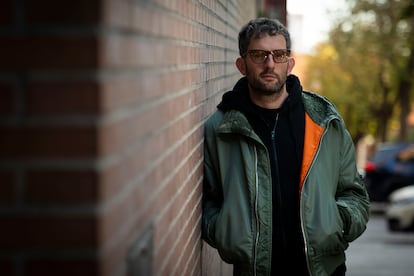
Mariano Blatt is an Argentine poet and editor, from Buenos Aires. He likes being a poet a little more than an editor, yes, because it has a “better aura,” he says after thinking about it for a few minutes. Blatt editor lived four years in Madrid, between 2020 and 2024, when he brought his publishing house Blatt&Ríos, which today expands its catalog to Spanish and Catalan writers. Blatt the poet will soon arrive in Spanish bookstores with a version of his book My youth united, —already published in Argentina in Ríos&Blatt and Mansalva—which will now be released on the La uÑa RoTa label.
He is 42 years old. There are no poets or writers in his family: his parents are “moderate readers, not very sophisticated.” He grew up in a house with rather popular, commercial, middle-class Latin American books. Even so, since he was little he wrote stories and had the dream of being an editor. At the age of 18 he came across the book Warsawby the Argentine poet and screenwriter Andi Nachón, and almost instantly a poet blossomed in him. He read those verses and returned home to write his own.
His career was born with digital, when at the beginning of this century on the social network Fotolog there were an abundance of photos edited with flashes and neon. There was an underworld interested in literature where Blatt made his debut: “I belonged to a community of young artists and poets who used Fotolog to get to know each other, spread the word, and find each other.” It was mandatory to upload a photo and he innovated by superimposing the poem on the image. There he met his people, who later were important in work, in friendship and in love.
The artist, dj and poet Perla Zúñiga was his partner for five years, until his death in July 2024 from cancer. They lived together in Madrid, where she dedicated her last years to making art based on her illness. From there it was born I’m dying, I love youhis only book, edited by Blatt after his death. In the prologue written by him, at her request, he says: “We had to work together on the finest edition of the book. Unfortunately, we didn’t get there. That’s why I almost preferred not to touch the texts, except for a few exceptions. I corrected some verse breaks, something in the punctuation, not much else. I discussed all of these corrections, in my own way, with an absent Pearl.” He says that he imagined the dialogue, listening to her and assuming in which cases she agreed with him.
He feels it like a unique experience in his more than 20 years as an editor. It is tough, a professional and personal challenge that he had never faced, probably unmatched in the rest of his life, he believes. “I did it quite close to Perla’s death, with the grief very fresh, but it had to be like that. We were working against the clock.” In her last days they had practically finished it, but she was too weak to concentrate on the final details. “With that mandate in mind, I took courage, I grabbed the material and revisited it, it was very hard, I made decisions. With all that there, raw.”
He lives his two personalities—poet and editor—24 hours a day. Regarding editing, “it is a trade, a professional practice like any other that can be learned. I may have more or better intuitions, but there is no secret.” In this profession he built his two houses: the Blatt&Ríos publishing house and the De Parado publishing house. The first has a limited catalog, between Argentina and Spain, with about 15 to 20 books per year. “There is little room to receive things. It fills up quickly with our reading, our worries.” Together with his friend and partner Damián Ríos they publish what they as readers consider should reach others. There are Spanish speakers, Latin Americans, Argentines, Spaniards, living, dead, new, translated, young and not so young. the geese by Álvaro Cruzado, for example, in the search to sign new and local authors—in this case from Granada—or The archaeologist by César Aira, a highly recognized author in Argentina, with more than 100 books and candidate for the Nobel Prize in Literature on more than one occasion.
De Parado is a publishing house queerin the broadest sense of the word, which he founded together with Francisco Visconti. “An Argentine publishing house dreamed of by two gays,” says Blatt. It was born as a publishing house ebooks of gay erotic literature, but it transformed along the way. It is not clear what the criteria is for choosing the publications, but the catalog still makes sense. “I don’t ask actors who they sleep with, but it turns out they’re all on the spectrum.” queer“, he says and points out, “if a heterosexual author brings us a completely heterosexual novel where there is absolutely no reference, we are not going to publish it, because we are not even going to read it.” In the end, he concludes, all gays know what falls into gay.
“The girl who remembers / the boy who went / to the center to be / the skull of his time / the mother who cannot tolerate seeing her daughter / sobbing over that parsley that is not worth a penny / and the taita, the tatita, indifferent to the suffering of his women / sitting at the bar table / undaunted / watching life go by / with no more company than a cognac / and the boys from the neighborhood / one more tormenting than the other / that must have been sensational / a time to have lived / I did not live it”.
Blatt does not seek to simplify poetry, nor make it more accessible or popular. “Recently someone told me about one of my poems ‘I like your little poems’, and I liked that definition.” It is not a contrast to other more complex, difficult or bombastic poetry, he clarifies: “it is the poetry that I was able to write, the one that came out of me, and that does not make it better or worse than any other.” Blatt’s writing is the product of an era, of a place at the end of the world, bathed in the interests and readings of an author who inhabits a mass of language from which he rescues the words for his poems. “I am interested in enriching my poetry with the Spanish language. All the available words, all the combinations, all the images that the Spanish language offers me and that life offers me.”
Poetry is not kidnapped by a privileged group, he believes, but rather it is everywhere: in the lyrics of songs, in graffiti, in the phrases of a group of friends, in popular chants and in the banners and flags of a protest. “Poetry is nothing more than an experience with language.” He has no writing routine. The poems flow out of him. He writes the first verse on his computer, and the second, and the third, and the magic appears.