
Turning things upside down helps you mature. It can also multiply life. “We must be prepared to start again many times.” That idea, which is true in any garden, served Vernon Lee to announce his ideas about the goodness and fruitfulness of life: the fact that it is worth living over and over again with strength, tenderness and humility.
In reality, Vernon Lee was a woman: the British writer Violet Paget (1856-1935), born in France and settled in Florence, who always defended that the origin of aesthetic studies was in individual experience. He wrote essays, a novel, stories and plays, almost all of them translated into Spanish: That damn voice, My aesthetic life, Specters, Presences.
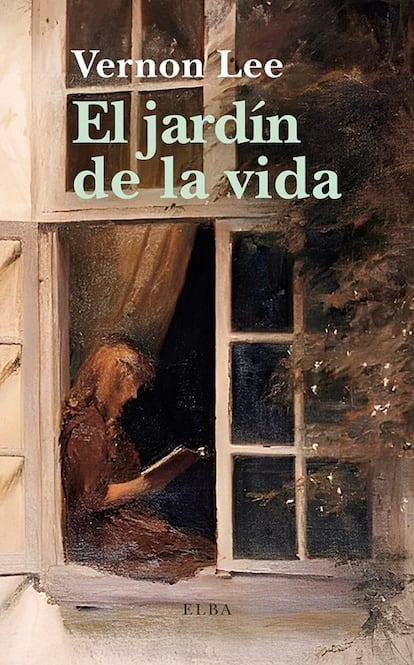
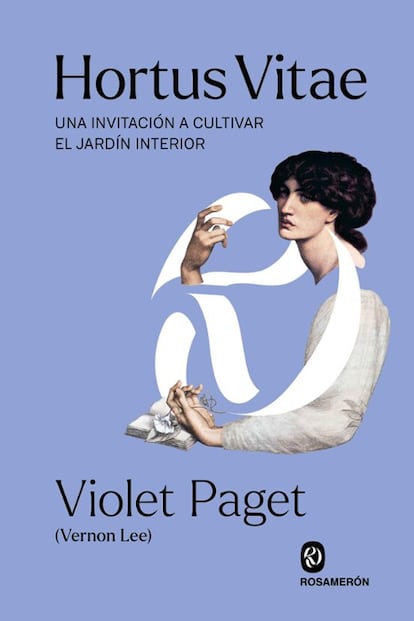
As a sign of the times, this year, two publishers have agreed to rescue one of his most personal essays. Garden of Life. Guillem Usandizaga has translated it for the Elba publishing house as The garden of life. For the Rosameron publishing house—which has left aside the author’s pseudonym to relaunch it under her real name—Juan Camilo Perdomo Morales has maintained the original title: Hortus Vitae, an invitation to cultivate the interior garden. That invitation is extended by this essay: a compendium of reflections and observations, also an ideology, that goes beyond the flowers of life—which are not the ones we see in flower shops.
It is true that the gardens that this book delves into are not always vegetal. Just like “life, it is willing to admit, is not a private garden, nor should we try to make it so. Nine-tenths of it are communal gardens, which we must cultivate in company and with the mutual sacrifice of our whims.” So, how can we have a childlike enthusiasm that offsets the loss of the ability to obtain joy? Paget concludes in his essay that gratitude—healing, consoling, making amends—is what multiplies life. “The protection of art helps, but it is important to remember that happiness is a stimulus. It cannot be the goal of life. In reality, life often forgets the people who pursue it for themselves.”
This is how Paget points out that the flowers of life do not grow in gardens. And that the rustic ones are closer to their owners: “It is no use trusting artists or philosophers to prepare the fenced spaces of our soul. We must cultivate our own garden.” This essay is about effort, enjoyment, attention and remaking yourself. Although there is more.
Paget observes that “every country has its own way of making us happy.” For her, Germany was understood from its institutions and France was explained in her books. “Reading books, above all, is useful for wanting to read more books,” he points out. Although, be careful, he warns that “for them to fulfill their purpose, you do not always have to read the books.” For example: a book that is a gift, or a tribute from the authorhas already served its purpose, as a business card or, at best, as a bouquet.
The same goes for books borrowed without having been requested. “There are plenty of reasons not to be up to date, as vain and stupid people presume.” One reads feeling the rapture of joint understanding, of a mind with another mind. That’s the kind of reading that interested her.
When talking about music, Paget refers to the inner ear versus the outer ear. It is the first that provides pleasure. “The union of music and soul occurs during what the layman calls silence.” Close to silence, Paget cites the ineffable sensation of resting in the affection and wisdom of a friend. “We are so imitative that anyone we like very much adds a new possible form, a new pattern, to our understanding and feeling.
He also detects, and protests, that there is too little courtship in the world. She is convinced that beautiful things require courtship. And that “the charm of things depends on our ability to detect them.” One of Paget’s most inspiring gardens is that of new friendships, new friends that make us discover in art, literature, our environment, or ourselves, something that we had not been able to observe. Or to appreciate.
To explain that sensation, he turns to nature: “A distant peak appears that one had not noticed, or an aromatic herb that had always grown on those rocks, but it also might not have done so, if other eyes had not directed ours towards it, or if another hand had not crushed it so that we could perceive its fragrance.”
Paget enters physical gardens like someone who goes to a friend: “We don’t talk, but I feel accompanied.” He does it to think, to avoid the profound dullness of so many human beings. The noise and confusion of life does not allow us to notice everything. That is why vital or professional changes are favored by the “accident” of a new friendship.
He talks about Goethe and Schiller or Ruskin after his meeting with Carlyle. Although he is aware of the gratitude that old friendships deserve: “They are made up of what, when all is said and done, we need above anything else.” Paget warns that after many years of familiarity one may not know each other.
Thus, he writes that with old friends we can be less sincere, less ourselves, than with new ones. “We imitate the self from years ago in its relationship with an equally obsolete you” out of pity, monotony, fear or ceremony. He’s talking about confusing care with fear. If we move that to a garden we can destroy it. Love is, in most cases, a creation. And she knows that “we have not yet discovered how to treat any of our possessions, including ourselves, in such a way that they always get better.”