
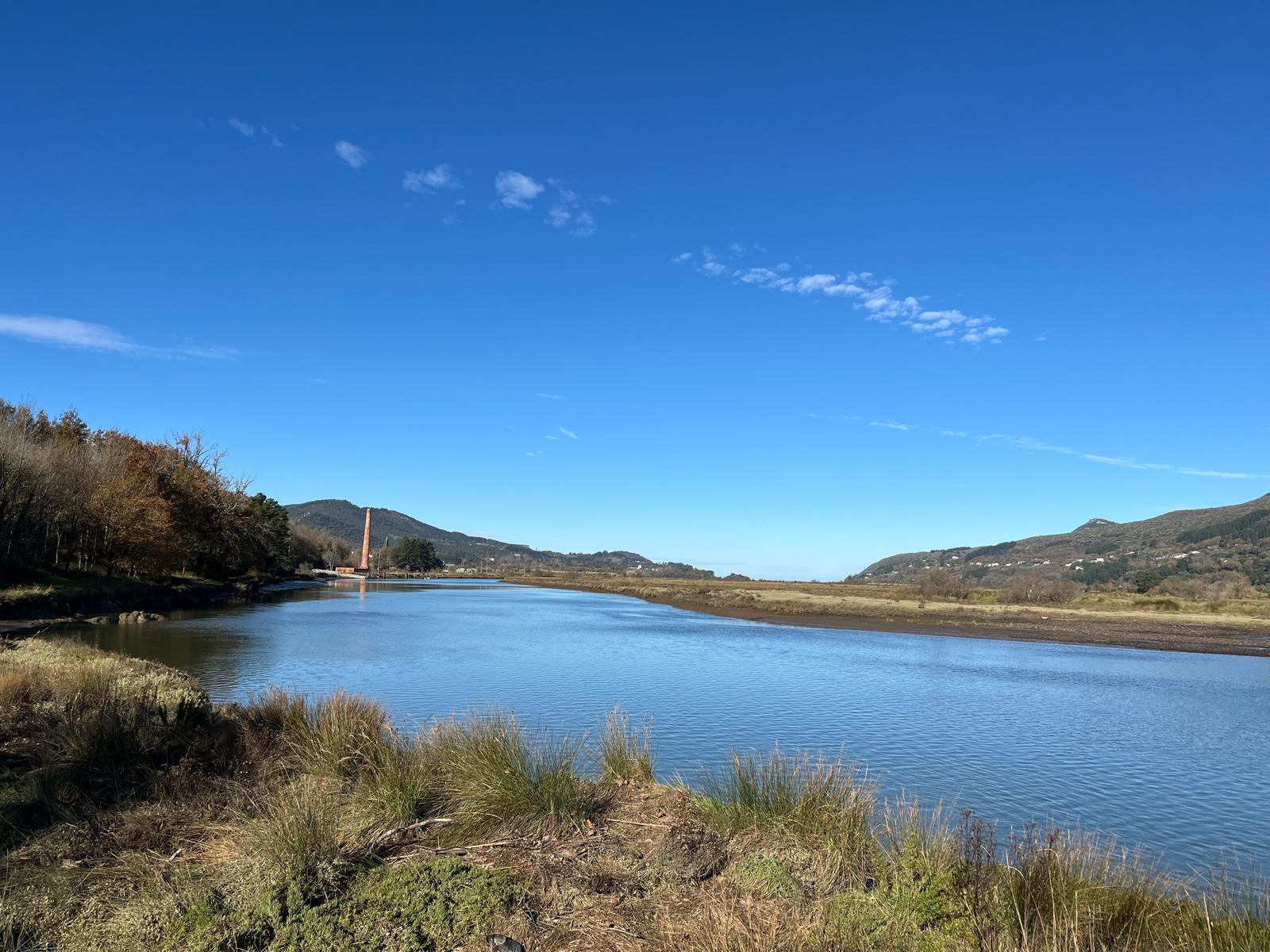
The board of trustees of the Guggenheim Bilbao museum agreed this Tuesday to paralyze the project to expand to the Urdaibai nature reserve. There will not be a museum with the American brand in the area of Gernika and Murueta. The institutions that are part of the Guggenheim management in Euskadi have given in to the administrative and judicial obstacles and the social outcry against installing a museum in the landscape surroundings of Urdaibai. This sudden stoppage was announced this Tuesday by the general deputy of Bizkaia, Elixabete Etxanobe; the Minister of Culture, Ibone Bengoetxea, and the new director of the Guggenheim Bilbao, Miren Arzalluz.
“The board has decided not to move forward,” the director of the Guggenheim in Bilbao, Miren Arzalluz, announced today. It was a death foretold, according to citizen platforms and environmentalists opposed to this project. “It has not been an easy decision,” Etxanobe acknowledged today, who admitted that they had to accept that they could not move forward due to the difficulties and “uncertainties” that surrounded this project.
The Bizkaia Provincial Council, always in the hands of the nationalists, has been the main promoter of this operation. In 2008, the proposal was devised to locate another Guggenheim in Urdaibai, complementary to the titanium building that opened in 1997 in the capital of Biscay. The provincial institution reactivated it in 2021 with a project that sought to combine the environment and the museum in the heart of the nature reserve. The original plan foresees locating in Gernika, in the former headquarters of the already demolished Dalia cutlery, the entrance door of the museum project with a building of 2,500 square meters on a total plot of 20,286 square meters, intended for educational and research activities. According to the report published by the Guggenheim, another building would be built in Murueta “fully integrated into the landscape, with exhibition galleries, temporary exhibitions and gastronomic spaces”, on a total area of 41,389 square meters, where a 3,700 square meter building would be built on the land currently occupied by the Murueta shipyard, still in operation.
Reflection period
Bizkaia has not given up its efforts to carry out its purpose. At the end of 2022, when the current Lehendakari Imanol Pradales was regionally responsible for Infrastructure and Territorial Development, he secured 40 million to undertake the works. That money remains frozen, unexecuted. Pradales, who was greeted with banners with the motto “Fewer Pradales and more wetlands” upon his swearing-in as Basque president, has always defended the initiative and went so far as to declare, in December 2024, that his wish was to preside over the inauguration of the Guggenheim in Urdaibai.
It was former Lehendakari Iñigo Urkullu who at the end of 2023 announced that a two-year period was open to rethink the project. That period for reflection now comes to an end. In recent months, a listening process has been carried out that has been directed by the Agirre Lehendakaria Center (an entity created in 2013 by the Basque public university in collaboration with Columbia University in New York). Its final conclusions will not be known until mid-January, although it is already known where the results will go in view of the consultations carried out so far. Of the first 660 interviews, 80% of those consulted declared themselves against the project and only 8% supported it. The rest are among those who are undecided or those who prefer not to speak out.
The international expansion of the Guggenheim Foundation has been as ambitious as it has been eventful. Several of the projects designed since the mid-2000s, such as those in Helsinki, Berlin, Salzburg or Rio de Janeiro, have been cancelled. In this context, the Guggenheim in Abu Dhabi emerges as the last major project underway: designed by Frank Gehry, it will be the largest museum in the network, although it has accumulated years of delays and still does not have an opening date. After Gehry’s death and the foundation’s strategic withdrawal, Abu Dhabi is emerging as the final and most tangible chapter of a global expansion that was never fully completed.