
Concha Piquer told Manuel Vicent that, after succeeding as a teenager on the New York stage, her mother, Ramona, had to return to Valencia and was left alone in the city of skyscrapers. It was the twenties of the last century. “In New York I was left alone, and to feel closer to my people, to my land, I read novels by Blasco Ibáñez, whom I met one day while eating. Soon I was so sad, at 18 years old, that I told Schubert that I wanted to go see my mother,” said the singer (1906-1990) in the interview published by EL PAÍS in 1981 and signed by the journalist and writer who, 40 years old Later, he would novel the amazing life of the coplista in Portrait of a modern woman (Alfaguara publishing house).
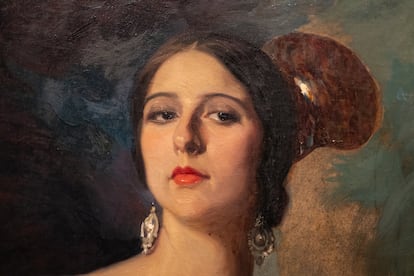
The singer returned to Spain and settled in Madrid. Then he went “to see the Virgin of the Forsaken,” patron saint of Valencia, the city where he was born into a very humble family, and then he “was too lazy to return to New York.” In Madrid he lived like the great star he was and very soon asked Manuel Benedito (1875-1963), one of the most recognized painters of the time – especially among the wealthy classes and the aristocracy – to paint a portrait of him.
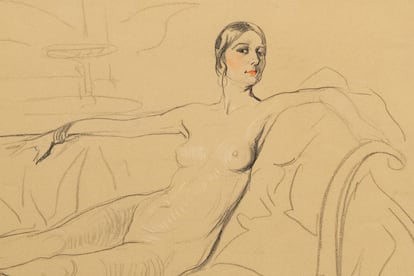
The artist and the model established a good relationship, based on trust and complicity, and the usual portrait also gave way to nude drawings, sketches, studies and sketches of the singer who was 20 years old at the time. For the first time, a selection of four of these unpublished nudes are on display, integrated into the exhibition. Manuel Benedito. The painter and the modelswhich has been inaugurated in the Museum of the City of Valencia on the occasion of the 150th anniversary of the birth of the Valencian painter, one of the main disciples of Joaquín Sorolla.
“Concha Piquer goes on her own initiative to the painter’s studio to have a portrait made of her. And a relationship of complicity and comfort develops between the artist and the model. They feel good together and that leads to creative situations different from the one that had summoned them both. So from posing for her portrait, one of the best known and which is also shown in the exhibition, they move on to posing for the nudes. And that comfort is noticeable in them: her expression is “She is smiling, she is happy, she is comfortable,” explains Pascual Masiá, curator of the exhibition, which can be seen in the municipal art gallery until April 29.
The curator highlights the beauty and quality of the drawings, coming from the Manuel Benedito Foundation, which has more compositions on Piquer, previous studies and preparatory sketches. He chose these four because, in addition, they adapt perfectly to the common thread of the exhibition that revolves around the painter and his models.
“The nude is a fundamental part of the history of art. She appears reclining in a classic position in this type of compositions. The four drawings had not been seen before. I knew that they were going to become the anecdote of the exhibition, that they were going to capture the attention of the media, but they are good and it is worth bringing them to light,” explains the expert, in a telephone conversation with this newspaper.
When Benedito painted Concha Piquer he was 51 years old and had a career already established, with an important clientele. He followed his teacher’s advice and moved to Madrid, after excelling in his hometown. Sorolla was painting in El Cabanyal at the end of 1894 and proposed that she go with him to Madrid, where he went to his studio until he opened his own. Then he received a scholarship in Rome, traveled through Holland and France and soaked up the painting he saw, separating himself from his teacher and finding his own path. However, he always maintained an affectionate relationship with the painter of light, of whom he was one of his two executors and the first president of the board of trustees of the Sorolla Museum, recalls the curator.
Regarding the relationship between the two artists, Javier Barón, head of the 19th century Painting Collection at the Museo Nacional del Prado, explains in the catalog of the exhibition, organized by the Consorci de Museus de la Comunitat Valenciana: “At first they are very close and it is logical, having been a student of Sorolla. He is very close to him, but from 1900 onwards he began to separate. Benedito’s load of material is not done by Sorolla and there is also a meaning decorativist, of total occupation of the surface of the painting in his work that separates him from Sorolla. He is closer to the international world, sometimes to the Frenchman Lucien Simon.
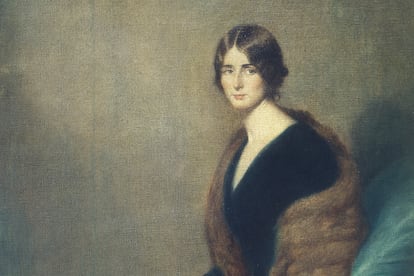
The exhibition at the City Museum vindicates the figure of Benedito through the 65 works – 50 paintings and 15 drawings – that comprise it, among them, the splendid portrait of the dancer Cléo de Mérode or the upper part of the large diptych Canth VII of the Divine Comedy. Dante’s Inferno which leaves the artist’s foundation for the first time and was in the artist’s studio.
The painter was a monarchist and conservative man who achieved success and fortune. Due to family circumstances, he had to take charge of the education of three nieces, his sister’s daughters, whom he also painted. One of them, Concha Muedra Benedito, was a renowned professor of Ancient and Middle Universal History at the Central University and collaborator of Claudio Sánchez-Albornoz. She was purged after the Civil War and went into exile in Mexico, where she also worked as a researcher at the College of Mexico. In 1979, with democracy, the Spanish Ministry of Culture readmitted her to the Faculty of Archivists from which she had been expelled by the Franco dictatorship.