
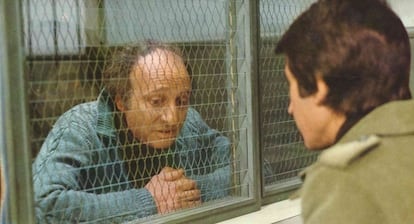
How Héctor’s death hurts. With him and with Federico Luppi, who died in 2017, two ties of union with Argentina, my second country, have disappeared. They were endearing each in their own way, but my bridges with that nation are gone.
The first time I worked with Héctor was in Pending subject (1977). He gave life to a alter ego by Marcelino Camacho. When the film premiered in Buenos Aires, the military, who had censored Héctor, cut his part. When the dictatorship fell, it was re-released Pending subject, and in the advertising they said “Now, with Héctor Alterio.” At last.
We are left wanting more. And we achieved that with the play Two less: We spent 10 months in Buenos Aires, two seasons in Madrid, another two in Barcelona and then the tour. Aside from working together, we enjoyed the things in life and the fact that we agreed on our way of thinking.
One was not to believe in nationalisms. When I lived in Buenos Aires I did a radio program, and there I interviewed Héctor—I have the recording saved—in which he was a guy from Chinchón with a program on Radio Rivadavia in Buenos Aires talking to an Argentine actor who lived in Spain because he was premiering a play, The cats, by a Spanish author exiled in France (Agustín Gómez Arcos) in which he played a woman. That is cosmopolitanism and recognizing oneself not only in a geographical latitude, but even in seeing twinning beyond sexual gender.
Héctor was very withdrawn. In Buenos Aires on some occasion we agreed to celebrate our birthday together at the actress Cipe Lincovsky’s house, because the three of us were born from September 21 to 27, and Héctor, with everyone gathered there, did not pay attention to us. First, because he was as deaf as a wall and, second, because he always followed his lead. His wife told us: “Don’t worry, come back right away.” Héctor, with his times, his distances, was a cordial and endearing guy, although reserved in his territory.
His career is impressive, what can I say about it. There is a reality: that he belonged to a current with Marilina Ross, with Luppi, with Walter Vidarte and Norma Aleandro, who brought us a way of approaching the truth that we did not even smell at that time in Spain: we were still a little stagnant, a little melodramatic and a little grandiose. The Argentine actors and actresses brought us closer to a territory that was closer to the truth and that has continued to be the case, with Ricardo Darín, Cecilia Roth… Fortunately, I have been lucky enough to share work with them and also, and above all, friendship.